Shimano 105 vs Tiagra vs Claris: Is the upgrade worth it for a beginner?
Compare Shimano 105, Tiagra, and Claris road bike groupsets: 8-speed vs 10-speed vs 12-speed, hydraulic disc brakes, gear jumps, weight, and real-world value.
 Field guide / shimano-105-vs-tiagra-vs-claris
Before you view or pay
Check fit, condition, and starter gear first
Use the buying checklist to choose the right path: used-bike viewing, first-bike fit and type, hidden repair costs, or starter gear.
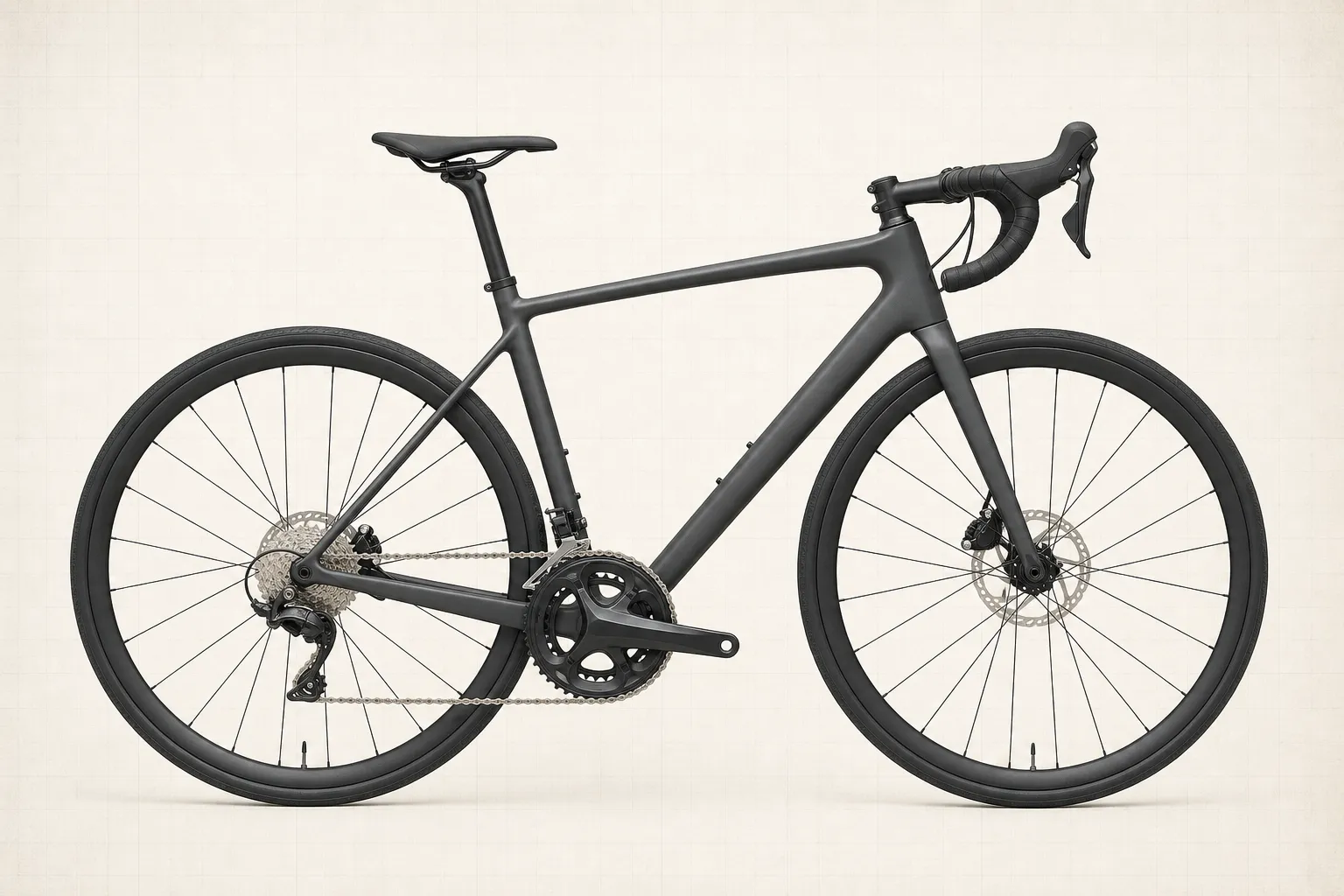
When shopping for your first road bike, you will quickly notice that the single biggest factor dictating price is the groupset name printed on the shifters and derailleurs. Shimano Claris sits on entry-level machines, Tiagra occupies the mid-range sweet spot, and Shimano 105 is praised across cycling forums as the non-negotiable gold standard.
If you have an extra £300 to £600 ($400 to $750) to spend, should you stretch your budget for Shimano 105, or is an 8-speed Claris or 10-speed Tiagra bike more than enough for your first years of riding?
The short answer: For most new road cyclists, Shimano Tiagra (10-speed) is the true sweet spot, offering crisp shifting, narrow gear jumps, and genuine hydraulic disc brakes without breaking the bank. Shimano Claris (8-speed) is completely reliable, tough, and affordable for beginners on a sub-£900 / $1,100 budget. Stretch to Shimano 105 (11-speed or 12-speed) if you plan to tackle steep hilly routes, join fast club group rides where cadence spacing is critical, or want a long-term bike you will never outgrow.
The Shimano road hierarchy explained
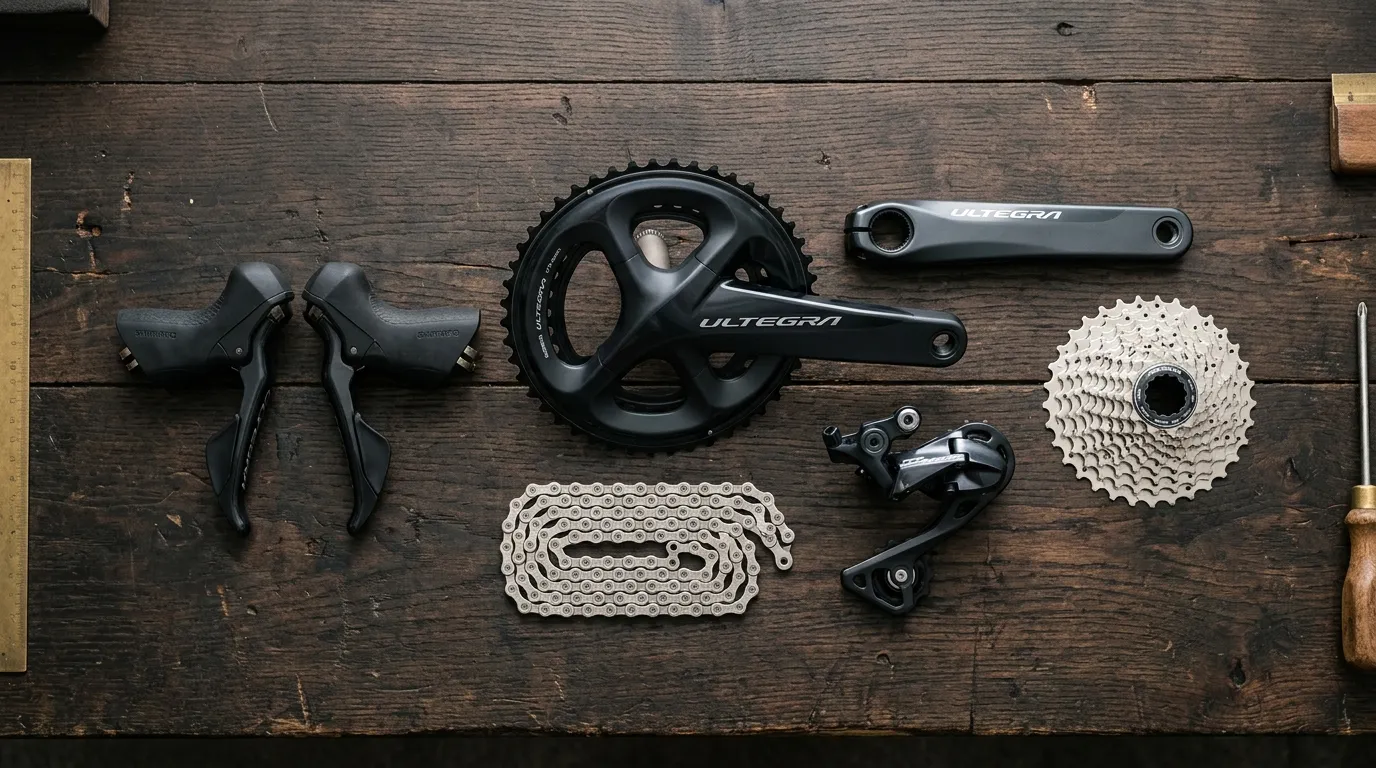
Before diving into gear ratios and brake fluid, let us establish what each groupset tier represents in Shimano’s road catalogue. If you are new to the terminology, read our foundational guide on what a groupset actually means before browsing shop listings.
Shimano’s mechanical road line flows in a clear hierarchy from entry-level to professional racing:
- Shimano Tourney (7-speed): Basic utility and budget hybrid bikes.
- Shimano Claris R2000 (8-speed): The entry point for dedicated drop-bar road cycling.
- Shimano Sora R3000 (9-speed): A capable budget step-up with 9 rear sprockets.
- Shimano Tiagra 4700 (10-speed): The enthusiast gateway featuring modern ergonomics and hydraulic disc braking.
- Shimano 105 R7000 / R7100 (11-speed / 12-speed): The performance workhorse used by racers, sportive riders, and serious club cyclists.
- Shimano Ultegra & Dura-Ace: Pro-tier, lightweight, mostly electronic (Di2) groupsets with premium price tags.
For first-time road bike buyers, the real debate almost always boils down to three options: Claris, Tiagra, or 105.
Head-to-head comparison table
Here is how the three groupsets compare across all key technical and financial metrics on complete new road bikes:
| Feature | Shimano Claris (R2000) | Shimano Tiagra (4700) | Shimano 105 (R7000 / R7100) |
|---|---|---|---|
| Rear Speeds | 8 sprockets | 10 sprockets | 11 sprockets (R7000) / 12 sprockets (R7100) |
| Front Chainrings | 2 (Double) or 3 (Triple) | 2 (Compact 50/34, 52/36) | 2 (Compact 50/34, Semi-compact 52/36) |
| Shifter Ergonomics | Clean under-tape cable routing | Modern 11-speed shape; dedicated small-hand reach | Pro-tier slim hoods; textured grip; short lever throw |
| Braking Technology | Rim brakes or mechanical disc | Rim brakes, mechanical disc, or Hydraulic disc | Hydraulic disc standard (Rim brakes on older R7000) |
| Total Groupset Weight | ~2,550 g | ~2,350 g | ~2,050 g (12-speed mech: ~2,150 g) |
| Typical Bike Price | £650 – £950 ($800 – $1,200) | £1,000 – £1,500 ($1,250 – $1,850) | £1,600 – £2,600 ($2,000 – $3,200) |
| Replacement Chain Cost | £10 – £15 ($12 – $18) | £18 – £25 ($22 – $32) | £30 – £45 ($38 – $55) |
| Replacement Cassette | £15 – £25 ($18 – $30) | £25 – £40 ($32 – $50) | £50 – £85 ($65 – $110) |
| Best For | Commuting, relaxed weekend loops, strict budgets | Sportives, endurance riding, all-weather commuting | Fast group rides, steep hill climbing, long-term keeper |
The 4 real-world differences that affect your ride
When cyclists talk about groupset upgrades, they often focus on weight and badge prestige. But out on the tarmac, you will feel four specific mechanical differences.
1. Gear jumps and cadence rhythm (Not maximum speed)
One of the biggest misconceptions among new cyclists is that a 12-speed bike is “faster” or goes up hills easier than an 8-speed bike.
In reality, an 8-speed Claris bike and a 12-speed 105 bike can have the exact same easiest climbing gear (such as a 34-tooth front ring paired with a 34-tooth rear sprocket) and the exact same top sprinting gear (50-tooth front with 11-tooth rear).
The difference is what happens between those extremes:
- On an 8-speed cassette, Shimano has to spread 8 sprockets across that 11–34 range. You get large jumps between gears (e.g. 11-13-15-18-21-24-28-34). Shifting one gear down can suddenly drop your pedalling cadence by 12 to 15 RPM. You may find one gear feels slightly too hard for your legs, but shifting one click makes it spin far too fast.
- On a 10-speed Tiagra cassette (11-34t: 11-13-15-17-19-21-23-26-30-34), the steps are noticeably smoother. You have single-tooth and two-tooth steps across your flat-road cruising gears.
- On a 12-speed 105 cassette (11-34t: 11-12-13-14-15-17-19-21-24-27-30-34), you have single-tooth jumps from 11 up to 15. You can always dial in your ideal pedalling cadence (usually 85–95 RPM) regardless of headwind or slight road gradients.
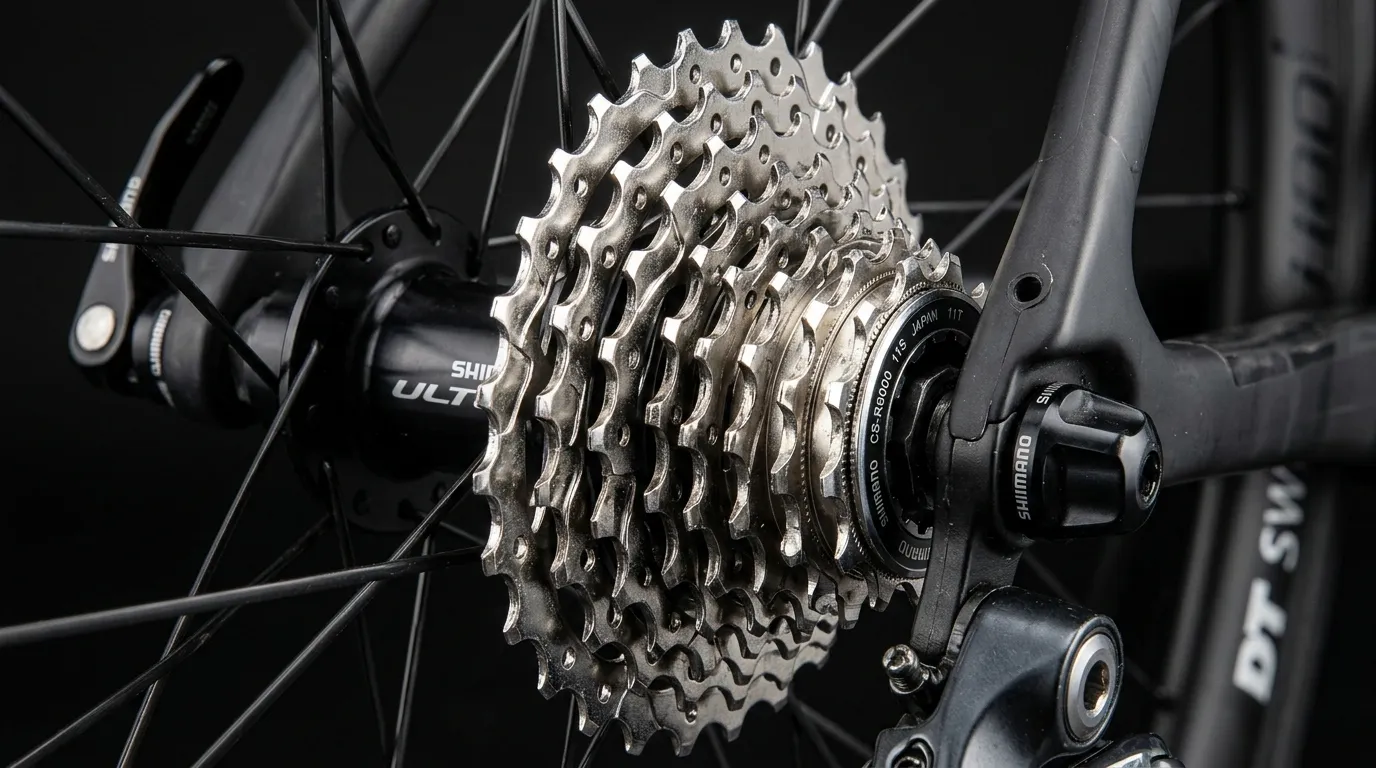
If you want to understand how to use these ratios smoothly out on the road, read our detailed guide on how to use road bike gears.
2. Braking: The massive leap to hydraulic disc brakes
If there is one technical feature that justifies spending more money on a road bike, it is not extra gears—it is hydraulic disc brakes.
Here is how braking breaks down across the three tiers:
- Shimano Claris: Almost always paired with dual-pivot rim brakes or entry-level mechanical (cable-actuated) disc brakes (such as Tektro Mira or Promax). Mechanical disc brakes pull a steel cable to push a single brake pad against the rotor. They work fine on dry flats, but can feel spongy, require frequent manual pad adjustments, and require significant hand effort on steep descents.
- Shimano Tiagra (ST-4720 / BR-4770): Tiagra was the first groupset to bring genuine, mineral-oil Shimano hydraulic disc braking to sub-£1,300 bikes. Dual hydraulic pistons push both pads evenly against the rotor with light, one-finger lever pull.
- Shimano 105 (R7020 / R7120 / Di2): Features Shimano’s finest hydraulic disc calipers with Servo Wave technology, offering immense stopping power, exceptional modulation, and zero hand fatigue on wet alpine descents.
Braking performance comparison:
Rim Brakes (Claris/Tiagra)       : [██████░░░░] Great in the dry, reduced power in rain & grime
Mechanical Disc (Claris)        : [███████░░░] Consistent all-weather, requires heavy lever squeeze
Hydraulic Disc (Tiagra & 105)   : [██████████] One-finger control, self-adjusting, immense wet-weather power
[!TIP] If you commute in the rain, ride on steep descents, or suffer from hand fatigue or arthritis, buying a bike with Tiagra hydraulic disc brakes (ST-4720) is worth every single penny over a cable-brake Claris bike.
3. Durability, weight, and wear-part replacement costs
High-tier groupsets are lighter because they use hollow forged aluminium, carbon-fibre reinforced polymers, and light alloy spider arms. Claris and Tiagra rely on stamped steel sprockets and solid alloy arms.
However, entry-level groupsets hold a major secret weapon: durability and cheap maintenance.
- Chain wear: An 8-speed Claris chain is wide, robust, and extremely tolerant of slight misalignment or road grit. A 12-speed 105 chain is significantly narrower and requires precise lubrication and regular cleaning. Check our guide on how to clean and lubricate a road bike chain to extend drivetrain life.
- Replacement costs: When you wear out your chain and cassette after 3,000 km:
- Replacing a Claris chain and cassette costs roughly £30 ($38) total.
- Replacing a Tiagra chain and cassette costs roughly £50 ($65) total.
- Replacing a 12-speed 105 chain and cassette costs roughly £100 to £130 ($125 to $165) total.
For daily commuters, winter training bikes, and riders on a tight maintenance budget, Claris and Tiagra are remarkably economical to run.
4. Beware the “mixed specification” listing
When bike manufacturers design an entry-level or mid-tier road bike, they often cut costs by mixing components. You might see a bike marketed as “Shimano 105” or “Shimano Tiagra” that does not actually have a complete groupset.
Common substitutions include:
- Cranksets: Substituting the Shimano crank for an FSA, Praxis, or unbranded alloy crank. (This is generally fine, though front shifting is slightly crisper with a genuine Shimano chainring).
- Cassettes: Using a SunRace or Microshift cassette instead of Shimano Hyperglide.
- Brakes: Swapping Shimano hydraulic calipers for third-party mechanical disc brakes. This is the biggest downgrade to watch out for.
Always read the full specification sheet of the bicycle before hitting buy. For more advice on evaluating complete builds, consult our comprehensive guide on how to choose your first road bike.
Real-world buying scenarios: Which should you choose?
To make your decision straightforward, find the scenario below that matches your budget, riding style, and goals.
                  ┌─────────────────────────────────────┐
                  │ What is your total bicycle budget?  │
                  └──────────────────┬──────────────────┘
                                     │
           ┌─────────────────────────┼─────────────────────────┐
           ▼                         ▼                         ▼
   Under £900 / $1,100     £1,000 – £1,500 / $1,800     Over £1,600 / $2,000
           │                         │                         │
           ▼                         ▼                         ▼
   ┌───────────────┐         ┌───────────────┐         ┌───────────────┐
   │ Shimano Claris│         │ Shimano Tiagra│         │  Shimano 105  │
   │ (8-speed)     │         │ (10-speed)    │         │ (11/12-speed) │
   └───────────────┘         └───────────────┘         └───────────────┘
Scenario 1: The budget-conscious beginner (£600 – £900 / $750 – $1,100)
Your match: Shimano Claris (R2000)
If you have a hard ceiling under £1,000 and still need to buy essential accessories (helmet, bib shorts, floor pump, lock, and puncture kit), buy a Shimano Claris bike with complete confidence.
Modern Claris R2000 features dual-control STI levers with cables tucked neatly under the handlebar tape, clean shifting, and bulletproof reliability. While the gear steps are wider, you will have no trouble completing 30 km to 80 km weekend rides, fitness loops, and daily commutes.
[!IMPORTANT] A £750 Claris bike that leaves you £250 for high-quality cycling shorts, proper tyres, and a bike pump will make you 100 times happier and more comfortable than spending every last penny on an expensive bike you cannot afford to equip.
Scenario 2: The sportive & all-weather rider (£1,000 – £1,500 / $1,250 – $1,850)
Your match: Shimano Tiagra (4700 Disc)
If you have a mid-range budget and want the best price-to-performance ratio in cycling, choose Shimano Tiagra with hydraulic disc brakes.
Tiagra 4700 uses the same cable pull ratio and shift geometry as Shimano’s 11-speed systems. Shifting is light and instantaneous, 10 speeds provide tight cadence steps on rolling hills, and the ST-4720 hydraulic disc brakes deliver true one-finger stopping power in torrential rain. It is the gold standard for beginner endurance riders.
Scenario 3: The aspiring club rider & hill climber (£1,600+ / $2,000+)
Your match: Shimano 105 (R7000 / R7100)
Stretch your budget to Shimano 105 if:
- You plan to ride with local cycling clubs or fast group rides, where staying in an efficient 90 RPM rhythm on drafting pacelines is essential.
- You live in a mountainous area where 11 or 12 tightly spaced gears make steep gradients manageable. See our advice on how to ride hills without burning out.
- You want a “forever frame and drivetrain” that you will not feel the urge to upgrade after two seasons.
Shimano 105 is universally cross-compatible with pro-level Ultegra components, meaning you can easily swap parts or upgrade wheels down the road.
Scenario 4: Browsing the used bike market
Your match: Condition beats hierarchy
If you are shopping second-hand on eBay, Facebook Marketplace, or local classifieds, do not assume an older 105 bike is automatically better than a newer Claris or Tiagra bike.
A 10-year-old Shimano 105 5700 bike with worn chainrings, stretched cables, rusted pivot points, and old external shift cables will shift and brake significantly worse than a freshly tuned, two-year-old Claris R2000 bike.
When buying used:
- Inspect chain and cassette wear with a ruler or chain checker.
- Verify that the brake levers snap back smoothly without sticking.
- Check that the derailleur hanger is straight and shifting is indexed properly.
- Run through the used road bike viewing checklist before handing over cash so ownership, frame damage, fit, brakes, wheels, drivetrain wear, and likely first repair costs are checked in one place.
If the used bike passes inspection but the repair list is long, open the starter gear checklist before buying extras. Helmet, lights, water, phone backup, and compatible puncture gear should stay inside the total budget before upgrades.
Summary comparison checklist
Use this quick summary to lock in your decision:
- Choose Claris (8-speed) if you want an affordable, dependable entry into road cycling, commute daily, or want to keep your total spend under £900 ($1,100).
- Choose Tiagra (10-speed) if you want the ultimate beginner sweet spot: smooth cadence steps, high-end ergonomics, and genuine hydraulic disc braking for under £1,400 ($1,750).
- Choose 105 (11/12-speed) if your budget allows £1,600+ ($2,000+), you want seamless cadence control for group pacelines and big hills, and you want enthusiast-tier performance that lasts for years.
- Check the brakes: Prioritise hydraulic disc brakes over extra rear sprockets if you ride in hilly or wet terrain.
- Protect your setup budget: Reserve at least £150 to £250 ($200 to $300) for safety essentials, puncture repair supplies, and comfortable cycling apparel.
Your next step
Take a look at two or three road bikes in your price bracket and write down their exact drivetrain and brake specifications. Rather than looking only at the headline brand name, verify the rear sprocket count, whether the brakes are cable-actuated or hydraulic, and whether the frame geometry suits your riding style.
Before you make your purchase, explore our companion guides:
- How to choose your first road bike — A complete guide to frame geometry, sizing, and total cost of ownership.
- What does groupset actually mean? — Understand all the mechanical components that make up a bicycle drivetrain.
- How to use road bike gears — Learn how to shift smoothly, avoid cross-chaining, and master cadence on the road.
- First ride preparation checklist — Everything you need to inspect and pack before rolling out on your maiden voyage.