How to plan your first road cycling route
Plan a first road-cycling route that fits your current skill, keeps traffic decisions simple, includes a safe exit, and leaves attention for the ride.
 Field guide / how-to-plan-your-first-road-cycling-route
Your first road-cycling route should be easy enough that the route almost disappears. The point is not to prove distance. The point is to ride a working bike, make calm traffic decisions, practise controls, and get home with a clear idea of what to repeat or change.
The short answer: plan a short loop or out-and-back on familiar, low-stress roads or paths, with ordinary surfaces, few complex junctions, a safe turnaround, and a realistic way home. Choose the route that leaves attention for steering, braking, shifting, traffic, and weather, even if it is not the fastest, prettiest, or longest option.
What makes a first route good
A good beginner route is not just short. It is understandable while you are riding.
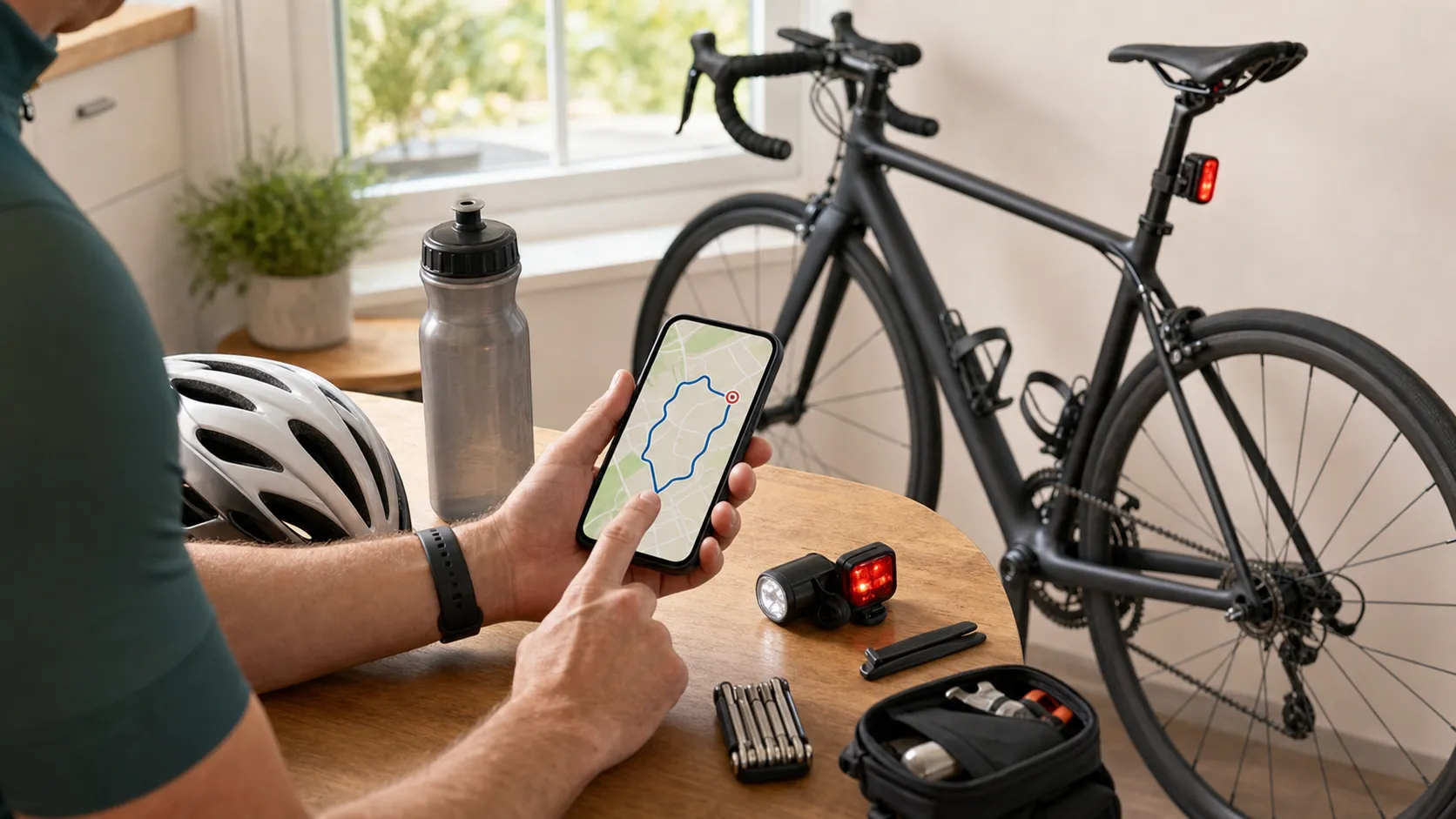
Recent beginner cycling threads keep using the same words: scared of cars, unsure which roads are quiet, trying to find residential streets, afraid of getting lost, and tempted by routes that look good on a map but feel stressful on the ground. In a r/cycling thread from 21 days before this guide was published, a newer road rider described being frightened by a close high-speed pass and asked what people do about being scared on the road. Another rider asked for a planner that prioritizes quiet residential streets because painted bike lanes on faster roads did not feel as calm as a slower neighborhood route.
That wording matters because beginners often do not need a more impressive route. They need a lower-decision route.
NHTSA bicycle safety guidance gives the practical foundation: choose routes with less traffic and slower speeds when riding on the road, and remember that the safest route may be away from traffic in a bike lane or on a bike path. It also tells riders to use a bike that fits and works, wear visible protective equipment, ride predictably, avoid distraction, and start practising away from traffic.
For your first route, that becomes one standard:
- You know where the route goes before you start.
- You can explain the shape in one sentence.
- You can shorten or stop the ride without improvising in traffic.
- You are not relying on speed, bravery, or perfect navigation to stay comfortable.
Choose the route shape first
Start with shape before distance. A route shape tells you how easy it will be to understand the ride when your attention is busy.
Out-and-back
An out-and-back goes away from the start, then returns the same way. It is usually the easiest first-road-cycling format because every turn you make on the way out becomes familiar on the way home.
Choose this when:
- you want one obvious turnaround point;
- you are unsure about fitness;
- navigation is new;
- there is one safe path, park road, quiet lane, or bike route near home.
The downside is repetition, but repetition is useful early. If the road felt calm in one direction, you already know a lot about the return.
Short loop
A loop feels more interesting, but it asks more of you because every junction is new. Use a loop only if the turns are obvious, the traffic exposure is modest, and you can describe it without staring at a screen.
Choose this when:
- you know the area;
- the loop avoids awkward right turns, fast junctions, or difficult merges for your country and road system;
- there is a clear shortcut back to the start;
- you can ride it in daylight with time left.
Destination and return
A small destination can make the ride feel purposeful: a park, cafe, station, shop, viewpoint, friend, or quiet car park. Keep the destination ordinary. The first route should not depend on reaching a scenic climb, remote trailhead, or busy town center.
Choose this when:
- the destination is easy to stop at without blocking anyone;
- there is water, shelter, transit, pickup, or a shop nearby;
- the return route is already planned;
- you can turn around before the destination and still feel the ride worked.
Judge roads by stress, not just distance
Most map tools can show distance. Fewer can tell you how calm a road will feel to a new road cyclist. Build your own judgement with five route filters.
1. Traffic speed and volume
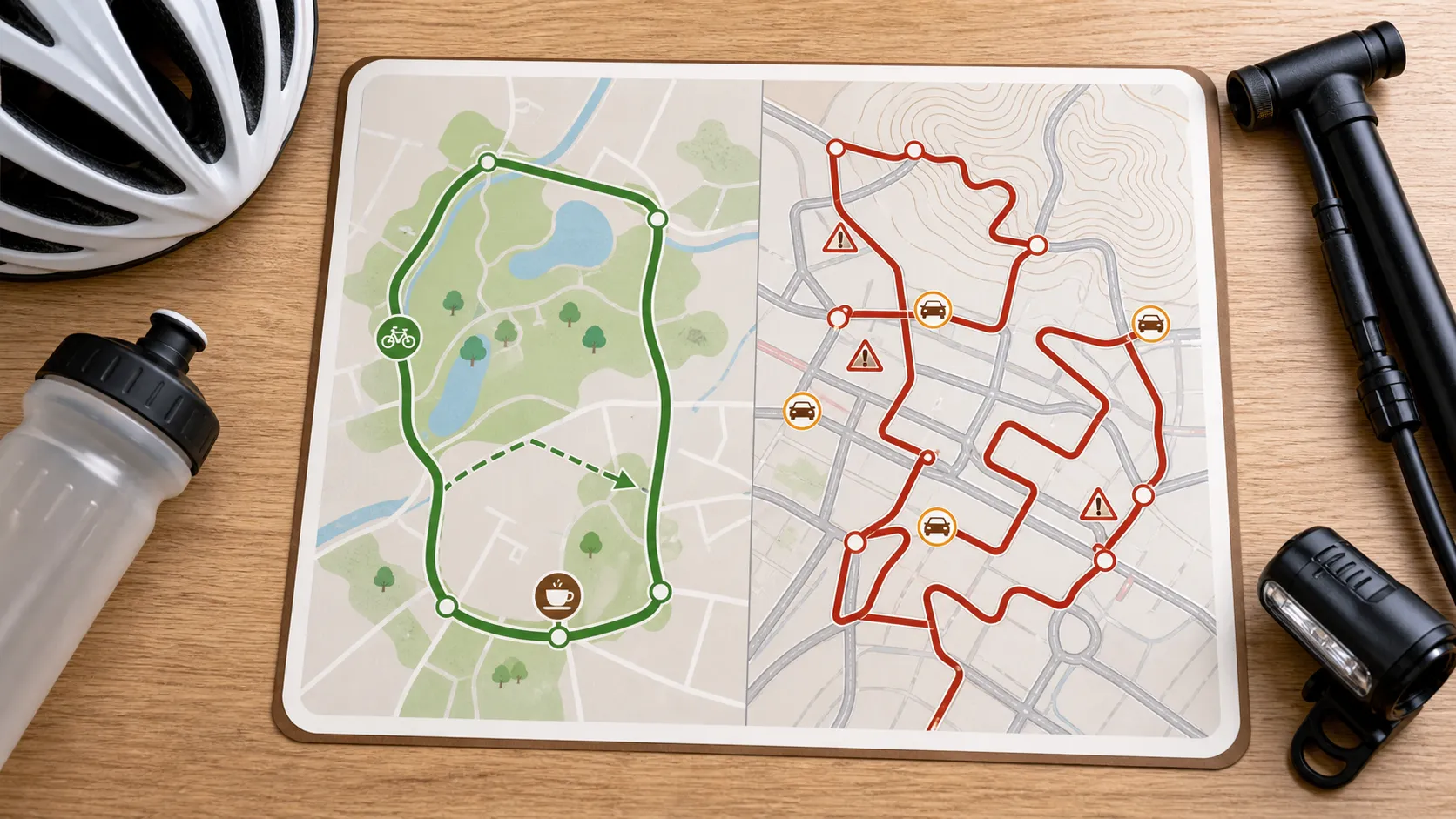
Prefer protected paths, bike lanes, quiet streets, bicycle boulevards, low-speed roads, and roads where drivers have time and space to pass safely. Be careful with a route that is short only because it uses a fast main road.
The FHWA Bikeway Selection Guide is written for planners, not individual riders, but its core idea helps beginners: bicycle comfort depends heavily on motor-vehicle speed, traffic volume, and how much separation the road provides. When speed and volume rise, a painted line may not create the same low-stress feeling as a protected lane, shared-use path, or calmer parallel street.
2. Junction complexity
Count stressful decisions, not just turns. A quiet road with five simple turns may be easier than a “direct” route through one large multi-lane junction.
Look for:
- roundabouts or traffic circles you have not practised;
- right or left turns across faster traffic, depending on your country;
- merges, slip lanes, freeway ramps, and multi-lane approaches;
- blind bends before junctions;
- routes that ask you to change lanes at speed.
British Cycling’s route-planning advice notes that roads with numerous junctions and traffic lights can make a ride harder to manage. For a beginner, that is not only a training problem. It is an attention problem.
3. Surface and hazards
Road bikes can handle normal paved roads, but narrow tyres and drop bars make surface choice feel important when you are new. Avoid making your first route a test of potholes, loose gravel, wet leaves, metal covers, sand, rough shoulders, or broken pavement.
Use street-level imagery or local knowledge where you can, but treat it as a clue rather than a guarantee. Roads change. Construction, weather, parked cars, debris, and temporary closures can turn a neat route into a different ride.
4. Hills and descents
A short steep route may be harder than a longer flat route. Climbs can force rushed shifting, and descents can add speed before braking and cornering feel calm.
If hills are unavoidable, choose the gentlest version first. Look for a route where the steepest section is short, visible, and easy to walk if needed. Avoid steep descents into junctions until braking and cornering with confidence feels ordinary.
5. Stops, shade, water, and daylight
A route can be technically rideable and still be a poor first choice if it leaves you exposed. Check daylight, temperature, wind, rain risk, refill options, and places to pause without blocking a path or road.
If weather, heat, darkness, or wind turns the ride into a judgement test, make the route shorter. You can build distance later.
Use a simple first-route score
Before committing, score the route honestly. You do not need a calculator. You need a stoplight decision.
| Route question | Green answer | Yellow answer | Red answer |
|---|---|---|---|
| Can I explain it simply? | One loop, out-and-back, or destination and return | Several turns but familiar | I need constant navigation |
| What is the traffic like? | Low speed, low volume, protected, or familiar | Some busier sections with space | Fast, narrow, aggressive, or unknown |
| Are the junctions manageable? | Few and predictable | One or two that need care | Multiple stressful crossings or merges |
| Is the surface ordinary? | Dry, paved, visible, and familiar | Some rough patches | Loose, wet, broken, dark, or unknown |
| Can I stop or shorten it? | Clear turnaround, shortcut, transit, pickup, or easy ride home | One fallback but not ideal | No graceful exit |
| Will I have attention left? | Yes, it feels almost too easy | Maybe, if everything goes well | No, it already makes me tense |
Choose a route with mostly green answers. One yellow answer is fine if you know how you will handle it. A red answer means change the route, shorten it, practise first, ride with a more experienced person, or wait for better conditions.
Plan the exit before the start
A safe exit is not a failure plan. It is part of the route.
Before you ride, answer these:
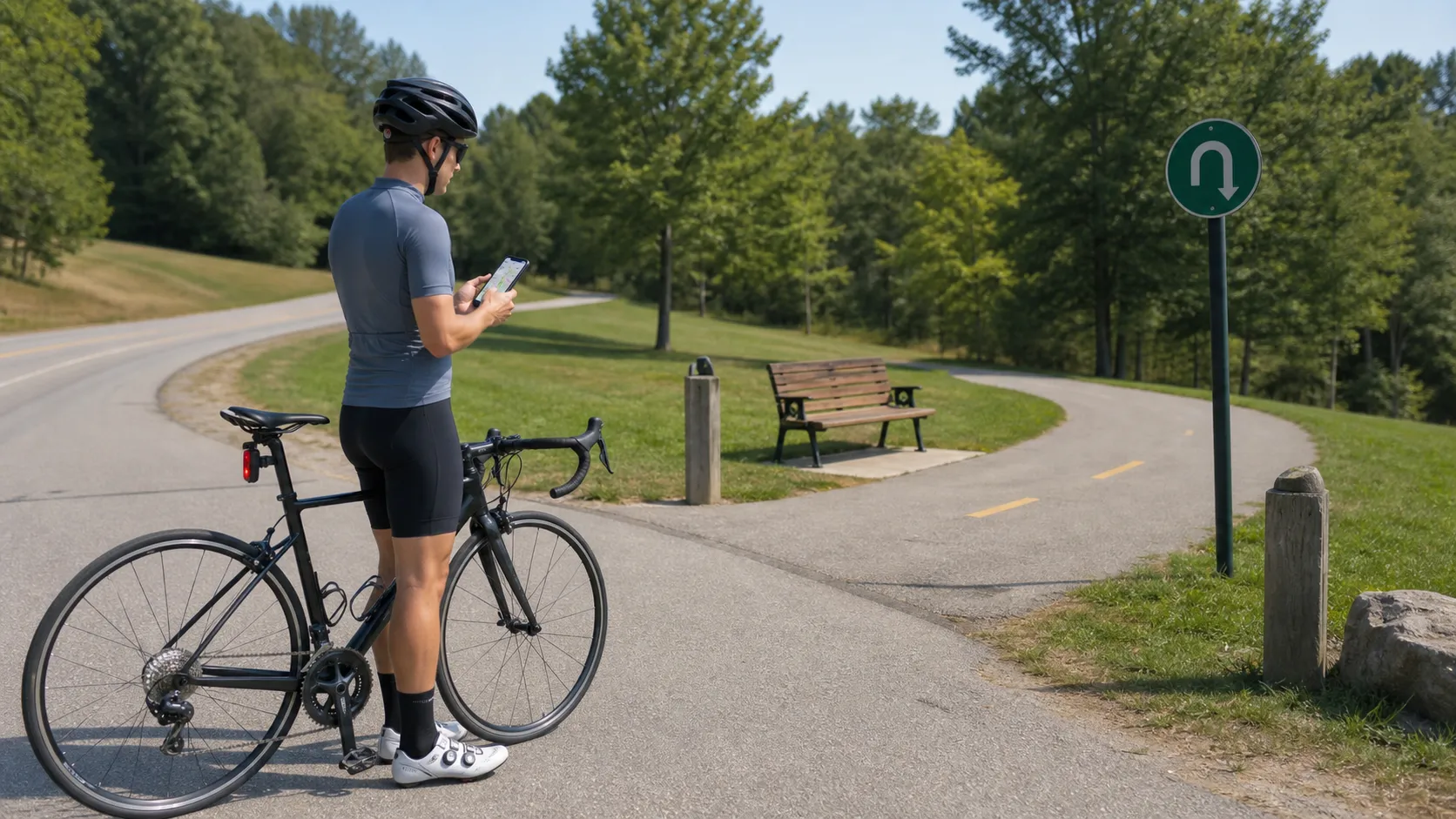
- Where is the first safe place to stop?
- Where can I turn around without rushing a traffic move?
- What is the shortest version of this route?
- Where could I get water, shelter, transit, or pickup?
- What would make me stop rather than continue?
Good stop triggers include a brake or tyre problem, getting lost, losing daylight, worsening weather, shaky handling, repeated close passes, hunger or dehydration, phone battery trouble, or simple discomfort that is pulling attention away from the road.
If stopping safely means walking the bike for a block, walking is the correct cycling decision. The route does not get to bully you into riding a section you have already judged badly.
Check the route the night before
Do the route-planning work when you are calm, not while clipped in at the kerb.
The night before or morning of the ride:
- Open the route and check the whole shape.
- Zoom in on every major turn or junction.
- Check whether cycling is legal and appropriate on each path, lane, road, or park road.
- Look for construction notices, event closures, or obvious map warnings.
- Check weather, wind direction, sunset, and temperature.
- Save the route offline if your app allows it, or write a tiny cue sheet.
- Tell someone your rough plan if the route is unfamiliar or you are riding alone.
Do not outsource judgement entirely to an app. Route tools can be useful, but they do not know your current bike control, traffic comfort, daylight buffer, or whether a “bike-friendly” road feels friendly to a new rider.
Keep navigation from stealing the ride
Navigation should be boring. If your route needs constant screen checks, it is probably too complex for a first road ride.
Use one of these low-stress setups:
- a route you can remember by landmarks;
- an out-and-back with one obvious turnaround;
- a phone or bike computer mounted securely where legal and safe;
- audio cues that do not block awareness;
- a printed cue sheet in a pocket;
- a friend who knows the route and understands beginner pace.
NHTSA warns against anything that takes your eyes, ears, or mind away from road and traffic. That is why the safest first-route navigation plan is the one that asks for the fewest checks while moving. If you need to inspect the map, stop somewhere safe first.
Match the route to the bike and kit
Use the five-minute pre-ride bike check before leaving. Route planning does not compensate for a weak brake, loose wheel, soft tyre, missing light, or repair kit that does not fit your bike.
For a first road route, carry the basics you actually know how to use:
- helmet and visible clothing appropriate for conditions;
- front and rear lights, even in daytime if visibility may change;
- water;
- phone, ID, payment, and a way home;
- spare tube or tubeless plan, tyre levers, pump or inflator, and any axle tool your bike needs;
- a simple layer if weather could change.
If you have never fixed a puncture, read practise one puncture repair at home before making the route remote. If your new road bike controls still feel unfamiliar, pair this guide with how to use road bike gears and keep the route flat.
A worked first-route example
Suppose you want to ride for about 30 to 45 minutes from home. The direct loop is 14 km, but it uses a fast road, a busy roundabout, and a descent into traffic lights. The alternative is only 8 km: a quiet out-and-back to a park path with one cafe stop and a clear turnaround.
Pick the 8 km route.
That is not timid. It is cleaner route design. The easier route lets you practise:
- starting and stopping;
- shifting before small rises;
- braking before turns;
- holding a predictable line;
- checking how the bike feels;
- using your route setup without panic.
If the 8 km version feels calm, repeat it once. Then add one change: a longer turnaround, one extra loop, a mild hill, a new quiet street, or a slightly busier time of day. Do not add all five.
This is the same principle as why your first route should feel almost too short: confidence grows faster when the ride leaves you wanting another ride.
Common route-planning mistakes
| Mistake | Why it causes trouble | Better first-route habit |
|---|---|---|
| Choosing the shortest road route | The shortest option may use fast traffic or awkward junctions | Choose the lowest-stress route |
| Trusting a map line without checking context | A “bike” route may still include traffic, hills, or rough surfaces | Zoom in and use local knowledge |
| Making the route too interesting | New turns, hills, roads, and stops all cost attention | Change one variable at a time |
| Skipping the exit plan | Fatigue, weather, or bike problems become harder to solve | Name the turnaround and shortcut before leaving |
| Riding farther because others do | Beginner progress is not a mileage contest | Finish with control and curiosity |
| Looking at the phone while moving | Navigation can become a road hazard | Stop safely before checking details |
When to postpone or simplify
Simplify the route if:
- rain, wind, heat, cold, or darkness changes the risk;
- the route depends on a road or junction you already dread;
- your brakes, tyres, gears, lights, or wheel fasteners do not pass the pre-ride check;
- your phone, light, or navigation battery is low;
- you feel rushed by time;
- you cannot explain the route without staring at a screen.
Postponing is not wasting the day. A shorter route, a traffic-free practice session, or a walk-through of the bike is still progress.
Your next step
Plan one first route today using the score table above. Make it an out-and-back or short loop with mostly green answers, choose the exact turnaround point, and do the five-minute pre-ride bike check before you leave.
After the ride, write down the one thing that demanded the most attention: traffic, turns, surface, hills, navigation, wind, fitness, or bike control. Keep the next route the same except for one small improvement.