How to ride past parked cars without getting doored
Choose a visible, predictable line outside the door sweep, read parked vehicles early, and avoid last-second swerves into moving traffic.
 Field guide / how-to-avoid-car-dooring-while-cycling
Do not ride close enough to parked vehicles for a suddenly opened door to occupy your line. Look far ahead, move into a visible position early when it is safe and legal, and hold that line predictably instead of weaving between gaps.
The short answer: treat every occupied or recently parked vehicle as capable of opening a door. Leave at least a door’s width where local guidance supports it, watch for occupants and movement, and preserve space from passing traffic. If the lane is too narrow for a safe pass beside you, do not invite a squeeze by riding in the door zone.
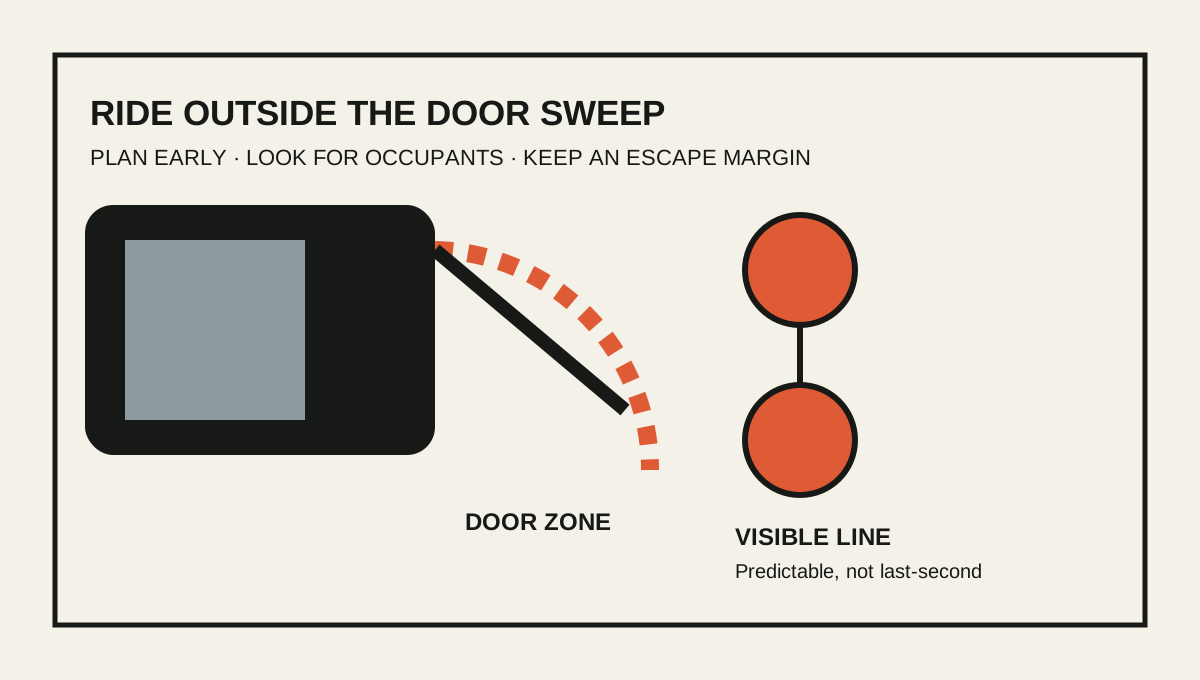
Understand the door zone
The door zone is the space a vehicle door can sweep through when someone opens it. It includes more than the narrow gap beside the bodywork. A full-size door, the person’s movement, and your handlebar width all matter.
The UK Highway Code advises cyclists to leave a door’s width or one metre when passing parked vehicles. Treat that as a useful safety reference, not a universal law: local rules and official cycling guidance may specify something different.
You also need an escape margin. Riding exactly at the theoretical end of a door leaves little room for an unexpectedly wide door, a pedestrian, a pothole, or a wobble. Position is a risk-reduction tool, not a guarantee.
Look several vehicles ahead
Dooring prevention begins before you reach the car. Scan for:
- brake lights or a vehicle that has just stopped;
- an occupied driver’s seat or passenger seat;
- a face, shoulder, hand, or head movement through the windows;
- illuminated interior lights;
- a taxi, rideshare, school, shop, or loading area where doors open often;
- a vehicle angled toward the kerb rather than settled into a space;
- pedestrians approaching a vehicle with keys, bags, or children;
- exhaust, wheels turning, or mirrors moving;
- a gap ahead that may tempt someone to pull out.
Tint, glare, darkness, headrests, and large vehicles can hide people. “I cannot see an occupant” means uncertainty, not an empty car.
Move out early, not at the last door
Check behind while your line is still stable. If moving outward is safe and legal, signal where appropriate and make the transition gradually enough to be understood. Then hold a steady line past the row of vehicles.
Last-second swerving creates a second hazard: you escape the door space by entering the path of overtaking traffic. Practise looking behind without swerving on a traffic-free surface until the movement is controlled.
If traffic prevents you from moving to a safe position, slow down or stop in a predictable place and wait for a usable gap. A delay is cheaper than trying to fit through two incompatible spaces.
Do not weave through every parking gap
Diving into an empty bay and back out around the next car may make you less visible and force repeated merges. A straight, predictable line is usually easier for following drivers to understand.
This does not mean occupying one rigid line regardless of conditions. It means planning transitions deliberately. Long empty sections, junctions, surface defects, and local law can change the appropriate position. Use the principles in predictability beats bravery rather than turning “hold your line” into an absolute.
Manage the squeeze from moving traffic
A cyclist, an opening door, and a passing motor vehicle may not safely fit side by side in a narrow lane. Avoid presenting the door zone as available cycling space merely to help someone pass without changing lanes.
Where local rules allow, a more central lane position can discourage an unsafe squeeze until the hazard has passed. Make the move only after checking behind and judging speed and space. Never assume a driver has seen you because your position is technically correct.
If a close pass is developing, your options depend on the actual road. Reduce speed smoothly, keep the bike controlled, and preserve room rather than accelerating into a narrowing gap. The broader road-positioning guide explains primary and secondary positioning.
Slow down when the evidence is poor
Speed changes the time available to detect a door, react, brake, and choose an escape. Reduce it when:
- visibility through the vehicle is blocked;
- pedestrian or passenger activity is high;
- the surface pushes you toward the cars;
- the road narrows;
- rain or darkness reduces detection and braking margin;
- a bus, van, or large SUV hides activity ahead;
- you cannot create both door clearance and passing clearance.
Cover the brake levers without gripping rigidly. Keep enough distance from another cyclist to see hazards yourself; a wheel directly ahead can hide an opening door until the first rider moves.
Bike lanes can still cross the door zone
Paint does not shorten a door. Some bike lanes run beside parking and leave generous separation; others place riders directly in the sweep. Judge the geometry you can see.
If safe passage requires riding near or across a painted boundary, local law matters. Learn the rules for your jurisdiction and use official cycle training if available. The point of this guide is not to tell you to ignore markings; it is to stop treating markings as a physical barrier.
At night, use legally required lights and visible clothing, but do not assume visibility equipment solves positioning. Read cycling safely after dark for the equipment and scanning layer.
If a door begins to open
There is no single manoeuvre that is safe in every traffic situation. Your available space, speed, surface, following traffic, and the door’s motion determine the least harmful option.
- Brake firmly while keeping the bicycle as straight as conditions allow.
- Look toward usable space, not at the door alone.
- Do not swerve blindly into traffic.
- Call out if it can warn the person without distracting you from control.
- If a collision occurs, move out of further danger if able, call emergency services when needed, and seek medical assessment for head impact, significant pain, loss of consciousness, confusion, or other concerning symptoms.
After any crash, use the people-first crash checklist rather than immediately inspecting cosmetic damage.
Practise the skill away from traffic
Set a line on an empty car park or closed training area. Practise looking behind, signalling, moving outward gradually, riding straight, and braking in a controlled way. Add no parked cars or opening-door simulation; the goal is stable control, not realism through unnecessary risk.
Then choose a quiet route where you can identify the door sweep and plan early. If riding beside parked traffic remains overwhelming, a qualified local cycle-skills course can provide supervised practice within the laws and road design where you live.
Your next step
On your next familiar ride, identify each row of parked vehicles before you reach it. Check behind early, choose a line outside the visible door sweep when safe and legal, reduce speed when occupants are possible, and avoid weaving into short gaps.
Sources and further reading
- UK Highway Code rules for cyclists: clearance from parked vehicles
- Transport for London cycling safety advice: stay a door’s width from parked cars
- r/CyclistsWithCameras discussion: a painted lane within the door zone — used as a current hazard-awareness signal, not verified crash evidence.
- r/NYCbike discussion: recurring concern about doors opening into a rider’s path — used as an editorial demand signal; its anecdotal details are not treated as verified facts.