What to do after a group-ride crash: people first, bike later
Use a calm post-crash sequence for scene safety, emergency care, facts and contacts, equipment quarantine, and responsible follow-up after a group ride.
 Field guide / what-to-do-after-group-ride-crash
After a group-ride crash, stop the secondary danger, assess people, call professional help when needed, and record facts only after immediate care is underway. Do not let embarrassment, blame, a damaged bicycle, or pressure to continue override injury warning signs.
The short answer: make the scene safer, appoint one person to lead and one to call, keep an injured rider still when head, neck, or back injury is possible, and give care only within your training. Exchange details and preserve evidence later. Quarantine every crashed helmet and any bike with uncertain structural or braking damage.
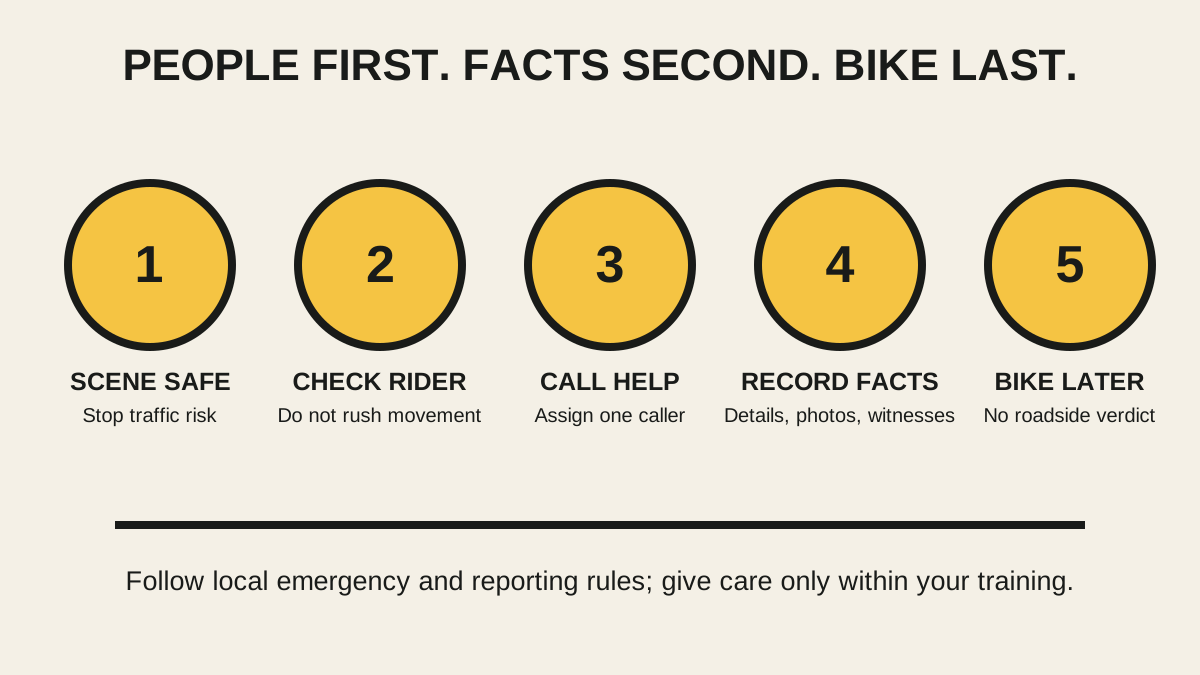
Why apology and blame are not the first jobs
A highly discussed group-ride question asked about responsibility and etiquette after one rider caused another to crash. The useful signal is that riders need a shared process after the impact—not a verdict assembled while adrenaline is high.
You can show care without deciding legal fault. “I am here, help is coming, and we will exchange details” is useful. Speculating about liability, promising a particular payment, arguing about wheel overlap, or posting footage can wait.
1. Prevent a second collision
The American Red Cross starts first aid with checking scene safety. On a road or path, the group may still be exposed to traffic, blind bends, descending riders, debris, fuel, broken glass, or unstable bicycles.
- Stop the rest of the group somewhere visible and out of the traffic line.
- Put a capable rider upstream only if they can warn others without entering danger.
- Switch on lights and use warning signals available under local rules.
- Do not cluster the whole group around the injured rider.
- Do not step into moving traffic to retrieve a bottle or bike.
- Tell the emergency dispatcher about road position, traffic, and access constraints.
Move an injured person only when staying put presents an immediate greater danger or when required for life-saving care within your training.
2. Check the rider before the bicycle
Approach calmly, identify yourself, obtain consent when possible, and follow your recognised first-aid training. Check responsiveness and breathing and look for life-threatening bleeding.
Call the local emergency number immediately when the rider:
- is unresponsive, not fully awake, not breathing normally, or only gasping;
- has life-threatening bleeding;
- may have injured the head, neck, back, pelvis, or upper leg;
- shows signs of shock, severe or multiple injuries, or worsening condition;
- cannot safely move or has significant pain, numbness, or loss of function;
- was involved in a high-energy impact and you are uncertain.
Red Cross guidance says not to ask someone with a suspected head, neck, or spinal injury to move. Keep them in the position found unless movement is necessary for safety, CPR, or bleeding control. Monitor breathing and responsiveness until help takes over.
Do not diagnose concussion from a roadside conversation. A rider who insists they are fine may still be affected by adrenaline or head injury.
3. Give the group clear roles
One calm coordinator prevents duplicated calls and missing tasks. Assign names, not general requests:
- Caller: contacts emergency services and follows dispatcher instructions.
- Scene watcher: warns approaching riders or traffic from a safe position.
- First aider: stays with the injured rider and gives trained care.
- Location guide: meets responders at a junction or gate.
- Recorder: notes time, location, contacts, and witnesses once care is established.
- Bike custodian: keeps equipment together without attempting repairs.
Everyone else should clear space, remain available, and avoid filming or sharing.
4. Preserve facts without conducting a trial
When immediate care allows, record neutral details:
- exact location, time, weather, and road conditions;
- names and contact details of involved riders and independent witnesses;
- vehicle registration and driver details if a motor vehicle is involved;
- photographs of the overall scene, road surface, signs, damage, and positions when safe;
- ride-camera files in their original form;
- police, ambulance, or incident reference numbers;
- damaged clothing and equipment kept rather than discarded.
Follow local collision-reporting and insurance rules. These vary widely. If another road user is involved, do not assume a cycling-club process replaces police or statutory reporting.
Keep observations factual: “the rear wheel has three broken spokes” is better than “that rider caused everything.” Do not edit the only copy of video, and do not publish identifiable injury footage.
5. Do not ride a questionable bike home
A quick handlebar straightening does not prove the bike is safe. Arrange collection when the crash involved meaningful impact or uncertainty around:
- carbon frame, fork, handlebar, stem, seatpost, or wheel damage;
- a helmet strike;
- bent, cracked, or deeply scratched components;
- impaired braking or changed lever feel;
- a shifted or damaged wheel, axle, rotor, or rim;
- a derailleur near the spokes;
- tyre cuts or bead damage;
- handlebars or saddle that moved under load.
Mark the bike do not ride and keep it in the condition required for inspection or an insurance claim. A damaged helmet should be removed from service and assessed under its maker’s replacement guidance. Our paint-crack versus frame-crack guide explains why photographs cannot clear uncertain structural damage.
6. Follow up like a responsible ride partner
After the immediate incident:
- Check on the injured rider privately without demanding updates.
- Share contact details, original files, incident references, and factual notes promptly.
- Notify the club or organiser through its incident process.
- Contact insurers without inventing certainty about liability.
- Keep promises specific and realistic: send the file, provide the witness name, or arrange equipment return.
- Review the ride procedure only after affected people have space and facts are available.
An apology can acknowledge harm and concern without turning a stressed roadside account into a legal conclusion. If fault or compensation is disputed, obtain qualified local advice.
Prevent the same crash pattern
Group-ride debriefs should produce one or two concrete changes, not humiliation. Common controls include:
- leaving more space and avoiding wheel overlap;
- pointing hazards early and smoothly;
- holding a predictable line;
- not braking abruptly inside a close group unless necessary;
- splitting groups that are too large or mismatched;
- stating regroup points and emergency roles before departure.
Use the first group-ride guide and practise avoiding wheel overlap before the next fast formation ride.
Your next step
Save your local emergency number, emergency contact, insurer details, and the ride leader’s number. Ask the group who carries first aid and who leads an incident. First-aid training is more valuable than memorising an article; book an accredited course if you ride regularly with others.