What is a good cycling cadence for a beginner?
Use cadence as a comfort and gear-choice cue, not a score: find a smooth pedalling range that you can sustain without bouncing, grinding, or chasing 90 rpm.
 Field guide / good-cycling-cadence-for-beginners
Before you buy
Check the starter kit first
Print the one-page buying brief for helmet, lights, water, phone, and repair compatibility before comparing upgrades.
A good beginner cycling cadence is the pedalling rate that feels smooth, controlled, and sustainable for the effort. For many new road cyclists, roughly 70 to 90 revolutions per minute (rpm) is a useful exploration range on flat roads—but 90 rpm is not a pass mark, and there is no single correct number for every rider or every hill.
The short answer: shift to an easier gear if each pedal stroke feels like a heavy press, and shift to a harder gear if your legs spin without control or your hips bounce. Aim for quiet, even circles before you aim for a number.
What cadence actually measures
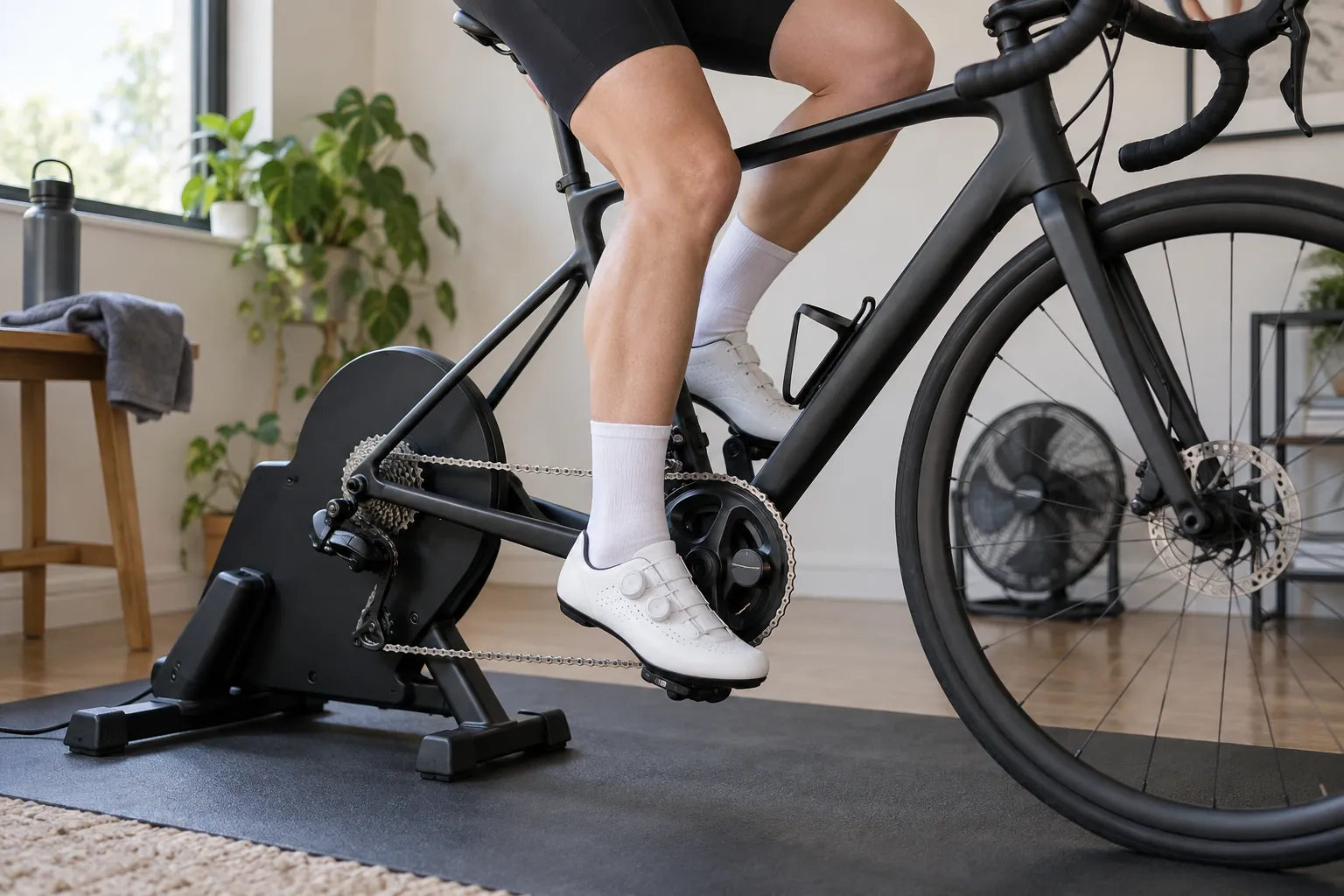
Cadence is the number of complete crank revolutions you make in one minute. If your right foot returns to the same top position 80 times in a minute, your cadence is 80 rpm.
Cadence is not speed. You can pedal at 80 rpm while climbing slowly in an easy gear or travelling quickly in a harder gear. It is also not power: two riders can hold the same cadence while producing very different efforts.
Recent beginner discussions repeatedly mix these ideas. One rider asked what a reasonable average cadence should be, while another described getting winded quickly and not knowing when to change gear. The useful connection is simple: your gears let you keep a manageable pedalling rhythm as the road and effort change.
If the whole gear system is still unfamiliar, start with how to use road bike gears before worrying about cadence data.
Why 90 rpm is not a universal target
Research does not support one magic cadence for all conditions. Reviews of cycling studies find that freely chosen cadence changes with experience, power output, gradient, duration, and the task itself. A systematic review of neuromuscular effects also found the evidence too varied to declare a single cadence optimal across riders and situations.
That explains an apparent contradiction beginners often notice:
- A slower cadence can feel calm but requires more force on each pedal stroke at the same power.
- A faster cadence reduces force per stroke but can raise cardiovascular demand and feel breathless or bouncy before coordination catches up.
- A steep hill may push cadence down even in your easiest gear.
- A descent may spin the pedals faster than usual or leave you coasting entirely.
Treat 70–90 rpm as a practice area, not a law. Someone comfortable at 72 rpm does not need to force 90 immediately. Someone naturally smooth at 92 does not need to slow down because an app uses a different default.
Find your current cadence without buying a sensor
You can measure cadence during a steady, traffic-free section or on an indoor trainer:
- Ride at a conversational effort in a comfortable gear.
- Count every time one knee reaches the top for 15 seconds.
- Multiply that count by four.
- Repeat twice after settling back into your natural rhythm.
For example, 20 right-knee rises in 15 seconds equals 80 rpm. Do not stare at a watch while riding in traffic. Have a riding partner count, use an audio timer, or perform the check indoors.
A cadence sensor or crank-based power meter can display the number continuously, but neither is required to learn the skill. Feel should lead; the number merely helps you label what you feel.
A simple three-ride cadence drill
Use the same flat, quiet stretch on three easy rides. Keep each experiment short enough that it does not dominate the ride.
Ride one: observe
Ride normally for ten minutes, then measure your natural cadence two or three times. Notice your breathing, whether your pedal strokes feel heavy, and whether your upper body stays still.
Ride two: add five rpm
Shift one rear sprocket easier and let cadence rise by about five rpm while keeping the effort easy. Hold it for two minutes, then return to normal for three minutes. Repeat three times.
The goal is coordination, not exhaustion. If your hips bounce, shoulders tense, or breathing jumps, back off. A slightly lower smooth cadence is more useful than a higher messy one.
Ride three: compare gears
On the same road, ride one minute in a gear that feels slightly too hard, one minute naturally, and one minute slightly easier. Keep speed unimportant. This teaches the sensations that should prompt a shift:
- Too hard: slow, forceful strokes; legs load up; rhythm fades.
- About right: steady pressure; quiet upper body; breathing matches the planned effort.
- Too easy: little resistance; choppy legs; hips begin to rock or bounce.
How cadence should change on hills
Shift before the gradient forces you into a slow grind. Move to an easier rear sprocket early, soften pedal pressure during the shift, and keep a rhythm you can sustain. Our guide to shifting before the hill explains the sequence.
On a steep climb, your cadence may still fall. That does not mean the ride has failed. If you are already in the easiest gear, lower the effort, use a shorter hill, take a break, or walk the steep section. Gearing and terrain set real limits.
Common cadence mistakes
Chasing an average
A ride-average cadence hides coasting, junctions, descents, climbs, and sensor dropouts. Use short steady sections to learn; do not grade an entire outdoor ride by one number.
Spinning faster while also riding harder
To practise cadence rather than intensity, change to an easier gear as your legs speed up. If you keep the same gear and add rpm, power and breathing usually rise too.
Forcing a jump from 60 to 90 rpm
Large changes feel awkward. Increase in small steps and let coordination develop over several rides.
Blaming cadence for every discomfort
Cadence can alter how an effort feels, but pain may involve workload, recovery, saddle position, cleats, injury, or bike fit. Read soreness versus pain on a new bike and do not use a cadence target to override warning signs.
Your next step
On your next easy ride, measure one natural 15-second sample, then try one gear easier for two minutes. Keep whichever rhythm feels smoother and more repeatable. That small comparison will teach you more than forcing an arbitrary 90 rpm for the whole ride.