Does a recumbent exercise bike prepare you for outdoor cycling?
Recumbent cycling can build useful aerobic work capacity, but outdoor balance, handling, upright comfort, and commuting pace require practice on the actual bike.
 Field guide / does-recumbent-exercise-bike-prepare-outdoor-cycling
A recumbent exercise bike can prepare your heart, lungs, and legs for some of the work of outdoor cycling. It cannot teach balance, steering, braking, road scanning, bike fit, or how your body tolerates an upright position. Use it as fitness preparation, then add short rides on the actual bicycle well before a commute or event.
The short answer: recumbent sessions are useful, especially when they help you exercise consistently, but their resistance levels and body position do not translate one-for-one to an upright bicycle. Keep indoor effort controlled and complete a staged outdoor skills-and-distance progression before relying on your fitness for a nine-mile commute.
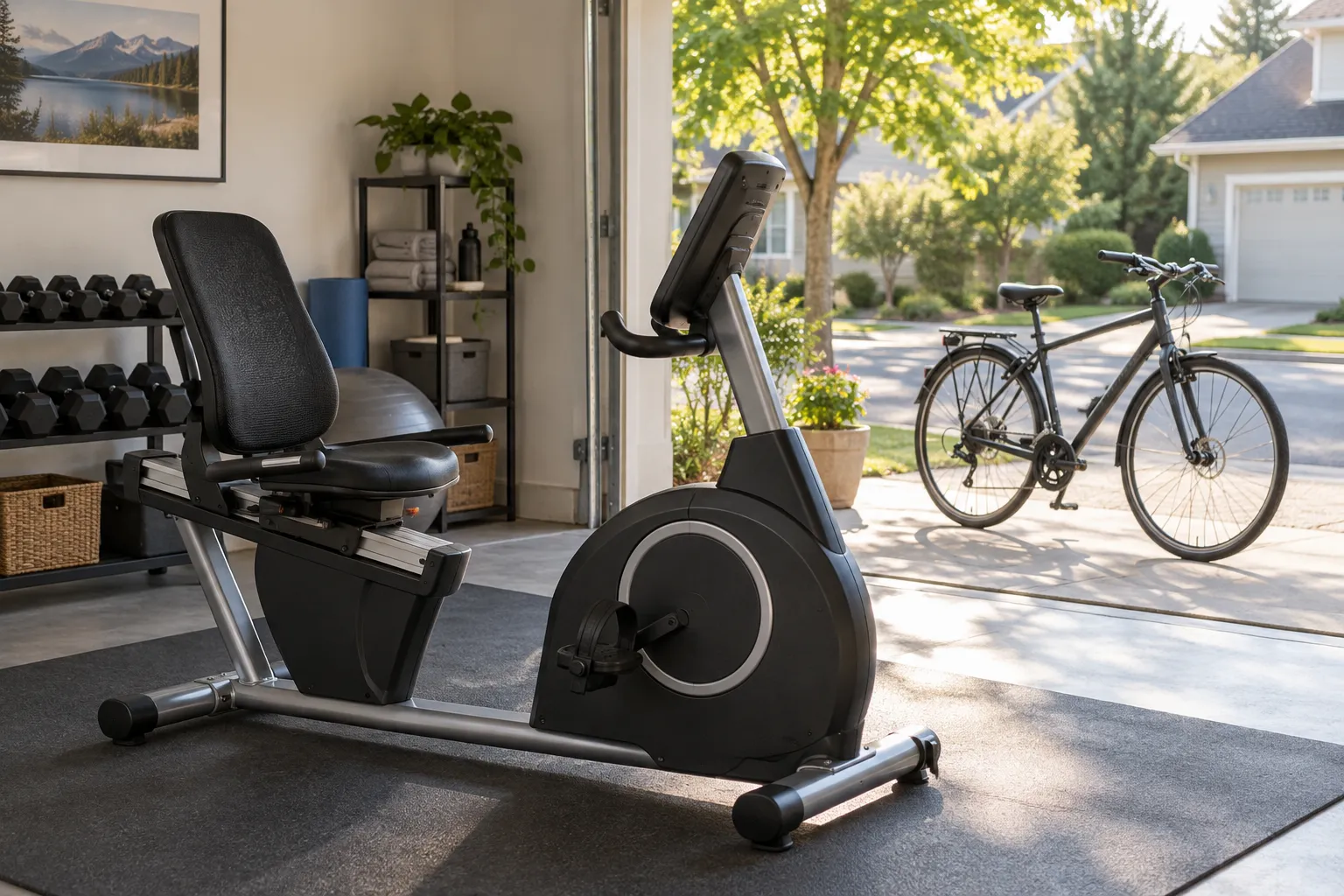
What transfers usefully
Both machines ask the legs to turn cranks against resistance. Regular recumbent sessions can therefore support:
- general aerobic work capacity;
- tolerance for sustained leg exercise;
- the habit of pacing an effort instead of starting too hard;
- confidence that you can exercise continuously for a planned duration;
- a low-consequence place to practise cadence and easy/hard intervals.
This is real preparation. It is not identical preparation. Research comparing upright and recumbent ergometry finds that posture changes power, oxygen use, heart-rate response, and efficiency. A resistance setting of “8” on one gym bike does not predict a road speed, gradient, or equivalent setting on another machine.
Use duration and perceived effort as broad guides, not the console’s speed or distance as a promise.
What does not transfer automatically
Balance and steering
A stationary recumbent supports the body and does not fall over. An upright bicycle requires low-speed balance, line choice, steering corrections, and stable starts and stops.
Braking and shifting
Road gradients, junctions, surface changes, and traffic require early gear selection and controlled use of both brakes. Gym-bike resistance buttons do not rehearse those decisions.
Upright contact points
Your hands, neck, back, saddle area, and feet experience different loads outdoors. A comfortable 60-minute recumbent session does not prove that the outdoor saddle height, reach, grips, or shoes are suitable.
Wind, hills, and repeated acceleration
Outdoor resistance changes constantly. Headwinds and climbs punish an over-fast start; junctions demand acceleration; descents require control rather than more fitness.
Traffic judgement
Fitness cannot substitute for observation, positioning, signalling, or route choice. Learn those as separate skills.
Build a four-stage transition outdoors
Keep using the recumbent bike for fitness while adding specific practice.
Stage 1: control in a traffic-free area
Practise smooth starts, straight-line riding, progressive braking, low-speed turns, gear changes, looking behind, and signalling. Make sure the bicycle passes the five-minute pre-ride check.
Stage 2: a short familiar loop
Ride 15–25 minutes on quiet roads or paths. Keep effort easy enough to talk. Adjust only one fit variable at a time if discomfort appears, and distinguish new-bike soreness from pain.
Stage 3: part of the real route
Ride the safest section at the same time of day you expect to commute. Note junctions, surface hazards, lighting, hills, secure parking, and places where you can stop. Route suitability matters more than matching a gym distance.
Stage 4: full dress rehearsal
Complete the entire route on a non-work day with the bag, clothing, lights, and lock you intend to use. Then assess how long you need to cool down, change, and prepare for work. Repeat in the reverse direction; the return may have different traffic, wind, and light.
Pace the commute below gym-test effort
If you can sustain an hour indoors, do not treat the commute as a race against that number. Begin at an effort where breathing remains controlled and you could speak in sentences. Shift early on hills and accept a slower first week.
To arrive less sweaty:
- leave extra time so speed is optional;
- wear removable layers and avoid overdressing;
- carry luggage on the bike if a backpack traps too much heat;
- use easy gears and a steady cadence;
- cool down for the final few minutes;
- bring a change of clothes and basic wash kit when facilities are limited.
No training method guarantees a sweat-free commute. Weather, clothing, route, effort, and individual physiology all matter.
Keep the indoor sessions specific but modest
Two simple sessions can complement outdoor practice:
- Easy endurance: 30–60 minutes at a conversational effort.
- Controlled changes: after warming up, alternate several minutes comfortably firm with several minutes easy, without sprinting or chasing a console score.
Set the seat according to the machine instructions and stop for pain, dizziness, chest symptoms, unusual shortness of breath, or numbness. The article cannot prescribe training around a health condition.
Do not copy outdoor power, heart-rate, or speed targets directly onto the recumbent bike. Comparative studies show position affects the response to the same displayed workload. Use each machine’s data to compare sessions on that same machine under similar conditions.
When to choose a different indoor option
An upright exercise bike or your own bicycle on a trainer may provide a more similar position and movement pattern if outdoor cycling is the main goal. It still cannot teach traffic handling, cornering, wind, or real braking.
Choose the machine you can use consistently and comfortably, then add the missing specificity outdoors. A theoretically perfect trainer that goes unused is poor preparation.
Your next step
Keep your next recumbent session, but add a 20-minute traffic-free outdoor ride this week. Practise starts, stops, looking behind, and easy shifting. Build toward a full off-duty route rehearsal; do not make the first complete ride the morning you must arrive at work on time.
Use how to plan your first road-cycling route and how long it takes to get used to a cycling commute for the next stage.
Sources and further reading
- PubMed: power output and efficiency during upright and recumbent cycle ergometry
- PubMed: cardiovascular responses on upright and recumbent ergometers
- r/cycling reader context: whether recumbent exercise prepares someone for an upright commute
The studies compare exercise positions under controlled conditions; they do not prove an exact conversion for an individual’s commute. Reddit was used only to identify the practical question.