How long does it take to get used to a cycling commute?
A cycling commute should become more manageable over several weeks. Learn how to pace the route, separate normal soreness from warning signs, and build frequency safely.
 Field guide / how-long-to-get-used-to-cycling-commute
A new cycling commute often feels disproportionately hard because it combines unfamiliar pedalling, traffic attention, hills, luggage, and a fixed arrival time. Most beginners notice useful adaptation over several weeks, but there is no honest day-by-day deadline.
The short answer: make the first two to four weeks easier than your ambition suggests. Ride gently, use low gears, add recovery days, and shorten or flatten the route when possible. Ordinary muscle soreness should settle over a few days and become less severe with repeated exposure. Sharp, joint, one-sided, or worsening pain is not a fitness test.
Why a short commute can still wreck your legs
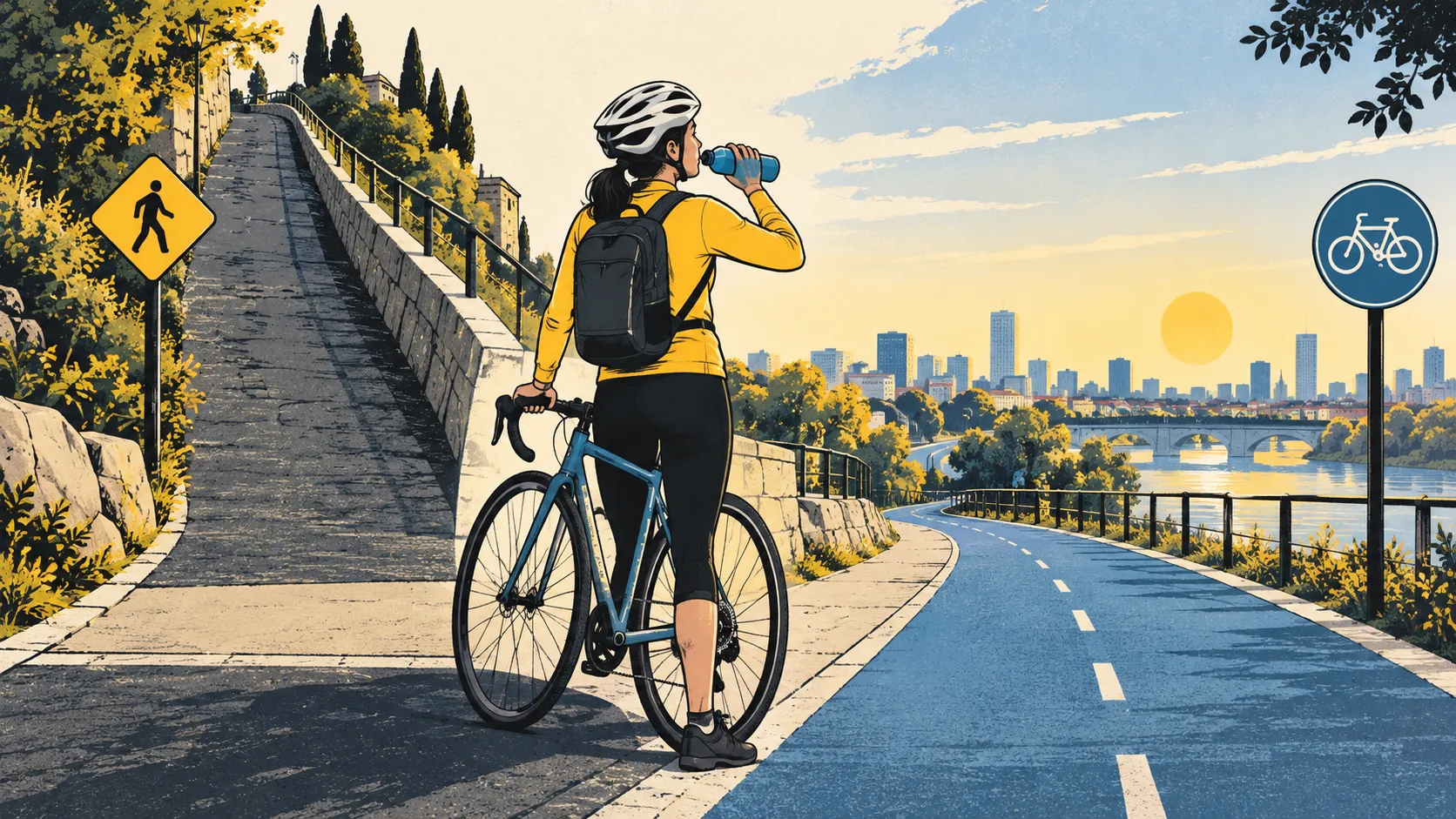
A current r/cycling question from a new commuter described sore, unsteady legs after a 5.6-mile journey and a large hill. Distance alone does not reveal the workload. Gradient, stops, gearing, wind, carried weight, and how hard you push all change the effort.
New riders also tend to press a large gear slowly, attack every incline, and treat the commute clock as a test. That creates more local leg fatigue than spinning an easier gear and arriving a few minutes later.
The useful question is not “Should this distance be easy?” It is “Can I repeat this ride while recovering normally?”
What normal adaptation can look like
Delayed-onset muscle soreness, or DOMS, commonly appears after unfamiliar exercise rather than during it. The American College of Sports Medicine says it usually lasts a few days, becomes less severe as the body adapts, and is best limited by progressing gradually.
Common beginner patterns include:
- both thighs feeling generally tired or tender the day after riding;
- the first hill feeling less shocking after several attempts;
- breathing and handling settling before speed improves;
- needing more food, water, and sleep than expected;
- one commute direction being much harder because of gradient or wind.
There is no requirement to be sore for the ride to “count.” Fitness gains do not depend on finishing every commute with empty legs.
Use a four-week ramp, not a toughness test
This is a conservative example, not a prescription. Adjust it around your current health, route, work demands, and recovery.
Week 1: learn one direction at a time
Ride the easier leg of the commute on one or two non-consecutive days if transport logistics allow. Keep the effort conversational. Walk the steepest section before your balance or judgment deteriorates.
Week 2: repeat before adding speed
Repeat the same frequency. Use an easier gear before the hill and allow more time. Notice whether soreness clears before the next ride and whether control stays steady at junctions.
Week 3: add one journey, not intensity
If recovery is normal, add a commute leg or another easy day. Do not add harder hills, intervals, and extra weekly trips simultaneously.
Week 4: review the route honestly
If every ride still ends in severe fatigue, change the dose. Use a flatter route, combine cycling with public transport, remove unnecessary luggage, or cycle on fewer days. Repetition works only when it remains repeatable.
Make the same route easier immediately
Shift before the gradient
Move into an easier gear while the pedals still turn smoothly. A sudden shift under heavy force can be rough on the drivetrain and makes balance harder. Our guide to using road-bike gears explains the controls and timing.
Start more slowly than feels necessary
The first ten minutes are not the place to recover time. Use them to settle your breathing and cadence. If the return journey is consistently harder, save more energy for it.
Remove time pressure
Leave early enough to ride gently, stop safely, and walk a hill. A beginner who is rushing is more likely to overpace and make poor traffic decisions.
Reduce carried weight and heat
Take only what you need and secure it so it cannot move into a wheel. Dress so you are slightly cool at the start rather than overheating within minutes. Drink according to conditions and trip length; do not use dehydration as a training strategy.
Check the bicycle
Low tyre pressure, rubbing brakes, poor saddle height, and excessively hard gearing can turn a manageable trip into a grind. Run the five-minute pre-ride check and address any sudden mechanical resistance.
Soreness, fit trouble, or a medical warning?
| Pattern | More likely response |
|---|---|
| General muscle tenderness on both sides after a new effort | Rest or light activity; reduce the next dose if needed |
| Sharp pain during pedalling | Stop; do not push through it |
| Front, back, or outer knee pain | Check fit, gearing, and load; seek qualified help if persistent |
| Numbness, weakness, or loss of control | Stop and assess promptly |
| Severe pain, heavy swelling, or dark urine | Seek medical care |
| Soreness that worsens from ride to ride | Reduce or pause the load and get appropriate advice |
Bike fit can contribute to local symptoms, but changing several parts at once makes the cause harder to find. Start with the difference between new-rider soreness and pain and make one measured change at a time.
How to know the commute dose is working
Track only a few signals for two weeks:
- how hard the ride felt on a simple easy/moderate/hard scale;
- whether you could speak in sentences on flat sections;
- how your legs felt the next morning;
- whether soreness had cleared before the next ride;
- any sharp, joint, numbness, or balance symptoms.
Progress is arriving with better control and recovering predictably—not necessarily raising average speed. If the ride feels easier at the same pace, that is adaptation.
Your next step
Choose the easiest version of your next commute: allow ten extra minutes, shift early, and plan to walk the steepest section. Keep at least one recovery day before repeating it. If symptoms are severe, unusual, or worsening, pause the experiment and get qualified medical advice.