50/34 vs 52/36: which road-bike crankset should you choose?
Compare compact and semi-compact road-bike gearing by the ratios you will actually use, then check compatibility before changing chainrings.
 Field guide / compact-vs-semi-compact-road-bike-crankset
Before you view or pay
Check fit, condition, and starter gear first
Use the buying checklist to choose the right path: used-bike viewing, first-bike fit and type, hidden repair costs, or starter gear.
A 50/34 crankset is the more useful default for most new and recreational road cyclists. Compared with 52/36, it gives an easier lowest gear with the same cassette and usually gives up only top-end gearing that many riders rarely use. A 52/36 can make sense for fast riding when you already know you run out of gear.
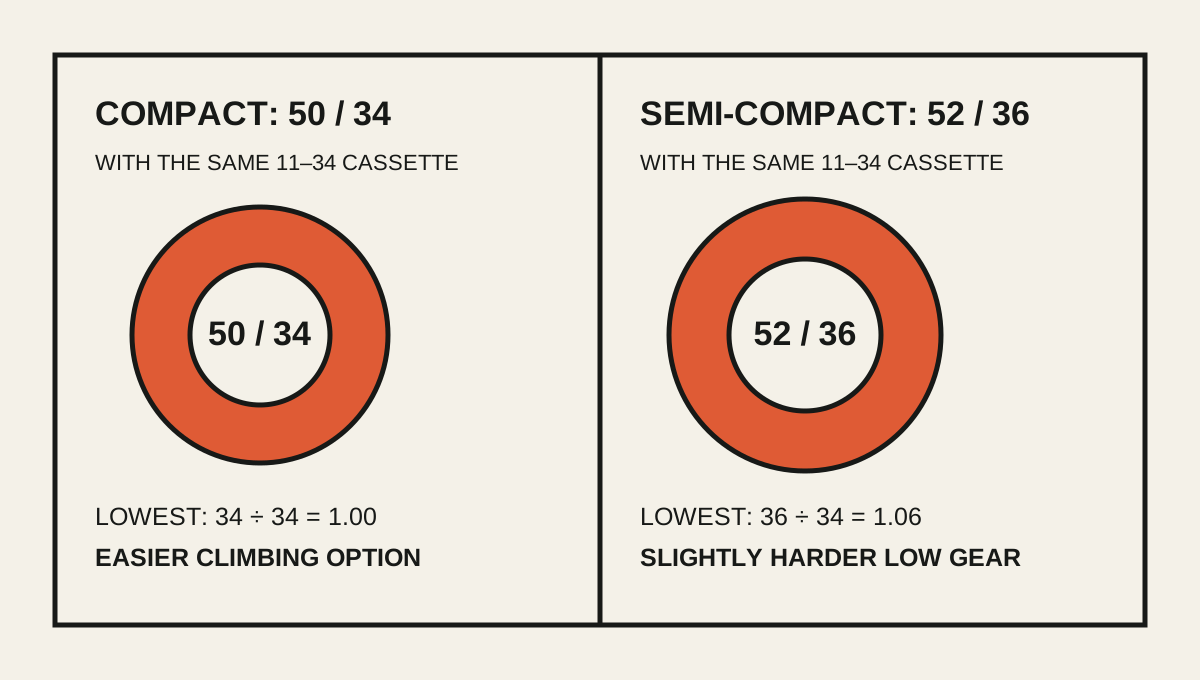
The short answer: choose from the complete gear range, not the chainrings alone. With the same 11–34 cassette, 50/34 gives a 1.00 lowest ratio while 52/36 gives 1.06, about 6% harder. The 52-tooth ring makes the highest ratio about 4% harder. If you do not spin out 50×11, the larger ring does not solve a real problem.
What 50/34 and 52/36 mean
The two numbers are the tooth counts of the front chainrings.
- 50/34, commonly called compact, has 50 teeth on the large ring and 34 on the small ring.
- 52/36, commonly called semi-compact or mid-compact, has 52 teeth on the large ring and 36 on the small ring.
One crank revolution pulls one chainring’s worth of chain. A larger front ring therefore travels farther for the same rear sprocket and wheel. That does not mean every pedal stroke must be harder: you can shift to a larger rear sprocket to select a similar ratio. The important differences appear at the ends of the available range and in where your everyday ratios sit on the cassette.
If the terms still feel abstract, start with how to use road-bike gears.
Compare the lowest gear first
Divide the front chainring teeth by the rear sprocket teeth. Lower is easier.
With an 11–34 cassette:
- 34 ÷ 34 = 1.00 for compact;
- 36 ÷ 34 = 1.06 for semi-compact.
The semi-compact lowest gear is therefore about 6% harder. That difference can matter on a long climb, a steep ramp, late in a ride, with luggage, or while deliberately keeping an easy effort. It will not transform an impossible climb into a flat road, but it is available every time you reach the largest sprocket.
Cassette choice can outweigh the two-tooth chainring difference. A 36-tooth small ring with a 34-tooth sprocket is easier than 34 with a 28-tooth sprocket. Compare the whole pair before judging a bike from “compact” or “semi-compact” in a product listing.
Our easy road-bike gearing guide explains the full range, while the bigger-cassette compatibility guide covers another route to a lower climbing gear.
Check whether you really need the higher gear
With the same 11-tooth smallest sprocket:
- 50 ÷ 11 = 4.55;
- 52 ÷ 11 = 4.73.
The 52-tooth option is about 4% higher. It is useful if you already spin 50×11 faster than your comfortable cadence on flat roads, in races, or while contributing to a genuinely fast group. Coasting on descents does not prove that your top gear is too small.
Look at your riding rather than the label. If several sprockets remain unused at the hard end, you have no top-gear shortage. If your usual flat-road ratio feels too hard, shift; a bigger chainring is not a fitness upgrade. Cadence, wind, tyres, position, gradient, and fatigue all affect how a gear feels.
Choose 50/34 when easier gears have more value
Compact is usually the safer choice when:
- your rides include sustained or steep climbing;
- you are new to drop-bar bikes or still building cycling-specific strength;
- you want to keep an easier effort on climbs rather than grind at low cadence;
- you carry bags, ride long events, or expect fatigue late in the day;
- you already have enough top gear for your fastest purposeful riding;
- you are choosing a first road bike and cannot test both systems on your own terrain.
Lower gearing is not “beginner gearing” in a dismissive sense. It is usable range. Strong riders also choose low gears for mountainous routes, recovery days, loaded riding, and pacing.
Choose 52/36 only for a problem it solves
Semi-compact is reasonable when:
- your terrain and riding are predominantly fast and flat;
- you regularly use the hardest ratios rather than merely owning them;
- 50×11 genuinely limits your target cadence at useful speeds;
- your cassette still supplies a low enough climbing ratio for your terrain and fatigue;
- you value how your common ratios line up on a particular cassette and understand the tradeoff.
Do not choose it because race bikes commonly have it or because a larger chainring looks more serious. Shimano, for example, sells its current 105 FC-R7100 crank in both 50/34 and 52/36 combinations; both are normal road configurations, not ability grades.
Test before buying parts
Use your current bike to collect evidence.
- Write down both chainrings and the cassette range. “Twelve speed” is not enough; count or read the actual teeth.
- Notice the limiting end. On your steepest normal climb, do you run out of easier sprockets? On your fastest purposeful flat riding, do you run out of harder sprockets?
- Separate gearing from technique. Shift before cadence collapses, as explained in shift before the hill.
- Compare ratios, not names. A free online gear calculator can turn each combination into development or speed at a chosen cadence, but the simple front ÷ rear ratio is enough for a first comparison.
- Test the target setup if possible. A borrowed or shop test ride on representative terrain is worth more than a debate about what strong riders use.
A chainring swap is not always a two-bolt decision
Before ordering, verify:
- the exact crank model, bolt pattern, mounting interface, and approved chainring pair;
- whether the inner and outer rings are designed to work together;
- front-derailleur capacity and installation position;
- chain length after the change;
- frame clearance and chainline;
- power-meter, crank-arm, chain, and drivetrain-speed compatibility;
- the manufacturer’s fasteners, tightening sequence, torque, and reuse rules.
Changing only one ring may produce poor shifting even when it physically bolts on. Some modern rings are shaped as matched pairs, and some cranks use proprietary mounting. Use the model code printed on the crank, not appearance or groupset nickname. The replacement-part identification guide gives a repeatable process.
If your actual problem is cross-chaining or confusion about the two front rings, replacing parts is premature. Read cross-chaining explained and practise shifting under light pedal pressure first.
Your next step
Record your full chainring and cassette combination, then inspect which extreme you actually use. If you reach the easiest gear on ordinary climbs, favour the lower option or investigate a compatible larger cassette. If 50×11 remains unused, keep the compact gearing and spend nothing.
Sources and further reading
- Shimano 105 FC-R7100 product specification: 50/34T and 52/36T combinations
- r/cycling discussion: beginner comparing 52/36 with 50/34 — used as an editorial question signal, not technical evidence.
- r/cycling discussion: choosing chainring size with an 11–34 cassette — used as a recurring demand signal, not technical evidence.