Can you fit a bigger cassette to your road bike? Check these six limits
A larger largest sprocket can make hills easier, but speed, freehub, derailleur range, total capacity, chain length, and frame clearance must all match.
 Field guide / can-you-fit-bigger-cassette-road-bike
Before you buy
Check the starter kit first
Print the one-page buying brief for helmet, lights, water, phone, and repair compatibility before comparing upgrades.
A bigger cassette can give a road bike an easier climbing gear, but matching the number of speeds is only the first check. The cassette must fit the freehub, the shifter and chain system, the rear derailleur’s maximum sprocket and total capacity, the required chain length, and the bike’s physical clearances.
The short answer: identify every component by model number and use the maker’s compatibility chart. A listing that says “11-speed” or an oversized pulley that claims extra capacity does not certify the system. If reliable specifications are missing, treat the change as unverified and ask a qualified drivetrain mechanic.
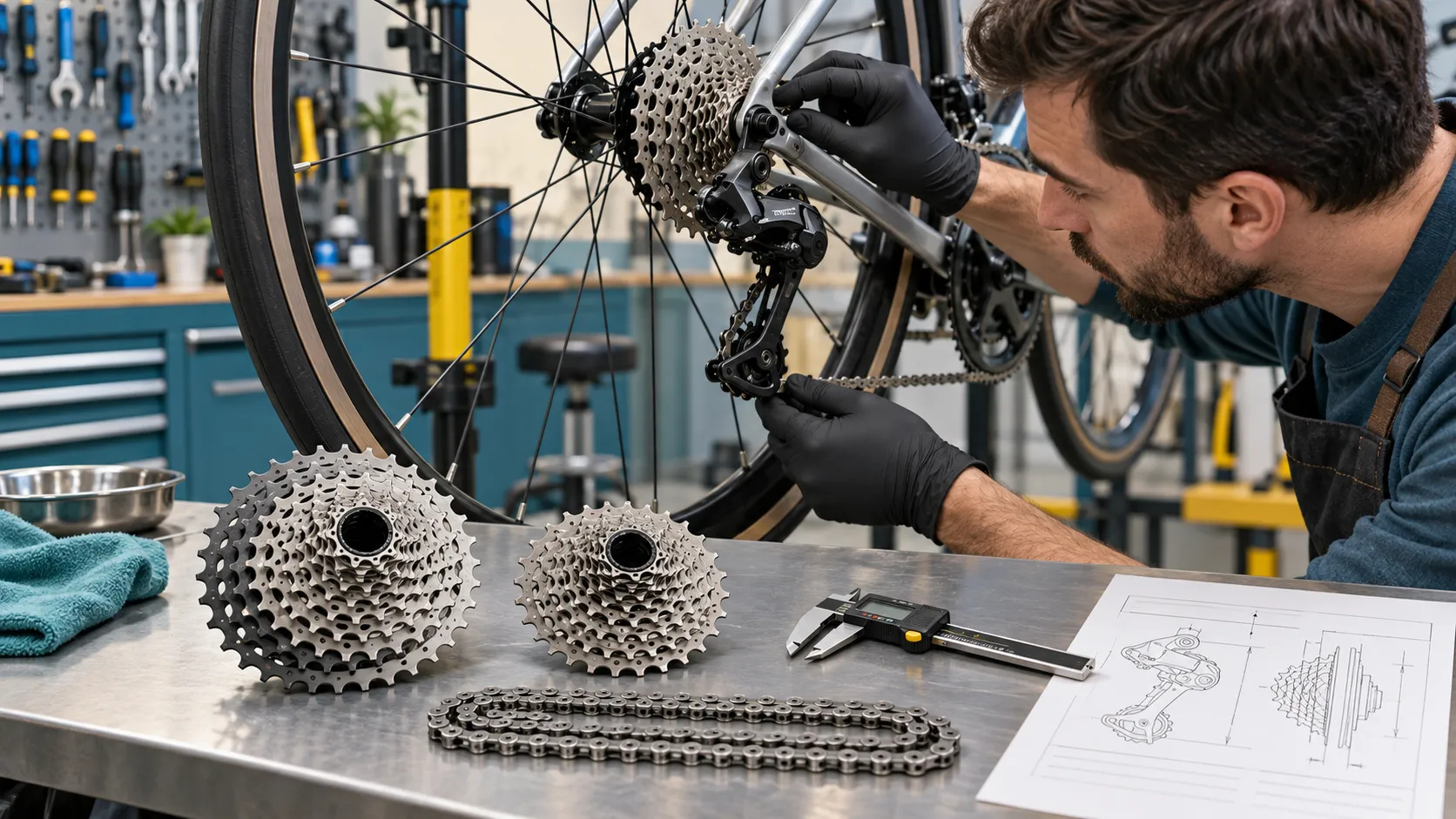
The current question behind this guide
A recent r/bikewrench post asked whether an 11–34 cassette could replace an 11–28 on a 53/39 road bike and whether oversized pulley wheels would make the combination work.
That is a useful demand signal because several different limits are often collapsed into “will the derailleur reach?” A pulley kit cannot automatically change shifter compatibility, freehub fit, total chain take-up, chain length, hanger geometry, or frame clearance. Marketing copy is not a substitute for a system chart.
First decide what improvement you need
Moving from an 11–28 to an 11–34 cassette makes the easiest gear substantially easier when the front chainring stays the same. The tradeoff is usually larger jumps between some rear gears. That can make it harder to hold an exact cadence on flat roads.
Before buying parts, confirm you are using the small chainring early enough and shifting smoothly under reduced pedal pressure. Read our easier-gearing guide to compare a cassette change with smaller chainrings or a different crankset.
The six compatibility limits
1. Number of speeds and shifting family
An 11-speed cassette needs an 11-speed system, but that label alone is not sufficient. Cog spacing, chain design, shifter cable pull or electronic programming, and derailleur geometry must belong to a documented compatible family.
Do not assume parts from two brands work together because both are marked 11-speed or 12-speed. Mixed systems sometimes work only in combinations explicitly approved by their makers.
2. Freehub body and cassette construction
The cassette must physically fit the wheel’s freehub body. Road wheels may use different Shimano/SRAM HG lengths, SRAM XDR, Campagnolo families, or other standards. Some cassettes need a spacer; others must not use one.
Identify the hub and current cassette rather than judging by appearance. The lockring tool and removal method also vary.
3. Maximum rear sprocket
Rear derailleurs are rated for a minimum and maximum cassette range. SRAM, for example, distinguishes some road AXS derailleurs with “MAX 33T,” “MAX 36T,” or XPLR ranges. Exceeding a stated maximum because somebody online made it shift on a workstand is not verified compatibility.
The B-adjust or chain-gap setting positions the upper pulley relative to the cassette within the designed range. It does not turn every short-range derailleur into a wide-range model.
4. Total capacity
On a common 2x drivetrain, the rear derailleur must take up chain released by both front and rear gearing changes. Manufacturers commonly express required capacity as:
(largest chainring − smallest chainring) + (largest sprocket − smallest sprocket)
For 53/39 chainrings with an 11–34 cassette, that worksheet gives (53 − 39) + (34 − 11) = 37 teeth. The rear derailleur must have documented capacity for the complete setup, not merely clearance beneath a 34-tooth sprocket.
Do not use the calculation to exceed a maker’s approved combinations. It is one check inside the compatibility process.
5. Chain length and chain specification
A larger sprocket commonly requires a longer chain. Size it with the method published for the exact drivetrain; do not add an arbitrary number of links. The chain must also match the cassette, chainrings, and connection method.
A chain that is too short can pull the derailleur violently tight in large/large. A chain that is too long can sag, shift poorly, or lose control in smaller combinations. If the current chain and cassette are worn together, putting an old chain on a new cassette can also cause skipping; see when a chain and cassette need replacement together.
6. Real bike clearance and adjustment
Even approved parts need correct installation. Check derailleur-to-sprocket clearance, hanger alignment, chainstay and spoke clearance, limit screws, indexing, and shifting under controlled load. Suspension movement is not relevant to a typical road bike, but frame and hanger variation still matter.
Test the complete usable range in a workstand and then on a safe, flat ride. Do not deliberately ride cross-chained combinations as a normal habit, but ensure an accidental shift cannot bind the drivetrain.
Why hanger extenders and oversized pulleys are not a free pass
A hanger extender moves the derailleur relative to the cassette and may help upper-pulley clearance in a specifically supported conversion. It can also change shifting geometry and does not create total capacity.
Oversized pulley cages and wheels may change cage geometry when supplied as a complete engineered system, but replacement pulley wheels alone do not prove extra cassette clearance or chain take-up. Demand a compatibility statement for the exact derailleur, cassette, chainrings, frame, and hanger. If it does not exist, you are experimenting—not performing a routine upgrade.
A shop-ready compatibility note
Bring these details to the mechanic:
- shifter make and exact model;
- rear derailleur model and cage version;
- crank and chainring sizes;
- current cassette model and range;
- proposed cassette model and range;
- chain model and current wear;
- rear hub or wheel model and freehub type; and
- bike model, year, and derailleur hanger.
That list produces a real compatibility answer. “It has Shimano 105” or “it is an 11-speed road bike” often does not.
If the change is part of a used-bike purchase, add its true parts and labour cost to the used-bike price check before calling the bike a bargain.
Your next step
Photograph every model code and write the current and proposed tooth counts. Check the manufacturer documents for all six limits. If one specification is absent or relies only on seller claims, pause the purchase and ask a qualified shop to confirm the whole system.