Can a hilly ride still be Zone 2?
Keep an easy cycling day useful on rolling or steep terrain with gearing, pacing, route choices, and a practical talk-test fallback.
 Field guide / zone-2-cycling-on-hills
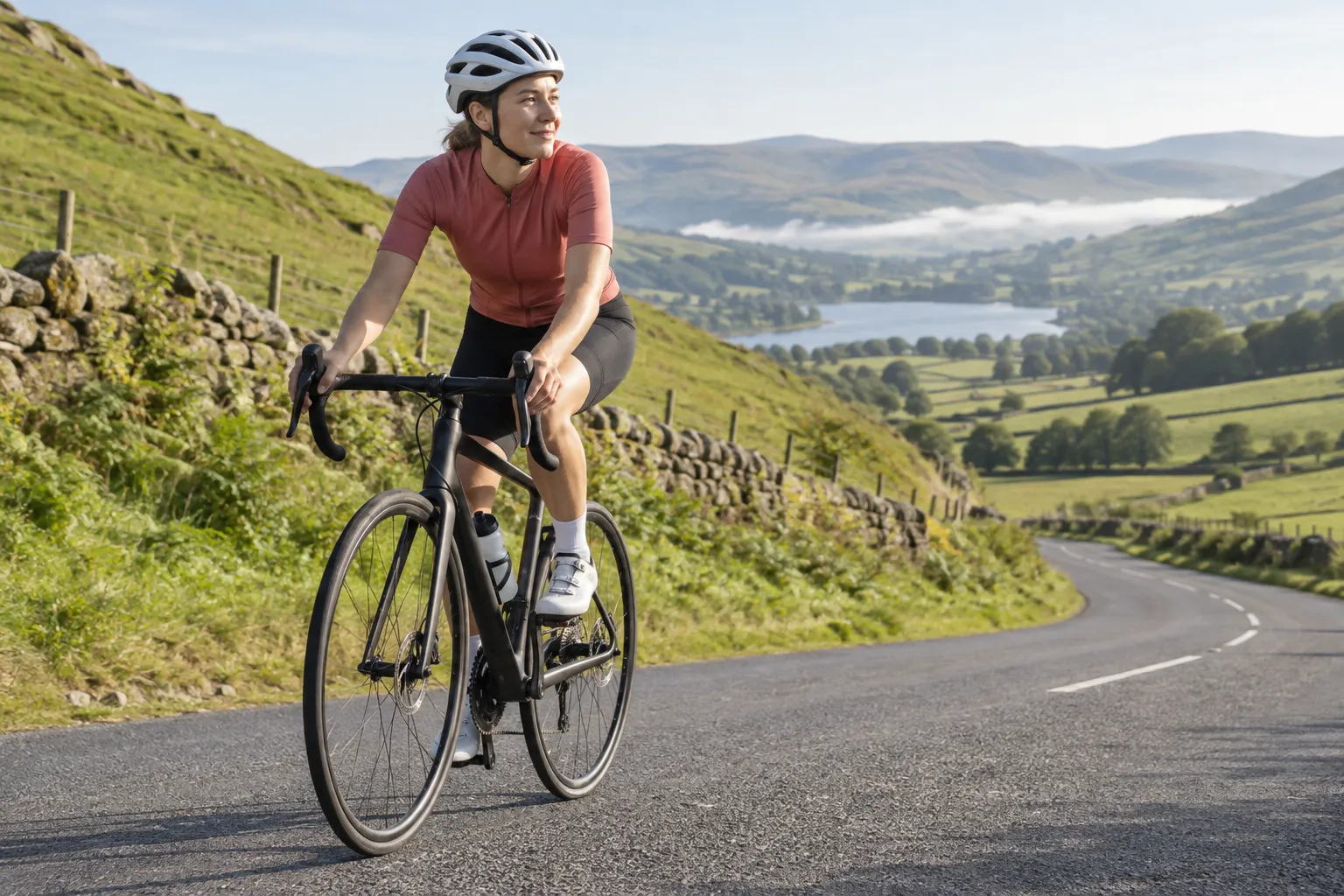
Yes. A hilly ride can still serve as an easy aerobic ride even if short climbs push you above your target. The goal is to keep the overall session controlled, make each climb as easy as the terrain allows, and avoid turning every rise into a test. A few brief excursions do not erase the rest of the ride.
The short answer: shift early, stay seated, let speed fall, and use breathing or the talk test alongside your normal training metric. If the hill is too steep for controlled pedalling in your easiest gear, accept a short harder section, walk, choose another route, or move the easy session indoors.
Define “easy” before the first hill
Zone labels depend on how they were set. Heart-rate zones derived from an age formula, power zones from an old test, and a watch’s default zones can disagree. Do not copy another rider’s beats-per-minute number from the internet.
For a beginner without laboratory testing, a practical easy-day cue is being able to speak in complete sentences without straining. In a study of trained cyclists, losing comfortable speech occurred at or near ventilatory threshold; other research has found useful relationships between structured talk tests and exercise intensity, while also showing individual variability. Use speech as a guardrail, not a precision instrument.
If you already train from a coach-set power or heart-rate range, keep using that plan. Expect heart rate to respond with a delay and to vary with heat, fatigue, stress, hydration, medication, and illness.
Climb with less force and less drama
As the gradient starts:
- Shift before cadence collapses. Move to the small front chainring and progressively larger rear sprockets while the chain is still under moderate load. See how to use road bike gears.
- Stay seated when practical. Standing often invites a surge. Sit back, keep hands and shoulders relaxed, and pedal smoothly.
- Let speed go. Easy effort on a hill can be walking pace. Speed is the outcome, not the target.
- Shorten the target. Concentrate on the next bend or landmark rather than the summit.
- Do not repay lost speed. Ease over the crest and settle before accelerating on the descent.
If cadence becomes uncomfortably low despite using the easiest gear, do not grind simply to protect a zone number. Ride at the lowest safe effort, stop for a moment, or walk the steepest section. Walking a steep hill is a cycling skill, not a failed workout.
Judge the session, not one data spike
A heart-rate graph may show a delayed rise after the gradient eases. Power may jump instantly with each ramp. GPS elevation can be noisy. None of those traces alone tells you whether the ride matched its purpose.
Review three things:
- Control: did you choose easy effort whenever the route allowed it?
- Duration: was most of the ride genuinely comfortable rather than repeatedly hard?
- After-effect: could you finish with steady form and recover as expected for an easy day?
Do not invent a universal rule such as “80% must be in Zone 2.” The right distribution depends on your plan, fitness, terrain, and how the zones were established. For a beginner, consistent restraint is more useful than arguing over a few minutes on the chart.
Four route strategies that work
Use the flattest approach as your main block
Warm up gently, ride the flatter part at controlled effort, and treat an unavoidable climb home as a short separate finish. Do not extend the hard section to make the file look impressive.
Repeat a gentle segment
A quiet flat or gradual loop can be better than a scenic route with repeated walls. Turn before traffic, surfaces, or gradients force erratic effort. Our first-route planning guide explains how to choose safe decision points.
Start elsewhere when practical
Walking or rolling the bike down a steep start, using safe transport, or meeting a ride on flatter ground may make the session easier to control. Do not create parking, security, or traffic risks simply to perfect a training trace.
Use an indoor session selectively
A trainer makes steady work simpler, but it is an option, not the only “real” easy ride. Outdoor skills, comfort, and enjoyment matter too. Choose indoors when weather, traffic, or terrain prevents the session you need.
Gearing may be the actual constraint
If every local climb forces very low cadence and high leg force, easier gearing may help. Compare your crankset, cassette, rear-derailleur capacity, and manufacturer compatibility before buying parts. A larger cassette is not automatically compatible, and drivetrain changes may require a longer chain or different derailleur.
Ask a shop for the easiest safe ratio available for your exact system. Bring the steepest local gradient and your current tooth counts, not just “I need a climbing upgrade.”
A simple hilly easy-ride plan
Try this without chasing a precise speed:
- 10–15 minutes very easy to warm up;
- 30–60 minutes at full-sentence conversational effort on the most controllable roads;
- on rises, shift early and cap effort rather than cadence or speed;
- after unavoidable harder minutes, ease off until breathing settles;
- 10 minutes easy to finish where the route allows.
Increase duration gradually. If every ride leaves you depleted, shorten the route or add recovery rather than forcing the plan to match an arbitrary distance.
Sources and further reading
- Editorial demand signal: current discussion about keeping Zone 2 on a hilly route
- Editorial demand signal: beginner discussion about Zone 2 outdoors on rolling terrain
- Primary research: Gillespie and colleagues — talk test and ventilatory threshold in trained cyclists
- Primary research: Foster and colleagues — talk test as a marker of exercise intensity
Reddit was used to identify the recurring training question. Individual comments were not treated as exercise-science evidence.
Your next step
Plan one route with a controlled middle section and an honest bailout option, then use the full-sentence test before and after each main climb.