Should you stop road cycling because it feels unsafe?
Make a calm, personal road-cycling decision by separating controllable exposure from residual risk and testing safer routes, times, skills, and ride formats.
 Field guide / should-you-stop-road-cycling-because-of-safety
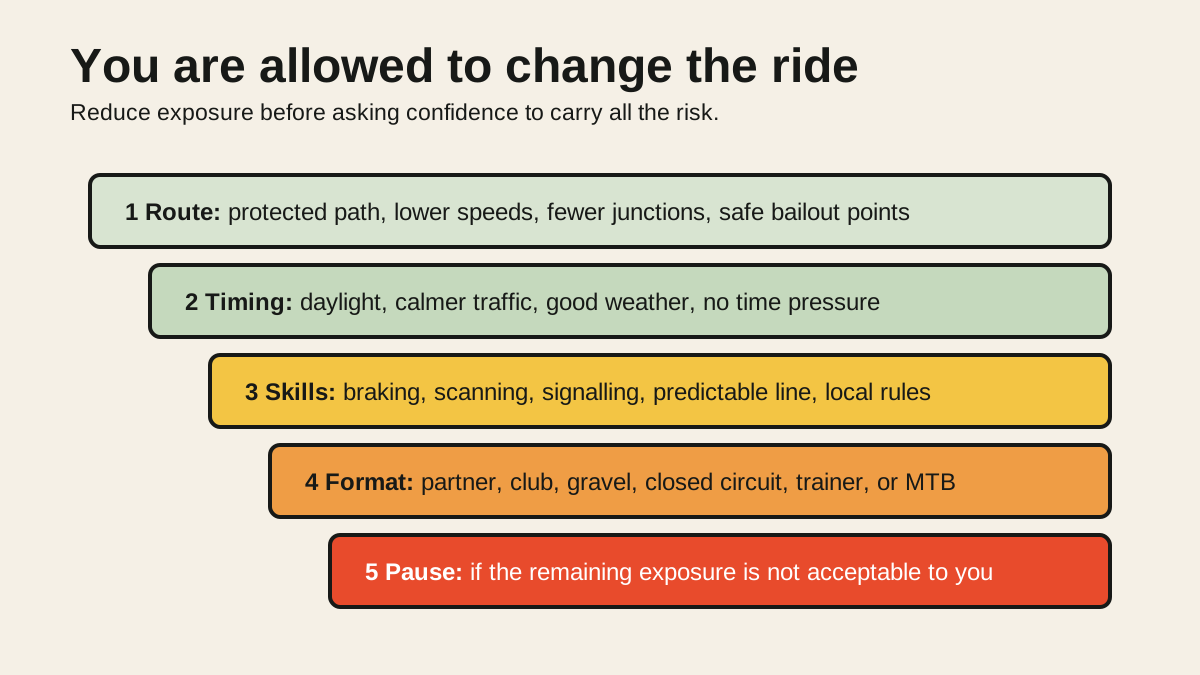
You do not have to quit cycling, and you do not have to keep riding roads that feel unacceptable. First reduce exposure through route, time, weather, skills, visibility, and ride format. Then decide whether the remaining risk is worth the benefit to you. Moving some or all rides to protected paths, gravel, closed circuits, mountain biking, or an indoor trainer is a valid cycling choice.
The short answer: do not ask confidence to solve a road-design or driver-behaviour problem. Build the safest realistic version of the ride, test it without pressure, and judge the residual risk. If it still exceeds your threshold, change the route or discipline—or pause road riding—without treating that as failure.
Why “is road cycling safe?” has no universal answer
A highly discussed r/cycling thread asked whether riders were considering giving up road cycling because of safety. The public replies show demand, but they cannot set another person’s threshold.
“Road cycling” can mean a protected urban lane at midday, a high-speed rural road without a shoulder, a club route with experienced leaders, or an unfamiliar descent at dusk. Traffic speed and volume, junction design, sight lines, road surface, lighting, weather, local driving culture, laws, and rider skill all change exposure.
Begin with the specific ride, not the identity label “road cyclist.”
Write down the incidents and conditions
Avoid deciding from one vague total such as “drivers are bad.” For the last several rides, record:
- route and segment;
- time and light level;
- weather and surface;
- traffic speed and volume;
- close pass, turning conflict, door zone, dog, debris, or harassment;
- whether the same location repeats;
- what escape space was available;
- whether fatigue or time pressure changed your choices.
This is not about blaming the rider. It identifies where a route change may remove repeated exposure. A dangerous junction that appears on every ride deserves a redesign or bypass, not another motivational speech.
After a collision or direct threat, prioritise people and evidence. The cyclist-driver collision guide covers immediate actions without assuming one legal system.
Change the route before buying more equipment
NHTSA advises choosing lower-traffic, lower-speed routes and notes that the safest route may be away from traffic in a bike lane or on a path. Use that as a planning principle even outside the United States, while following local rules.
Compare alternatives by:
- protected separation from moving traffic;
- vehicle speeds and traffic volume;
- number and complexity of crossings;
- door zones and loading activity;
- shoulder width and surface quality;
- sight distance at bends and crests;
- safe places to stop or leave the route;
- mobile coverage and access to help;
- whether the route remains legal for your bicycle type.
The shortest route is often not the best cycling route. A longer connection to a protected corridor can reduce stressful conflict points. Inspect unfamiliar routes with the safe route-planning guide before relying on an app’s bicycle icon.
Change the time and conditions
Run the same route at a calmer time, in daylight, and in stable weather before deciding whether every version feels the same.
Avoid stacking difficulty:
- darkness plus rain;
- a new route plus a hard workout;
- school or commuter peak plus poor visibility;
- strong crosswinds plus exposed high-speed roads;
- fatigue plus a technical descent;
- a deadline that encourages risky gaps.
There is no prize for proving you can tolerate the worst slot. If a route is only acceptable at one time, name that condition and have a backup.
Improve skills that change available options
Technique cannot control a driver, but it can improve detection, communication, and escape choices.
Practise away from traffic:
- firm, progressive braking without losing control;
- looking behind while holding a straight line;
- clear hand signals;
- starting quickly and choosing an easy gear before stops;
- scanning through junctions and driveways;
- avoiding sudden swerves around surface hazards;
- recognising door zones and blind spots.
NHTSA recommends practice in a safe environment and an on-bike class where available. Local instruction is especially valuable because lane position and road rules vary. The road positioning guide is a foundation, not a substitute for local law.
Use visibility equipment for the job it can do
Working lights, reflectors, and visible clothing can help other road users detect you. They cannot make an unsuitable road suitable or guarantee attention.
Check:
- whether local law requires lights or reflectors;
- that a front light illuminates the road without dazzling others;
- that a rear light remains visible from the relevant angles;
- that bags and clothing do not block reflectors;
- battery runtime for the whole ride plus delay;
- a backup for essential night lighting.
A rear radar can add information but does not create safe passing space. Read whether rear bike radar is worth it before treating a device as permission to use a route you otherwise reject.
Change the ride format
If solo road riding is the problem, test a properly run beginner group, a coached skills session, or a known partner. Ask about pace, regrouping, route risk, hand signals, and no-drop policy before joining.
If motor traffic itself is the problem, alternatives include:
- protected cycleways and traffic-free paths;
- gravel routes appropriate to your tyres and skill;
- closed road circuits or velodrome sessions;
- mountain-bike or mixed-surface riding;
- indoor training for structured work;
- driving or taking transit past the unsafe connection, where practical.
Each alternative has its own hazards. Gravel can bring loose surfaces and isolation; trails can involve falls and access rules; indoor riding needs ventilation and stable setup. The point is to choose the risk profile you accept, not to claim one discipline is harmless.
Use a personal go/no-go rule
Write a rule before the next ride. For example:
I ride this route only in daylight, in dry conditions, outside peak traffic, with both lights working. If the protected section is closed or crosswinds exceed my comfort, I use the path loop or trainer.
A rule reduces negotiation at the door and makes a pause factual rather than emotional. Revisit it after route changes, instruction, new infrastructure, or a significant incident.
Do not let sunk cost decide. Owning an expensive road bike does not require you to use it on roads you reject. It can be sold, adapted within its safe limits, or used indoors.
When pausing is the right answer
Pause if you are scanning so anxiously that you cannot control the bicycle, repeatedly choosing unsafe evasive moves, reliving a collision, or riding only to prove something to others. A gradual return after a crash may need a traffic-free first step; use the return-to-cycling guide.
Also pause when the environment leaves no acceptable route. Risk tolerance is personal, but infrastructure is real. Waiting for a safer time, advocacy result, route opening, or change in circumstances can be rational.
Your next step
Take your most common ride and mark its three highest-stress segments. Replace each with a lower-speed, protected, or traffic-free alternative if possible. Set one written go/no-go rule, then test the revised ride in daylight without a pace target. Decide from that version—not from pressure to fit a label.
Sources and further reading
- NHTSA: bicycle safety, route planning, visibility, and defensive riding
- NHTSA: learn to bike safely
- r/cycling reader context: reconsidering road cycling because of safety — used as a current demand signal; anecdotes were not treated as risk estimates.