What to do after a cyclist–driver collision: people first, evidence second
Use a calm post-collision order: get out of immediate danger, call appropriate medical help, record facts and witnesses, preserve equipment, and arrange follow-up.
 Field guide / what-to-do-after-cyclist-driver-collision
After a cyclist–driver collision, the first useful decision is not who was right. It is whether anyone needs urgent help and whether remaining in the road creates another collision. Medical care comes first; scene details and the bicycle come later.
The short answer: get yourself and others out of immediate danger if that can be done safely, call local emergency services when injury or risk warrants it, and do not ride away with possible head, neck, limb, or bicycle damage. Record the location, people, vehicles, witnesses, and scene without arguing about fault. Preserve the bike and equipment for a proper inspection.
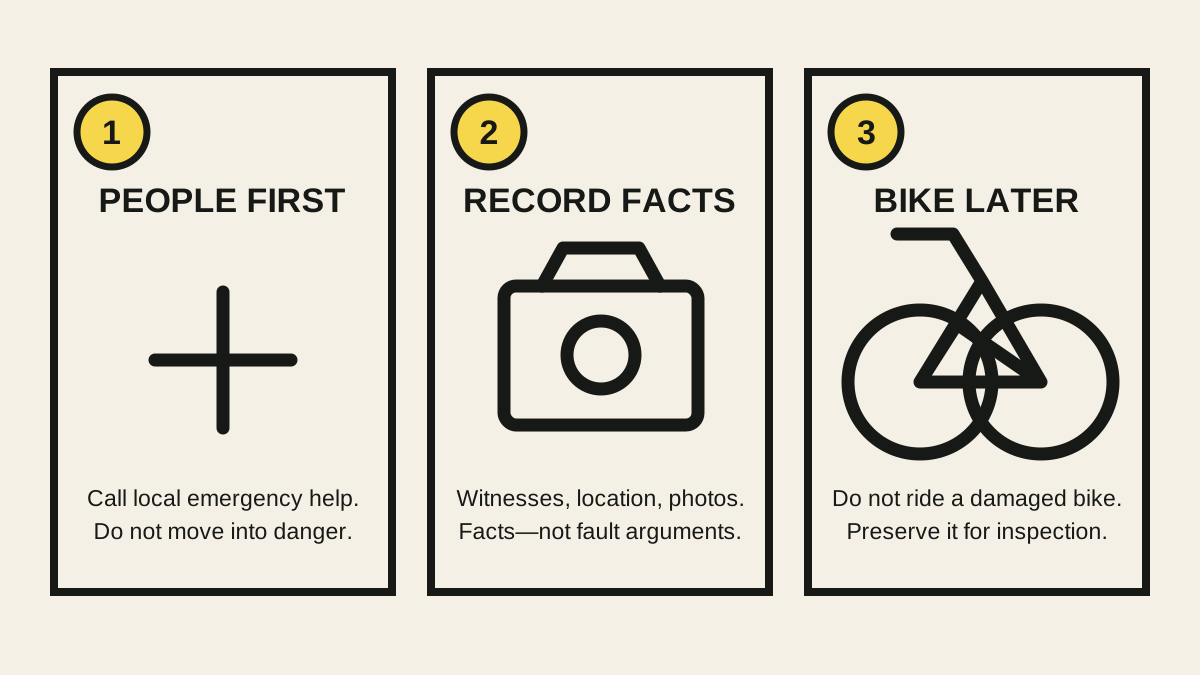
Why a plan matters before a crash
A current London cycling discussion about a serious cyclist–driver collision quickly became an argument about lights, helmets, vehicle classification, and liability. Those questions may eventually matter, but anonymous comments cannot establish the facts, medical outcome, or law that applies to one incident.
The transferable reader need is a sequence that still works while someone is shocked, hurt, or surrounded by traffic. Save this guide and add an emergency contact to your phone before you need either.
1. Stop the second incident
Look for moving traffic, fire, leaking fuel, damaged electrical equipment, broken glass, and unstable vehicles. If you can move yourself to a safe place, do so without stepping into another lane. Warn approaching traffic only if you can do that without becoming another casualty.
Do not move someone with a possible neck, back, pelvic, or serious limb injury merely to clear the road. Call emergency services and follow the call handler’s instructions. Move an injured person only when leaving them in place creates a more immediate danger that cannot be controlled.
Do not remove a helmet from an injured rider unless emergency instructions or an immediate airway need require it. Do not offer food, drink, or medication to a seriously injured person while waiting for professional help.
2. Treat a road-impact head injury seriously
You do not need a cracked helmet or loss of consciousness to justify medical advice. The NHS lists a high-speed head impact, including a road collision, among the reasons for emergency assessment and highlights signs such as inability to stay awake, seizure, weakness, balance or speech problems, and vision or hearing changes.
Call your local emergency number now for:
- unconsciousness, seizure, confusion, unusual behaviour, or increasing drowsiness;
- new weakness, numbness, poor balance, slurred speech, or vision trouble;
- breathing difficulty, chest pain, major bleeding, or a visibly deformed limb;
- severe or worsening head, neck, back, abdominal, or pelvic pain;
- a high-energy impact or any situation where you cannot judge the injury safely.
Adrenaline can hide pain. If you hit your head, feel dizzy or unwell, take anticoagulant medication, or cannot clearly remember the event, do not remount and “test” yourself. Arrange appropriate medical assessment and a safe journey away from the scene.
3. Call the appropriate authorities
Collision-reporting rules differ by country, state, and sometimes by injury or damage threshold. Use the local police or transport authority’s current guidance rather than a remembered forum rule.
When you call, give observable information:
- exact road, direction of travel, nearest junction, and a map pin if available;
- number of people and vehicles involved;
- immediate hazards and whether traffic is blocked;
- injuries and changes in alertness or breathing;
- whether the other vehicle remains at the scene.
Do not minimise an injury to avoid inconvenience. Equally, do not speculate about speed, motive, or legal blame on an emergency call. Facts help responders choose the right resources.
4. Record facts without turning the scene into a debate
If medical needs are under control and it is safe to do so, capture:
- the full scene from several positions;
- road layout, signs, signals, lane markings, sight lines, lighting, weather, and surface;
- final positions of the bicycle, vehicle, and debris before anything is moved;
- damage to the bicycle, vehicle, helmet, clothing, phone, and carried equipment;
- the vehicle registration, make, model, colour, and driver details required locally;
- the time and exact location.
Ask witnesses for their names and a reliable contact method. A witness who leaves with “the driver seemed wrong” is less useful than one whose details allow an investigator to obtain a factual account.
Use neutral wording. “The vehicle turned across the cycle lane while I travelled straight” records an observation. “The driver is obviously guilty” is a conclusion. Do not sign, post, or agree to an account you do not understand while shocked or medicated.
5. Preserve electronic and physical evidence
If you use a camera, bike computer, phone navigation, or fitness recording, prevent the relevant file from being overwritten. Export or back it up in its original format and keep an untouched copy. Note that a device clock, GPS line, estimated speed, or automatic pause can be imperfect; preserve the data rather than interpreting it at the roadside.
Keep damaged items together:
- bicycle and detached parts;
- helmet, even when damage looks minor;
- torn or bloodied clothing and bags;
- lights, mounts, reflectors, and batteries;
- receipts for transport, medical costs, and damaged property.
Photograph the equipment, then avoid washing, straightening, adjusting, charging, or repairing it until the relevant insurer, authority, lawyer, or mechanic has said what inspection is needed. Do not let a well-meaning friend “make the wheel rideable.”
6. Do not ride the bicycle home
A bicycle can appear straight while its fork, steerer, handlebar, frame, wheel, brake, crank, or helmet has been compromised. Arrange collection, a taxi that accepts the bike, public transport where permitted, or secure storage.
Later, give a qualified mechanic the impact direction and symptoms. The post-crash bicycle inspection guide explains why cleaning or test riding can erase useful evidence. Replace a helmet according to its maker’s crash policy; do not judge it only by the shell.
7. Make a same-day record
As soon as you are medically able, write a factual timeline in your own words. Include what you saw before impact, the sequence, road and signal state, conversations, responders, witnesses, injuries, and where the bicycle went. Mark anything uncertain as uncertain.
Then:
- Follow the reporting rules for the place of collision.
- Notify the relevant insurer or membership service within its stated time limit.
- Seek a qualified local lawyer when injury, liability, lost work, or major damage makes legal advice appropriate.
- Follow clinical discharge instructions and monitor for delayed symptoms.
- Avoid public speculation while facts are being established.
Do not copy legal advice from another jurisdiction. Helmet, light, reflectors, e-bike classification, reporting, insurance, and compensation rules can all differ.
Prepare a small collision card now
Put a note in your phone or wallet containing:
- emergency contact and relevant medical information;
- local emergency and non-emergency numbers;
- insurer or cycling-membership claim contact;
- bicycle serial number and current photographs;
- a reminder: people → emergency help → witnesses → scene → equipment.
That card is more useful than trying to remember a long article under stress. Pair it with the five-minute pre-ride bicycle check and road-positioning safety guide to reduce avoidable risk without pretending every collision is preventable.
Sources and further reading
- NHS: head injury and concussion—when to seek urgent or emergency help
- NHTSA: bicycle fit, visibility, route planning, and predictable road behaviour
- r/londoncycling reader context: questions after a serious cyclist–driver collision — used as a current preparedness signal; the account and replies were not treated as verified medical or legal findings.