How to make indoor trainer rides less boring
Make indoor cycling time pass faster by matching entertainment to workout intensity, using short blocks, fixing cooling, and removing setup friction.
 Field guide / how-to-make-indoor-trainer-rides-less-boring
An hour indoors can feel longer than an hour outside because the trainer removes scenery, navigation, coasting, corners, and the small decisions that normally divide a ride. The solution is not necessarily a new app. Give the session more structure, reduce physical discomfort, and choose entertainment that matches how much attention the workout needs.
The short answer: start with 30–45 minutes, split it into visible blocks, and decide the purpose before getting on. Watch something engaging during easy riding, use audio or familiar video for steady work, and keep hard intervals visually simple. A strong fan and a setup that is ready in minutes often help more than another subscription.
Why the trainer changes your sense of time
A current r/cycling discussion about an hour indoors feeling much longer than an outdoor ride drew nearly 200 comments. That volume is a useful demand signal, not evidence that one entertainment choice works for everyone.
Outside, attention moves constantly between the road, traffic, surface, route, weather, effort, and other riders. Indoors, effort is continuous while the surroundings barely change. Poor cooling adds to the strain: the same power can feel harder when heat and sweat accumulate.
Treat boredom as a design problem with three parts:
- the session has no visible progress markers;
- the stimulus is wrong for the effort;
- getting hot, thirsty, or uncomfortable makes every minute louder.
Choose the ride before the entertainment
Pick one purpose. “Ride indoors for an hour” is vague; “complete three 8-minute steady blocks” gives the mind a finish line.
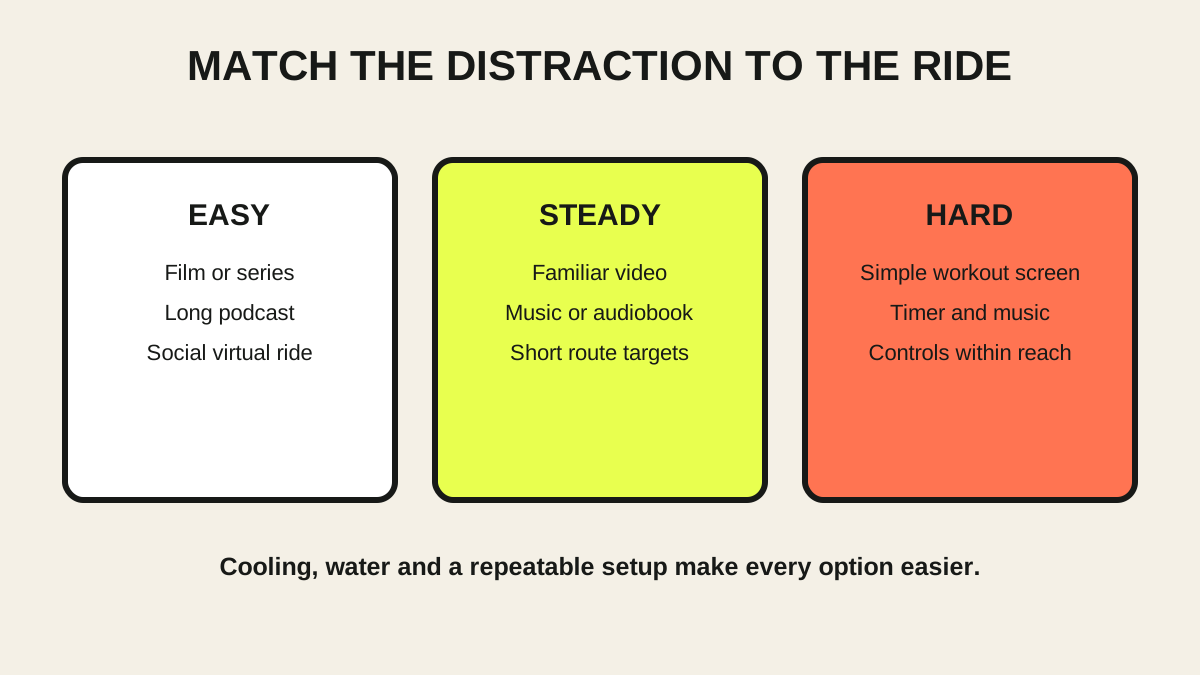
Easy endurance ride
This is the best place for a film, series, long interview, audiobook, or social virtual ride. Keep the effort easy enough that missing a visual cue does not change the session. If subtitles make you crane your neck or stare down, change the screen height or use audio.
Steady tempo or progressive ride
Use something familiar enough that you can look away. A concert, race replay, playlist, or audiobook works better than a complex drama. Divide the ride into 5–10 minute steps and change cadence, resistance, or hand position at each marker without turning it into an all-out session.
Hard intervals
Use a simple workout display, timer, and music. A complicated film or game competes with breathing, cadence, and technique. Put all controls within reach before starting; do not type, scroll, or handle a controller during a hard effort.
The guide to adding your first cycling intervals explains why every indoor ride should not become a maximal one.
Make one hour into five smaller jobs
Try this low-complexity 45-minute session:
- Ride easily for 8 minutes while checking fan position and bike comfort.
- Complete 8 minutes at a steady conversational effort.
- Ride easily for 3 minutes and change hand position.
- Repeat the 8-minute steady block twice, with 3 easy minutes between them.
- Finish with 4 easy minutes.
The exact numbers are not magic. The point is that you are never staring at “45 minutes remaining.” You are completing the current block. If 30 minutes is the duration you can repeat, that still counts; short rides can improve fitness when they are done consistently.
Fix cooling before buying software
Set the fan so airflow reaches your torso and face, then start it before you are soaked. More than one fan may be useful for a long or hard session, but begin with the indoor cycling fan setup guide so the airflow helps the rider without blowing sweat deeper into the bike.
Also place these items before mounting:
- water you can reach without twisting;
- a small towel away from the drivetrain;
- phone or remote on a stable stand;
- the chosen workout and entertainment already loaded;
- a second dry top for after the session, not draped near the wheel.
If saddle, hand, or neck discomfort appears much faster indoors, the fixed position may be exposing a fit or movement issue. Use the indoor trainer comfort checklist rather than trying to distract yourself through pain.
Remove the setup tax
A trainer session feels harder to start when every ride requires moving furniture, finding an axle adapter, pairing sensors, logging into three services, and choosing from hundreds of workouts.
Create a default session that works offline:
- one 30–45 minute easy workout;
- one playlist or downloaded episode;
- fan, mat, towel, and water bottle stored together;
- the correct axle, skewer, or cassette left with the trainer;
- one charging routine for sensors and controls.
You can use many smart trainers without a paid subscription. Start with the tools you already own, then pay only if a platform genuinely makes you ride more consistently.
Use variety deliberately
Rotate the type of attention, not just the app logo:
| When the session drags | Change one thing next time |
|---|---|
| You keep checking elapsed time | Use 5–10 minute blocks with a written sequence |
| Video feels mentally busy | Switch to music, a podcast, or an audiobook |
| Easy riding feels pointless | Give it a duration, effort ceiling, and recovery purpose |
| Hard intervals feel chaotic | Use only a timer, power/resistance cue, and music |
| Every ride feels physically miserable | Improve cooling and investigate fit before adding entertainment |
| You skip because setup is slow | Build one ready-to-go default session |
Standing briefly or changing hand position can reduce monotony, but only when the trainer is designed and installed for that movement. Do not force side-to-side rocking on an unstable setup.
Know when indoors is the wrong tool
You do not have to make every winter ride an indoor ride. A short walk, strength session, outdoor ride in suitable conditions, or complete rest day may better serve the week. The trainer is useful because it is controlled and convenient, not because suffering through boredom earns extra credit.
If you are repeatedly dreading all training, sleeping poorly, failing normal workouts, or feeling unusually fatigued, do not solve that with a louder screen. The failed-workout recovery guide helps separate one bad day from a load problem.
Your next step
Prepare one 35-minute ride now: 8 minutes easy, two 8-minute steady blocks with 3 easy minutes between, then 8 minutes easy. Put the fan and water in place, choose one piece of audio or video before mounting, and finish while the setup still feels repeatable.