Failed two cycling workouts: recover or change the training plan?
Use two failed key sessions as a recovery signal by checking sleep, fuel, illness, life stress, training load, and plan difficulty before adding more work.
 Field guide / failed-cycling-workouts-recovery-or-training-plan
One bad workout is normal. Two failed key sessions close together are useful data: your current demand exceeded what you could deliver under the current conditions. The productive response is usually to reduce pressure and identify why—not to add a punishment session.
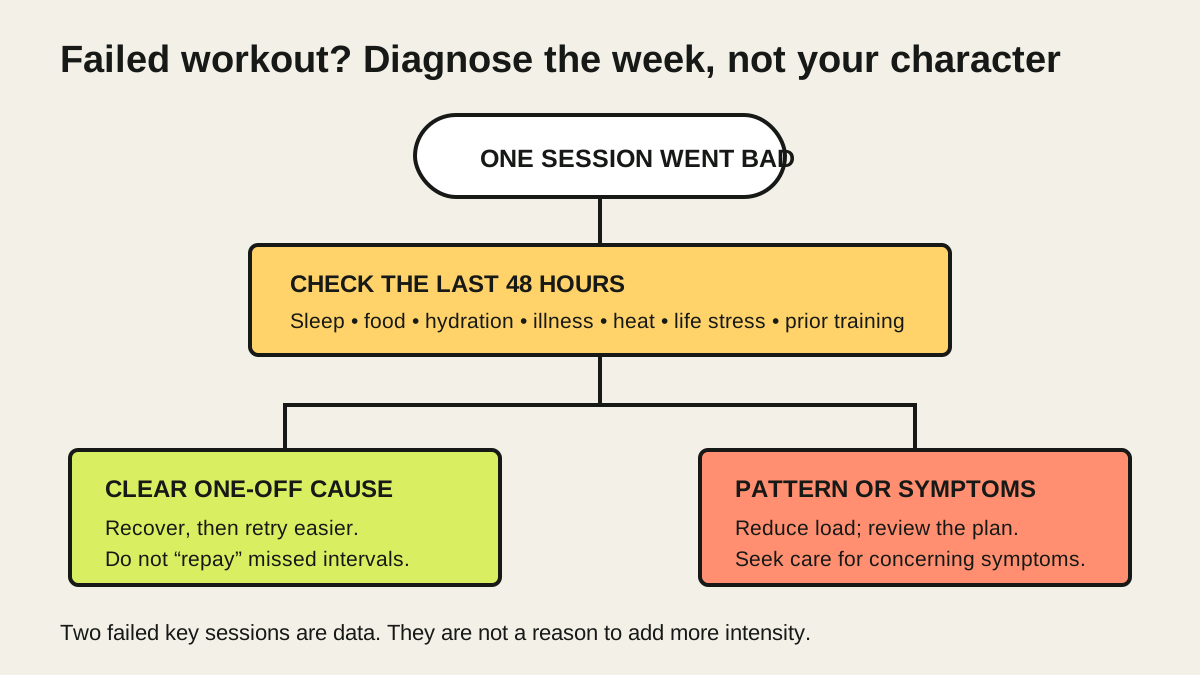
The short answer: take the next hard session off the calendar. Review the previous 48 hours, recent training, sleep, food, hydration, illness, heat, and life stress. Resume with easy riding or rest, then retry at a lower demand. Change the plan if the pattern repeats after recovery; seek medical advice when fatigue is persistent, unexplained, or accompanied by concerning symptoms.
First define what “failed” means
A workout is not failed merely because it felt hard, your power varied, or you shortened one interval. A genuine miss might mean you could not complete the planned work despite an honest attempt, your output fell sharply at normal effort, or familiar targets felt unexpectedly unsustainable.
Record what happened without drama:
- planned duration and intensity;
- completed duration and intensity;
- perceived effort compared with normal;
- heart rate or power compared with your usual response, if available;
- any pain, illness symptoms, dizziness, or unusual breathlessness;
- temperature, indoor cooling, altitude, and route conditions;
- food, fluid, caffeine, and sleep beforehand.
Do not immediately lower or raise your FTP from one session. A stale training setting can be the problem, but so can an unusually hot room, a poorly calibrated trainer, depleted carbohydrate, accumulated fatigue, or a bad night.
Check the last 48 hours before the last 12 weeks
The nearest explanation is often the most useful.
Sleep
Was sleep shorter or more interrupted than normal? One disrupted night can change how a hard session feels. Several poor nights may justify replacing intensity with rest or an easy spin.
Food and hydration
Did you begin the session hungry, underfuelled from the previous day, or dehydrated? High-intensity work depends on carbohydrate availability. This does not mean every miss is a nutrition failure or that one precise grams-per-hour target fits everyone; it means you should compare the session with your normal successful preparation.
Illness and symptoms
Do you have a sore throat, feverish feeling, stomach symptoms, unusual resting heart rate, or new respiratory problem? Training through illness to protect a calendar is a poor trade. Rest and use medical advice when symptoms are concerning or persistent.
Environment and equipment
Indoor heat and poor airflow can turn a familiar workout into a different physiological demand. Confirm fan placement, room temperature, trainer calibration, tyre pressure for a wheel-on trainer, drivetrain condition, and whether the device actually held the requested resistance.
Life load
Work deadlines, travel, caregiving, emotional stress, and reduced recovery time all count even though they do not appear as training stress. Recovery research treats training and non-training demands as part of the same balance.
Do not repay missed work
Avoid stacking the unfinished intervals onto tomorrow’s ride. You have not created a debt. You have discovered that the planned load did not fit that day.
A conservative response after two misses is:
- End the second session when technique deteriorates or the target is clearly unavailable.
- Take a rest day or short easy ride, depending on symptoms and overall fatigue.
- Eat normally, rehydrate, and prioritise sleep.
- Remove the next high-intensity session rather than moving every workout closer together.
- Resume with an easy endurance ride.
- Retry the key workout with fewer repetitions, shorter intervals, or a modestly lower target.
The exact reduction depends on the plan, athlete, and cause. The principle is stable: restore successful training before restoring maximum training.
When to adjust the plan
Change the plan when the original structure repeatedly asks for work you cannot absorb, even after normal recovery. Look for patterns across two to four weeks rather than a single number.
Common plan problems include:
- too many hard days close together;
- every endurance ride drifting into moderate intensity;
- volume and intensity increasing at the same time;
- no easier week after a sustained build;
- targets based on an old or inflated test;
- strength training, racing, and group rides not counted as hard work;
- a generic plan that ignores available time and recovery;
- trying to maintain peak-season load through winter or a stressful life period.
Our beginner training-plan guide shows how to anchor a week around repeatable sessions. If the issue is accumulated fatigue, use the cycling recovery-week guide rather than improvising random rest days indefinitely.
Recovery is not the same as overtraining syndrome
Cyclists often call any tired week “overtraining.” The joint consensus statement from the European College of Sport Science and American College of Sports Medicine distinguishes short-term performance reduction after overload from more prolonged maladaptation. It also stresses that overtraining syndrome is difficult to diagnose and requires excluding illness, infection, insufficient energy or nutrients, and other causes.
That means you should not diagnose yourself from two intervals. It also means persistent decline deserves more attention than motivational slogans. Track duration, symptoms, mood, sleep, appetite, and whether performance improves after recovery. A coach can help with training design; a clinician is the appropriate person for medical causes.
Should you test FTP again?
Retest only after obvious short-term problems have cleared. A test performed while under-recovered may simply measure the fatigue you already knew was present.
Consider a new baseline when:
- several different workouts miss in a similar way;
- your current setting came from an old test or optimistic estimate;
- equipment or testing protocol changed;
- easy and threshold sessions both feel mismatched;
- you have completed recovery and returned to stable riding.
You can also reduce workout targets temporarily without declaring a permanent new FTP. Consistent completion at a slightly easier setting is more useful than repeatedly failing a number chosen for pride.
A simple seven-day reset
This is not a prescription, but it is a practical template for an otherwise healthy rider whose issue appears to be ordinary accumulated fatigue:
- Day 1: rest.
- Day 2: 30–60 minutes easy, or rest if still flat.
- Day 3: easy endurance only.
- Day 4: rest or normal light strength work—not a make-up interval set.
- Day 5: short endurance ride with a few brief, controlled efforts if you feel normal.
- Day 6: easy or rest.
- Day 7: retry a reduced key session.
If easy riding still feels abnormally difficult, symptoms are developing, or recovery is not progressing, stop using a template and seek individual advice.
Your next step
Cancel the urge to compensate. Write down the two missed sessions and the 48 hours before each. Choose the most plausible recoverable factor, remove the next hard workout, and return through easy riding. If the same pattern survives recovery, simplify the plan or use a coach; if fatigue or symptoms are persistent or unexplained, use a clinician.
Sources and further reading
- ECSS and ACSM joint consensus statement: prevention, diagnosis, and treatment of overtraining syndrome
- Recovery and performance in sport: consensus statement
- r/cycling discussion: repeated failed workouts prompting questions about winter structure and recovery — used as an editorial question signal, not an individual training prescription.