How to handle road rage while cycling without escalating it
Use a cyclist-specific exit plan for aggressive drivers: create space, reach people and light, call emergency help when danger is immediate, and preserve evidence safely.
 Field guide / how-to-handle-road-rage-while-cycling
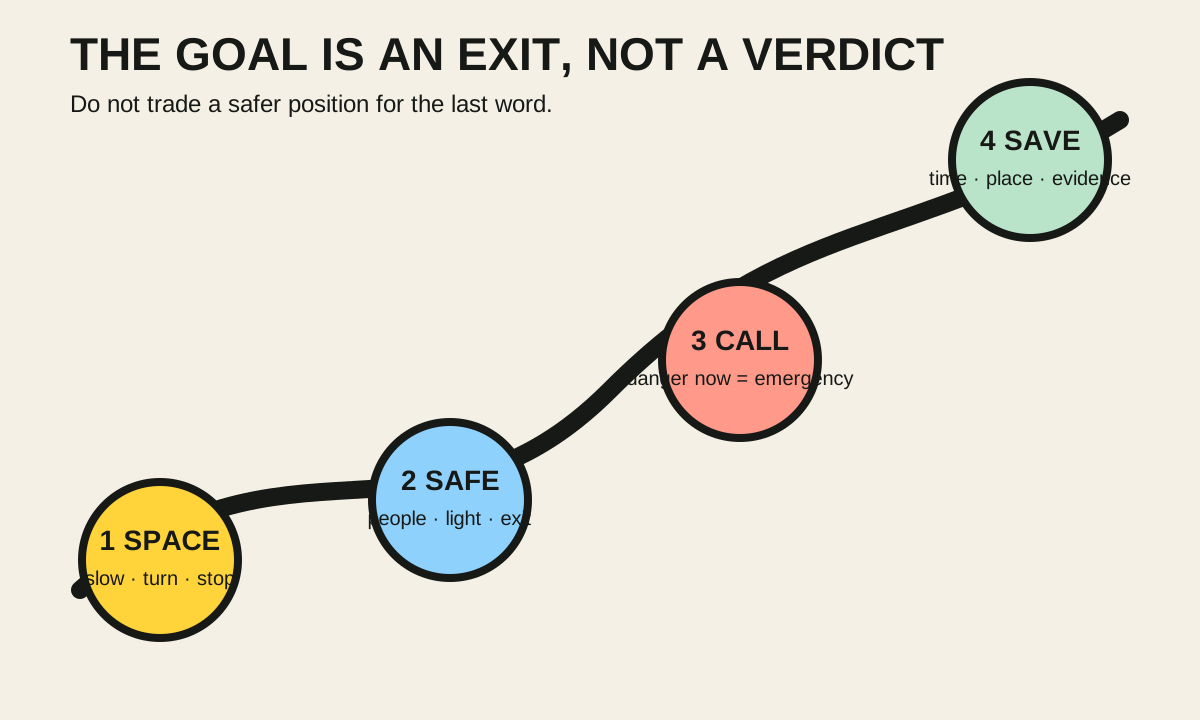
The safest goal during road rage is not to prove who was right. It is to create distance, reach a place with people and an exit, call emergency help when the threat is immediate, and preserve useful information only after you are safe.
The short answer: do not stop beside an angry person to argue. Slow enough to make a controlled choice, turn away when safe, and move toward an open business, staffed public place, police station, or other visible refuge. If you are followed, do not lead the person home. Call the local emergency number and follow the operator’s instructions.
Recognise when a traffic conflict has become a threat
A current public discussion followed a serious reported road-rage assault on a cyclist in Brussels. Reddit supplied the demand signal, not a verified account or a universal risk estimate. The practical question is what a rider can do when impatience becomes pursuit, intimidation, or violence.
Treat these as escalation signs:
- a driver repeatedly follows after either party could have left;
- a vehicle blocks your path, swerves at you, or reverses toward you;
- someone gets out and moves toward you aggressively;
- threats become specific or a weapon is shown;
- the person tries to grab you, the bicycle, or your phone;
- a second vehicle or person joins the pursuit.
Do not wait for certainty before choosing distance. A rude remark is unpleasant; a person changing direction to keep contact is a different problem.
First, keep control of the bicycle
An angry gesture can pull your attention away from the road at exactly the wrong moment. Keep both hands available for braking and steering. Look through the escape path, not at the person’s face or number plate for several seconds.
Avoid:
- riding one-handed to film while close to moving traffic;
- striking or holding a vehicle;
- sprinting blindly through a red light or across live lanes;
- stopping in a pinch point, dead end, or isolated driveway;
- making a U-turn without checking behind;
- matching speed beside the driver’s window to continue the argument.
If a safe side street, protected path, open forecourt, or populated place is available, use it. If not, slow and create as much physical separation as the road allows without entering a new hazard.
Use a simple exit sequence
1. Break the conversation
Do not debate intent, law, camera footage, or blame at the roadside. A neutral phrase such as “I am leaving” is enough if speaking is necessary. Silence is also a valid choice.
Police guidance collected by Ask the Police advises road users not to become involved when someone behaves badly and to pull over and calm down when safe. For a cyclist, “pull over” must mean a location that cannot be used to trap you. Sometimes continuing to a staffed place is safer than stopping immediately.
2. Move toward people, light, and options
Choose a place with more than one exit and witnesses: an open shop, petrol station, transit hub, staffed venue, busy café, or police facility. Stay outside a locked gate or narrow alley that removes your route away.
If you are being followed, do not go home, to your parked car, or to a family member’s address. West Yorkshire Police advises drivers who feel at risk to go to a place where other people are present; the same destination principle is useful on a bicycle.
3. Call when danger is current
Call the local emergency number when the threat is happening now, someone is injured, violence has occurred, a weapon is involved, or you fear immediate harm. Give the operator the location first, then direction of travel, vehicle description, number of people, injuries, and what is happening now.
Use hands-free calling only if it does not interfere with riding. If operating the phone would reduce control, reach a safe stopping point first. Follow local emergency instructions rather than trying to coordinate your own interception.
4. Preserve evidence after safety
Write or record a voice note as soon as practical:
- time and exact location;
- direction of travel;
- vehicle make, colour, type, and registration if genuinely observed;
- description of conduct, not conclusions about motive;
- independent witness contact details;
- nearby businesses, buses, or homes that may have cameras;
- injury and bicycle damage photographs;
- original camera files and the device clock setting.
Do not publish an accusation or identifying material while the facts are unresolved. Provide original evidence through the relevant police or reporting channel. Keep a copy and note any reference number.
If the vehicle blocks your path
Stop far enough away to keep turning room. Do not squeeze between a person and the vehicle or approach a door that may open. Look for a pavement or path you may legally and safely walk the bike along, a turn back, or a populated place you can reach without crossing moving traffic.
If you cannot leave safely, put a solid object between you and the person where possible, call emergency services, and attract specific help: “You in the blue jacket, please call the police.” Do not rely on the bicycle as a weapon or try to protect property at the expense of your body.
If you have a cycling camera
A camera can support a later report, but it is not a shield. Configure it before the ride, use a secure mount, set the date and time, and learn how to protect a file from automatic overwrite. Do not announce the camera to provoke a reaction or chase a vehicle for a better plate image.
After an incident:
- stop recording only when safe;
- save the original file without editing;
- export a working copy for viewing;
- photograph visible damage and the wider scene;
- use the reporting authority’s upload process;
- avoid compressing or posting the only copy to social media.
Our cycling camera guide covers mounting, retention, and evidence limitations in more detail.
Report the right problem
Different places use different emergency, non-emergency, road-safety, and dangerous-driving portals. Report what happened in observable terms: close pass, deliberate block, threat, collision, assault, damage, or continued pursuit. “Road rage” is a useful description but may not be a specific legal offence.
If a collision occurred, use the cyclist-driver collision checklist. If it was a dangerous near miss without confrontation, the near-miss guide helps separate immediate safety, evidence, and route changes.
Recover before resuming the ride
Adrenaline can narrow attention and make braking, navigation, and judgement worse. Once safe, sit or stand away from traffic, check yourself and the bicycle, contact someone you trust, and decide whether continuing is sensible. Do not ride a damaged bike or dismiss a head impact, loss of consciousness, new confusion, severe pain, weakness, or breathing difficulty.
Being shaken after a threat is a normal reason to arrange a lift, public transport, or a later pickup. The incident does not need to meet somebody else’s definition of “serious” before you stop riding.
Your next step
Save the local emergency and non-emergency numbers, identify two staffed safe places on your regular route, and set one rule now: if someone follows after you change direction, you do not go home. You go to people and call for help.
Sources and further reading
- Ask the Police: what police can do after a road-rage incident
- West Yorkshire Police: personal safety while travelling
- Reddit demand signal: public discussion following a reported cyclist road-rage assault — used to identify the question, not as a source for legal or safety claims.