How to fit cycling around work and family
Build a sustainable cycling routine with a minimum week, protected ride windows, short-route options, clear family agreements, and no make-up mileage.
 Field guide / fit-cycling-around-work-and-family
Cycling fits a busy life when the smallest useful version of the week is easy to repeat. Start with one protected ride, add one flexible short ride, and treat a longer weekend ride as an agreed option—not as a weekly entitlement that everyone else must absorb.
The short answer: schedule a minimum week you can complete during work deadlines, bad weather, and family disruption. Prepare short routes and equipment in advance, agree longer ride windows explicitly, and never “repay” a missed ride by stealing time from recovery or the next family commitment.
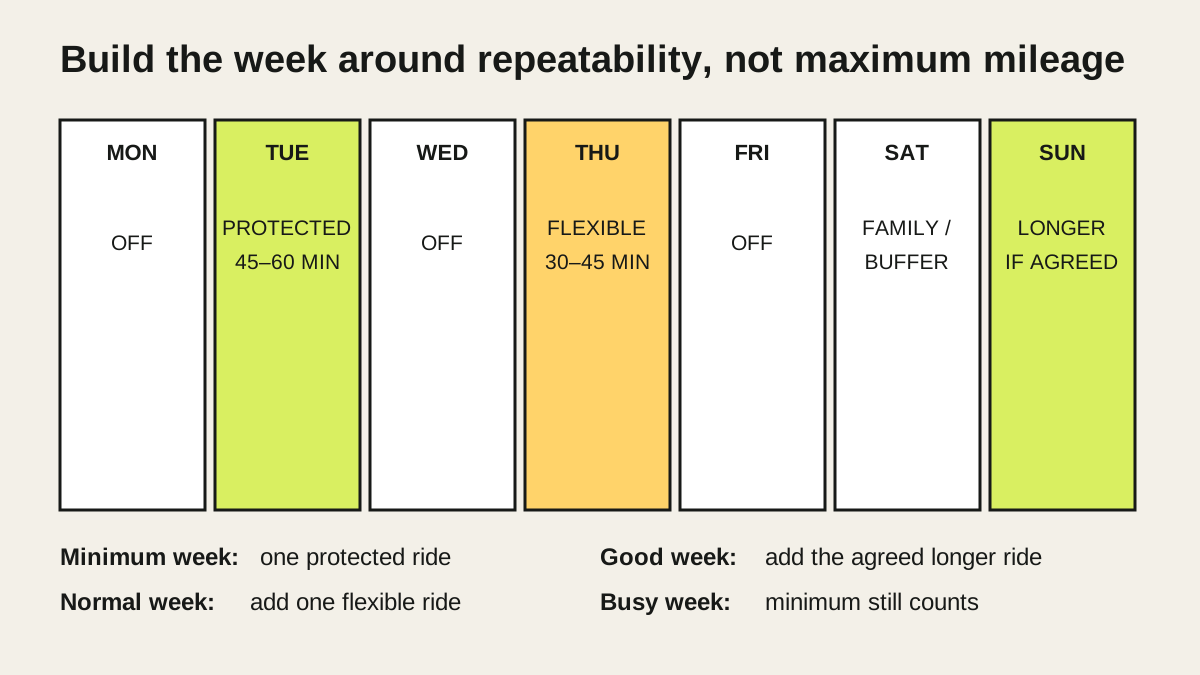
Stop planning from the perfect week
Many routines fail because they are built from maximum available time: a quiet work week, healthy children, good weather, clean bike, empty weekend, and plenty of sleep. That week is real occasionally, but it is a poor baseline.
Build three versions instead:
- Minimum week: one ride that keeps the routine alive.
- Normal week: the minimum ride plus one short flexible session.
- Good week: the normal week plus a longer ride that has been agreed in advance.
The minimum week should feel almost too modest. Its job is not to maximise fitness. Its job is to survive disruption without forcing you to renegotiate your whole identity as a cyclist.
If one 45-minute ride is what remains repeatable, begin there. You can still practise cadence, hills, cornering, or a few controlled efforts inside it. Consistency gives you more useful training months than an ambitious routine you abandon after three weeks.
Protect one window, keep the second flexible
Put one ride on the shared calendar as a real appointment. Choose the window with the fewest dependencies: perhaps early Tuesday, a lunch break, directly after school drop-off, or immediately after work before arriving home.
Then identify a flexible backup slot. It should be easy to cancel without resentment and easy to use when time appears. A short indoor session, commute extension, or 30-minute local loop works better than a second elaborate plan.
Do not reserve every attractive weekend morning by default. Family schedules also need unclaimed space. A routine is more sustainable when everyone knows which cycling window is protected and which is optional.
Negotiate the whole time cost
A “two-hour ride” can occupy much more than two hours. Changing, pumping tyres, finding food, driving to a start, showering, cleaning the bike, and post-ride recovery all consume time.
When agreeing a window, state the door-to-door cost:
- departure and return time;
- whether travel is involved;
- what preparation happens beforehand;
- who is covering a child, pet, errand, or meal;
- what happens if the ride runs late;
- whether your partner or family member gets equivalent protected time.
This is not bureaucracy. It prevents the ride from expanding invisibly and makes the commitment easier to trust.
For a longer ride, set a hard turnaround alarm and choose a route that offers an early shortcut. Returning at the agreed time is more valuable to the next ride than squeezing in an extra climb.
Reduce preparation friction the night before
Do not spend a scarce ride window searching for gloves or charging a computer.
Create a small readiness routine:
- Check the forecast and choose route A, B, or indoors.
- Put out clothing, shoes, helmet, and lights.
- Fill bottles and prepare any ride food.
- Charge lights and navigation if needed.
- Perform the five-minute pre-ride bike check.
- Put the pump, tube, tyre levers, and multitool in one permanent place.
Keep a default saddle bag on the bike. Refill it immediately after use. A repeatable setup makes a 35-minute opportunity worth taking.
Build two time-boxed local routes
Create one 30–40 minute loop and one 60-minute loop from your door. Both should have predictable surfaces, minimal navigation, a safe turnaround, and no mandatory café stop. Save them to your phone or head unit.
Ride by time rather than chasing a distance that can be disrupted by wind, traffic, punctures, or fatigue. Turn back when the alarm sounds even if the planned landmark is close.
If darkness or traffic makes the direct route unsuitable, use an indoor trainer, protected circuit, commute, or daylight lunch ride. Do not make a narrow schedule an excuse to accept a route you consider unsafe. The first-route planning guide provides a fuller risk check.
Let commuting and family riding count
A ride does not need to look like training to be valuable. A bike commute, school escort, child-paced path ride, errand, or 30-minute spin still develops routine, bike handling, and time in the saddle.
Keep the purpose honest. A family ride should move at the pace and attention level of the least experienced rider; it is not a disguised interval session. A commute needs secure storage, lights, weather planning, and enough margin to arrive reliably.
If you want a harder session, place it in the protected solo window. That separation keeps family time from becoming performance time and makes the week easier for everyone to understand.
Use intensity when time is short—but not every time
Short rides can include useful work, but turning every available 40 minutes into maximum effort creates a recovery problem. Keep at least one ride easy and conversational. Add controlled intensity only when you are rested and the following day can absorb it.
A simple normal week might be:
- one 45–60 minute ride with a few planned efforts;
- one 30–45 minute easy spin, commute, or indoor ride;
- one optional 90-minute to three-hour ride when agreed and recoverable.
The duration of the long ride should grow from your current ability, not from the size of the calendar opening. If you are restarting, use how to return after a long break rather than filling the first free Sunday.
Do not create make-up mileage
When work, illness, or family needs cancel a ride, delete it. Do not move it into the next rest day, stack two hard sessions, or extend the weekend ride without agreement.
Training is not a monthly bill. The missed session did not create a debt. Resume the next planned ride or use the minimum week if disruption continues.
This rule protects both recovery and relationships. It also stops one cancellation from turning a simple schedule into a crowded, demoralising plan.
Review the routine monthly
Ask four practical questions:
- Which ride window was completed most reliably?
- Which preparation step repeatedly wasted time?
- Did cycling create surprise work for someone else?
- Did the minimum week preserve energy and motivation, or is it still too ambitious?
Change the system before blaming discipline. Move the protected slot, shorten the route, prepare kit earlier, arrange reciprocal free time, or choose an indoor option for one season.
Measure success by weeks in which cycling and the rest of life both remained workable—not only kilometres.
Your next step
Open the shared calendar and choose one protected 45–60 minute window for next week. Save a short route from home, prepare the kit the night before, and agree the complete door-to-door time. Treat every additional ride as optional until that minimum week feels routine.
Sources and further reading
- World Health Organization: physical activity guidance for adults
- r/bicycling discussion: returning to cycling while balancing work and family responsibilities — used as an editorial question signal, not as evidence that one schedule fits every household.