How to find the weight limit for an older road bike
Identify the exact bike, find archived manufacturer limits, include bike and luggage where required, and check wheels, tyres, and replaced parts before riding.
 Field guide / find-weight-limit-old-road-bike
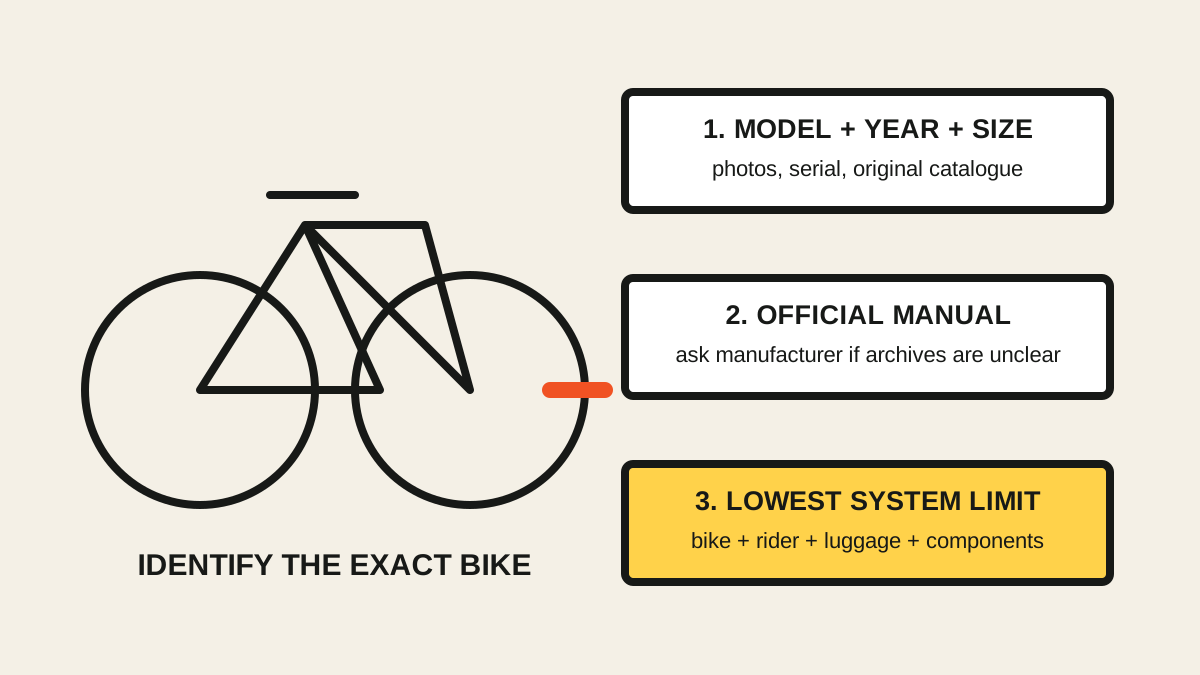
To find an older road bike’s weight limit, identify the exact model, year, size, and original specification before searching archived manuals. Then determine what the maker’s number includes—rider only, rider plus luggage, or the complete system of rider, bicycle, and gear—and obey any lower limit from the wheels, tyres, seatpost, or replaced components.
The short answer: do not borrow a limit from a similar-looking bike or a current model. Use the serial number, frame details, original catalogues, and manufacturer archives to identify the bike. If the manufacturer cannot confirm a limit, a shop inspection can assess condition but cannot invent the missing engineering specification.
Why the answer is not “all road bikes are rated the same”
A recent r/cycling question asked how to find the limit for an older road bike when the original specification was unclear. This is a common used-bike problem: the paint scheme may identify a family, but limits can vary by year, model, use category, and fitted components.
Manufacturers also define loads differently. Trek’s owner manual, for example, defines its listed limit as rider plus bicycle plus gear or cargo. Cannondale tables separate rider, luggage, and total limits. Specialized publishes year-specific rider/bike weight-limit documents alongside archived model pages.
Those examples show why a bare number copied from a forum is incomplete without its definition and model context.
Identify the exact bicycle
Collect evidence before searching:
- serial number and its location;
- brand and model decals;
- frame size marking;
- distinctive frame features and cable routing;
- brake type, axle type, and original-looking components;
- date codes on the frame or components where documented;
- high-resolution photos of both sides and the bottom-bracket area.
Do not publish the full serial number in a public forum. Share it privately only with the manufacturer, an authorised dealer, insurer, or ownership registry when appropriate.
Search the manufacturer’s archived model pages and catalogues by probable year. Compare frame geometry, colour, fork, brake mounts, cable routing, and original build. Components alone are weak evidence because owners replace them.
If two years look identical, ask the manufacturer or dealer. State that you need the exact weight and intended-use documentation, not a resale valuation.
Find the original manual and limit document
Prefer sources in this order:
- exact model-year manual or weight-limit sheet from the bicycle manufacturer;
- archived official model page linking that manual;
- written response from the manufacturer based on the serial number;
- authorised dealer records or original printed documentation.
An archived retailer listing, specification database, or forum can help identify what to ask for, but should not overrule the maker’s safety information.
Save the manual locally with its publication date and the model evidence. Old product pages can disappear, and a future buyer or mechanic will need the same trail.
Read what the number includes
Weight terminology is not standard enough to guess. Look for definitions such as:
- rider limit: rider and worn equipment only;
- luggage limit: separate maximum carried on the bike;
- total limit: rider plus permitted luggage, sometimes excluding bicycle;
- system weight: rider, bicycle, luggage, bottles, tools, locks, and fitted accessories;
- use condition: paved-road, gravel, touring, racing, or another terrain category tied to the limit.
Use the exact formula in that manual. If the limit includes the bicycle, weigh the ready-to-ride bike with pedals, bottles, bags, lights, lock, computer, and repair kit. Weigh the rider in riding clothing and shoes. Add food and anything carried.
Do not subtract a lighter wheelset from a rider-only limit or add unused luggage allowance to a rider limit unless the manufacturer explicitly defines it that way.
The lowest component limit wins
The frame’s documented limit does not automatically approve every fitted part. Check current specifications for:
- wheelset and spokes;
- tyres, tubes, and rims;
- seatpost and saddle rails;
- stem and handlebar;
- racks and luggage mounts;
- suspension or proprietary comfort components;
- replacement fork and brakes.
Used bikes may carry lighter aftermarket wheels or an unrelated carbon seatpost. A part without traceable identity or limits creates uncertainty. Replace questionable parts with a documented compatible option rather than assuming the frame limit covers them.
Tyre pressure is also bounded by the tyre and rim, not chosen solely from rider mass. Use the lower applicable pressure ceiling and an evidence-based starting pressure. The heavier-rider tyre-pressure guide explains that process.
Condition can invalidate an otherwise acceptable limit
A twenty-year-old bicycle does not necessarily become unsafe on its birthday, but age, impacts, corrosion, fatigue, storage, and poor repairs matter. A printed limit applies to a bicycle in serviceable condition, not one with hidden damage.
Before riding, inspect or have a shop inspect:
- frame and fork for cracks, dents, corrosion, bulges, repairs, and paint changes;
- wheels for rim cracks, loose or broken spokes, bearing play, and correct tension;
- tyres for casing damage, cracking, cuts, and secure seating;
- cockpit and seatpost for correct insertion, clamp condition, and torque;
- brakes and drivetrain under a controlled workshop check.
Carbon damage may require a specialist; a photograph cannot prove internal integrity. The used-bike test-ride guide and paint-versus-frame-crack guide cover those decisions.
A shop cannot certify an undocumented design limit
A competent mechanic can identify parts, find damage, test function, and tell you whether the current build is serviceable. They generally cannot create a manufacturer load rating for an undocumented frame.
Ask the shop to separate its conclusions:
- “This frame has no visible damage in our inspection.”
- “These wheels have a published system limit of ___.”
- “We could not verify the original bicycle limit.”
Those statements are more useful than “it looks strong.” If no reliable original limit exists and the margin matters, choose a bicycle with traceable documentation.
Do not use tyre failures as a weight-limit test
Repeated flats do not prove that the rider exceeds the frame limit. They can result from low pressure, excessive pressure, rim-tape faults, debris, damaged casings, pinched tubes, poor installation, or incompatible tyre-rim combinations.
Likewise, a bike surviving one ride does not prove a safe limit. Structural margins are not tested by gradually adding load in public roads.
Diagnose punctures separately with the same-spot puncture checklist and stop using any damaged tyre or rim.
Buying an older bike when you are near the limit
Build a margin for actual use. Include winter clothing, full bottles, tools, laptop, lock, and luggage. Consider the roads: potholes and impacts create dynamic loads beyond a stationary scale reading.
Before buying:
- Obtain the official limit and its definition.
- Calculate your ready-to-ride system weight.
- Check each fitted component.
- Pay for a pre-purchase inspection.
- Confirm that suitable replacement wheels, tyres, and seatposts are available.
- Walk away if identification, damage history, or limits remain materially uncertain.
The road-bike buying checklist gives you one place to record fit, condition, repair costs, and documentation before paying.
Your next step
Photograph the identifying details and write the manufacturer with the partial serial number, full details sent privately, and clear pictures. Ask for the model-year manual, intended-use category, weight-limit definition, and any component-specific restrictions. Do not ride until both the documentation and the bike’s condition support the intended load.
Sources and further reading
- Specialized archived Roubaix page with model manuals and 2017 weight-limit document
- Trek bicycle owner manual: use conditions and complete-system weight definition
- Cannondale bicycle owner manual: separate rider, luggage, and total limits
- r/cycling reader context: tracing the limit for an older road bike