Can you convert a 2× road bike to 1× by removing a chainring?
Plan a safe 2×-to-1× road-bike conversion by checking chain retention, chainline, gearing, derailleur capacity, chain length, controls, and compatibility.
 Field guide / convert-two-by-road-bike-to-one-by
Removing the inner ring from a 2× road crank does not automatically create a reliable 1× drivetrain. A practical conversion normally needs an approved single-ring solution with suitable tooth profile and chainline, plus verified cassette range, derailleur capacity, chain compatibility, chain length, and controls.
The short answer: treat 1× as a complete system, not one deleted chainring. If the exact crank has no approved 1× ring or mounting arrangement, a compatible 1× crankset can be simpler and safer than improvising with the 2× hardware.
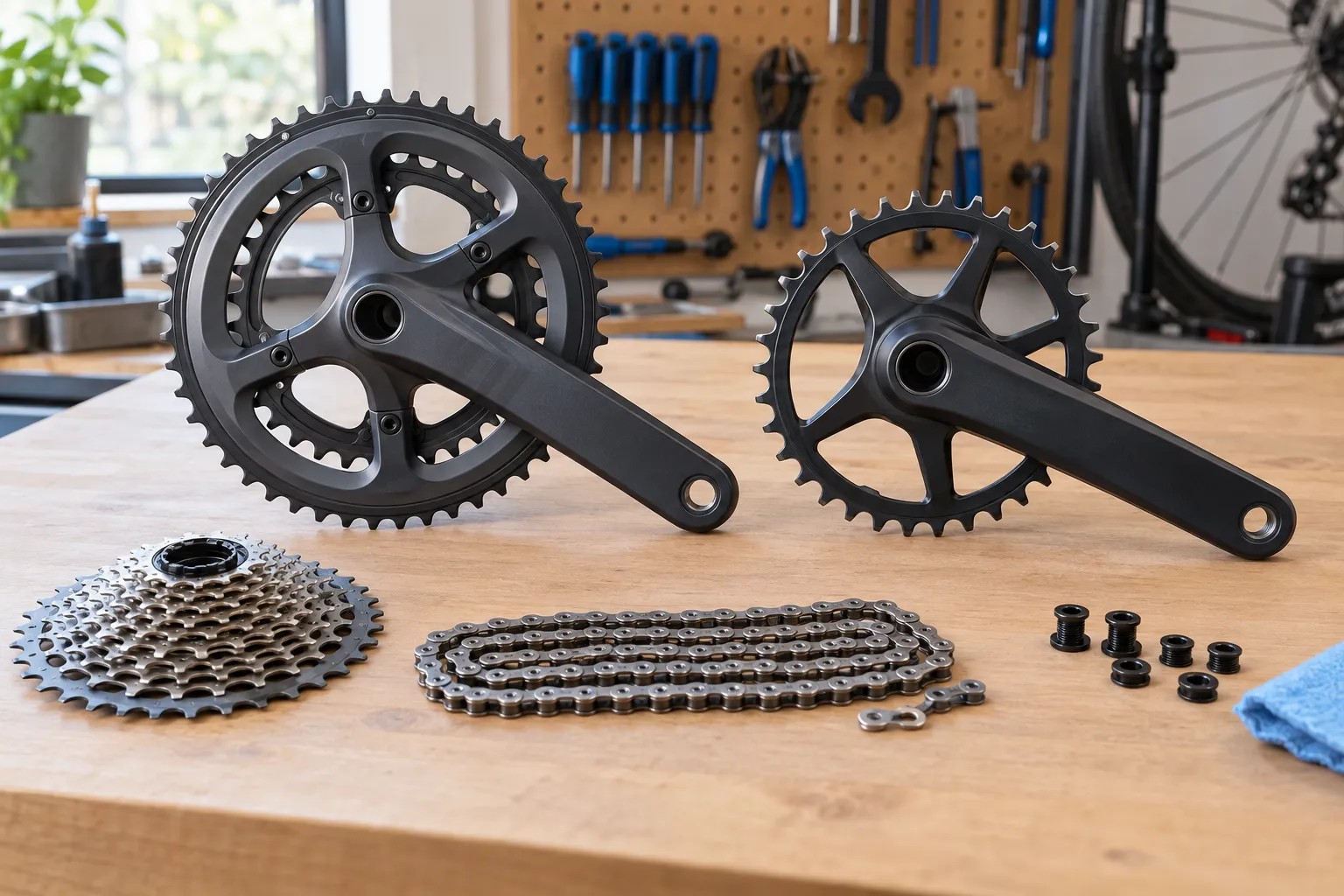
Decide whether 1× solves your problem
One chainring removes front shifting and can simplify a bike used in flat terrain, winter grime, time trials, or mixed-surface riding. It also creates tradeoffs:
- a lower total range unless the cassette becomes wider;
- larger jumps between neighbouring rear gears;
- more extreme chain angles at the cassette ends;
- possible rear-derailleur and freehub changes;
- reliance on the ring and derailleur for chain retention.
If your complaint is poor front shifting, first check cable condition, derailleur alignment, chainring installation, and compatibility. Removing the system can cost more than repairing it. Compare the riding tradeoffs in 1× or 2× gearing for road and gravel.
Map the gears you use now
Record the front and rear combinations you actually use on flat roads, climbs, and fast sections. Put both drivetrains into a gear calculator and compare:
- easiest ratio;
- hardest ratio;
- percentage jumps between nearby gears;
- cadence at your usual speeds.
Do not select the front ring alone. A larger cassette may restore climbing range but exceed the rear derailleur’s largest-sprocket limit or total capacity. A different cassette may also require another freehub body. Read whether a bigger cassette will fit before ordering.
Use a ring designed for the chain and system
A shifting ring from a double crank is designed to move the chain between rings. A dedicated 1× ring commonly uses a retention-focused tooth profile. Shimano describes its narrow-wide Dynamic Chain Engagement+ rings as intended for single-ring systems and matched to specific chain families. SRAM’s compatibility map lists separate approved 1× road and 1× road-wide cranksets rather than telling riders to remove one 2× ring.
For the exact proposed ring, confirm:
- mount type or bolt-circle diameter;
- speed and chain-family compatibility;
- tooth count options;
- chainline and any offset;
- mounting face and orientation;
- required bolts, covers, washers, and torque procedure;
- frame and chainstay clearance.
Standard double-ring bolts may be too long after one ring is removed. Do not stack random washers or reuse hardware unless the maker approves that arrangement.
Put the chainline in the intended position
Chainline is the lateral position of the ring relative to the cassette. Mounting a ring in the old outer position may produce a poor angle in climbing gears; moving it inward without approval can cause frame contact or improper hardware seating.
Measure and compare with the component maker’s specification. Turn the crank and inspect clearance through a full rotation. Then sight the chain in middle and extreme sprockets. A quiet workstand test does not prove safe retention under bumps and load, but obvious rubbing or severe deflection is already a stop signal.
Verify the rear derailleur and cassette as a pair
Check the exact rear-derailleur model for:
- number of speeds and compatible shifter;
- maximum and minimum sprocket;
- total capacity where applicable;
- compatible chain and cassette family;
- whether a clutch or chain-stabilising design is required or recommended for the intended use.
Do not treat an aftermarket hanger extension as universal permission to exceed the derailleur manual. It changes geometry but does not certify shifting, capacity, chain wrap, or frame clearance.
Size a fresh chain using the approved method
Changing the front ring or cassette can change chain length. SRAM explicitly directs riders to recheck chain length when chainring size changes. Follow the current manual for the final combination; do not copy the old chain link-for-link.
Check the full range slowly on a stand. The derailleur must not be pulled tight in the largest sprocket, and the chain must remain controlled in the smallest. If you reuse a chain, verify wear, model compatibility, direction, and quick-link policy first. Read how to identify a chain that is too long or short.
Decide what happens to the left control
On a mechanical road bike, the left brake/shift lever can often remain as a brake lever with the front-shift cable and derailleur removed, but the exact control still needs its maker’s procedure. Electronic systems may require configuration changes and compatible firmware. Never remove or alter brake hardware while simplifying shifting.
Seal unused cable openings only with frame-approved parts. Keep removed components labelled if the conversion may be reversed.
Price the complete conversion
Include the ring or crankset, chain, cassette, rear derailleur, freehub body if needed, chainring hardware, bottom bracket implications, labour, and any control changes. Compare that total with repairing the 2× system or buying a complete compatible drivetrain.
This is also the point to ask whether the current frame is worth the conversion. The replacement-part identification guide helps turn an attractive idea into an exact parts list.
Your next step
Create one compatibility sheet with every current model code and the proposed front ring, chainline, chain, cassette, rear derailleur, shifter, and freehub. Add the easiest and hardest ratios. If any box depends on “probably compatible,” do not remove the front derailleur yet.
Sources and further reading
- Shimano: Dynamic Chain Engagement+ single-chainring design
- Shimano: drivetrain compatibility chart
- SRAM: road mechanical compatibility map
- SRAM: chain length must be checked when chainring size changes
- r/bikewrench demand signal: planning a 1×11 drivetrain on an older road frame — used as an editorial question signal, not as a compatibility source.