Cold, wet, and dark: should you ride outside or change the plan?
Make a calm go, reroute, shorten, or indoor decision when low temperature, rain, and darkness combine on a road ride.
 Field guide / cold-wet-dark-cycling-decision
Before you buy
Check the starter kit first
Print the one-page buying brief for helmet, lights, water, phone, and repair compatibility before comparing upgrades.
Cold, rain, and darkness are each manageable in some conditions. Together they reduce grip, visibility, warmth, dexterity, and the margin for fixing a puncture. Choosing an indoor ride or a shorter protected route is risk management, not a failure of toughness.
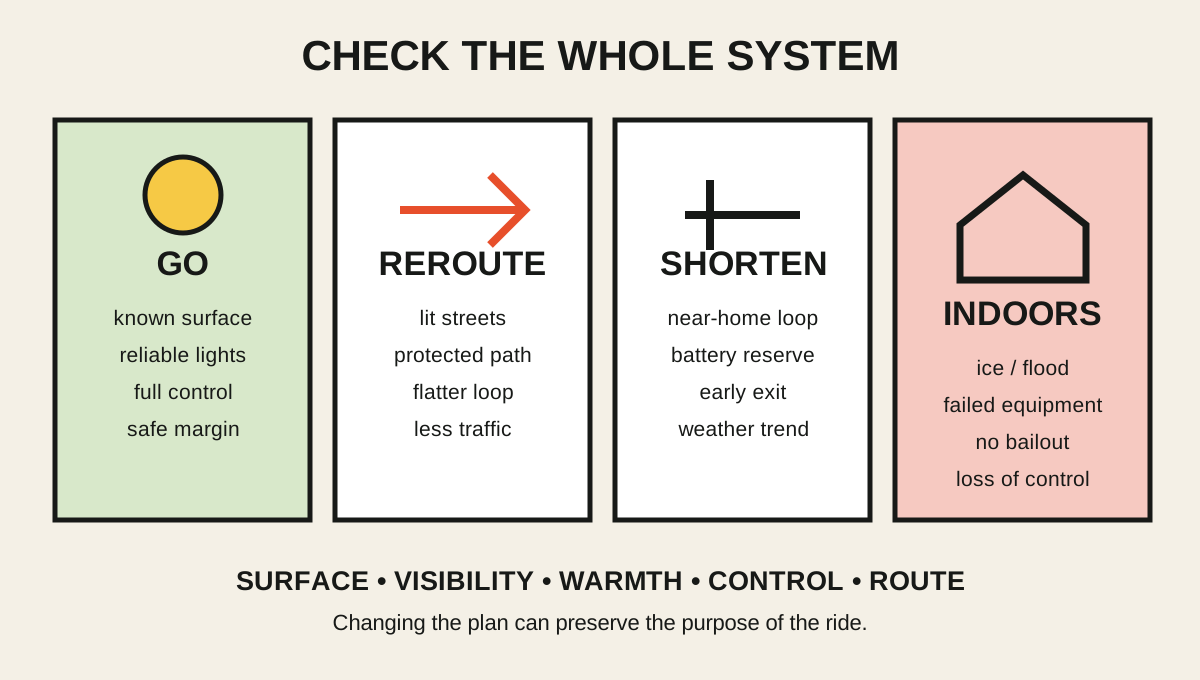
The short answer: check the surface, visibility, wind, temperature trend, route, equipment, and your condition as one system. If one weak link has no safe backup—especially lights, grip, braking, shelter, or warm hands—change the plan. Do not let clothing turn a bad road or weather decision into an equipment challenge.
Start with hard stop conditions
Do not bargain with any of these:
- ice, freezing rain, or water likely to refreeze;
- flooded roads, moving water, or hidden road edges;
- lightning or an official instruction to avoid travel;
- gusts that can move you across the lane;
- visibility too poor for you to see surface hazards in time;
- no legal, reliable lighting for the whole ride;
- brakes, tyres, or steering that are already questionable;
- hands too cold to shift and brake firmly;
- shivering, confusion, unusual clumsiness, or inability to warm up;
- a remote route with no credible bailout.
The correct response may be to turn back even when the first 20 minutes felt acceptable. Conditions, batteries, and body temperature change.
Score the combined problem
Surface
Rain reduces available grip and can hide potholes, metal covers, painted markings, leaves, and debris. Darkness shortens the time available to identify them. Cold may add frost or ice on bridges, shaded bends, and untreated lanes.
If the route depends on fast descents, painted cycle lanes, leaf-covered paths, or standing water, reroute before trying to compensate with slower reactions.
Visibility
You need to see and be seen. Check both lights at full brightness, clean the lenses and reflectors, and confirm the expected runtime in the actual mode. Carry a backup rather than assuming a phone light can replace a road-legal front or rear lamp.
The UK Highway Code requires a lit white front and red rear light at night and recommends a steady front lamp where there is no street lighting. Requirements differ by country, so verify your local rules.
Temperature and exposure
Use the forecast for the coldest, wettest part of the ride—not only the temperature at departure. Add the time needed for a puncture, wrong turn, or wait. A comfortable jacket while pedalling may be inadequate while standing beside the road.
Control
Warmth is a control feature. Gloves must let you reach both levers, modulate the brakes, operate the shifters, and open food. The cold-hands guide helps choose insulation without losing lever control.
Route and traffic
A familiar lit loop, protected path, or low-speed street network can be a different decision from an unlit high-speed road. Avoid routes where spray, glare, narrow lanes, and fast traffic combine. Plan a turn-home option every few kilometres.
Choose one of four outcomes
Go as planned
Use this only when the route, weather trend, visibility, surface, equipment, and rider are all comfortably within known limits. “I have ridden in rain” does not automatically cover cold darkness on an unfamiliar descent.
Reroute
Keep the duration but move to a protected, lit, lower-speed, or flatter route. Repeating a safe loop is better than discovering a flooded underpass far from home.
Shorten
Keep the outdoor skill or mood benefit with a short ride near home. Start into the wind when practical so a strengthening headwind does not trap you on the return. Leave enough time and battery margin to finish well before the forecast worsens.
Switch indoors or reschedule
Preserve the training purpose. An easy endurance ride can become an indoor steady session; intervals can be moved to a trainer; recovery can become a walk or complete rest. Fitness is built through consistency, not by winning one argument with the forecast.
Prepare the bike for the combination
Before leaving:
- Test both brakes and note that wet stopping can feel different.
- Check tyre condition and pressure within the tyre and rim limits.
- Fit and test the primary and backup lights.
- Keep lenses, reflectors, and bright surfaces unobscured by luggage or clothing.
- Use full mudguards where compatible if spray is a recurring problem.
- Carry a repair kit you have already tested in gloves.
- Protect the phone from water and keep emergency power in reserve.
- Tell someone the route and return time when the ride is remote or late.
Review the separate rain-riding guide and after-dark guide before combining the conditions.
Change how you ride
- Brake earlier and more progressively.
- Keep the bike more upright across paint, metal, leaves, and uncertain surfaces.
- Increase following distance and avoid a vehicle’s spray plume.
- Reduce speed before the bend rather than braking abruptly while leaned over.
- Choose a clear, predictable lane position; do not weave between puddles at the last second.
- Look farther ahead to use the part of the light beam with useful reaction time.
- Stop somewhere sheltered to adjust layers before sweat chills you.
Lights and reflective clothing improve conspicuity; they do not guarantee that another road user has seen you. Ride with an escape margin.
Run a ten-minute exit check
During the first safe loop, ask:
- Can I see surface defects early enough at this speed?
- Can I brake firmly with these gloves?
- Are my torso and hands warming without heavy sweat?
- Are the lenses already covered in spray?
- Is traffic giving enough space?
- Is the rain, wind, or temperature trending worse?
- Would a puncture here be manageable?
If two answers are doubtful, shorten or turn back. You do not need an accident or near miss to validate the decision.
Your next step
Save three routes now: a protected bad-weather loop, a short near-home loop, and an indoor equivalent. On the next cold, wet, dark day, choose among them before getting dressed rather than letting preparation effort force the decision.
Sources and further reading
- UK Highway Code: cyclist lighting, visibility, and road positioning
- UK Highway Code: adverse weather reduces grip and increases stopping distance
- Reading Borough Council: practical dark-riding equipment and route planning
- r/cycling reader context: limited daylight and the combined concern of cold, wet, dark urban riding — used as a high-engagement planning signal; individual risk tolerances in replies were not treated as safety standards.