Can you fit larger chainrings than your bike's stated maximum?
Check frame clearance, front-derailleur range, crank compatibility, chain length, and the manufacturer's limit before changing from 50/34 to 52/36 chainrings.
 Field guide / can-you-fit-larger-chainrings-than-bike-frame-limit
Before you buy
Check the starter kit first
Print the one-page buying brief for helmet, lights, water, phone, and repair compatibility before comparing upgrades.
If your bike maker lists 50/34 as the maximum double chainring, do not assume a 52/36 pair is safe merely because it bolts to the crank. The larger ring must clear the frame in every permitted gear and under normal movement, while the front derailleur, crank, chain, and shifters must all support the combination.
The short answer: a manufacturer’s maximum is not a starting suggestion. Ask the bike maker to confirm the exact frame size and model year. If it will not approve 52/36, keep 50/34—even when a static ruler check appears to show space.
Why physically fitting is not enough
A current r/bikewrench discussion asked whether a 52/36 pair could replace 50/34 when the frame maker listed 50/34 as the maximum. The replies disagreed about how much visible space was enough. That disagreement is the useful signal: a photograph and an unloaded measurement cannot define a frame manufacturer’s engineering limit.
The limit may account for several things at once:
- clearance between the large ring, chain, chainstay, and any chain catcher;
- frame flex, crank movement, manufacturing tolerances, and paint thickness;
- front-derailleur mount height and cage shape;
- the chainline specified for that frame;
- differences between frame sizes or model years;
- cable routing, bottle bosses, covers, or sensors near the derailleur;
- the combinations the manufacturer has actually validated.
Trek’s Domane AL Gen 4 FAQ, for example, publishes 50/34 as the maximum double configuration. Shimano separately lists both 50/34 and 52/36 for its FC-R7100 crank. Those statements answer different questions: the crank can support both matched pairs, while the frame may impose the smaller limit.
First decide whether 52/36 solves a real problem
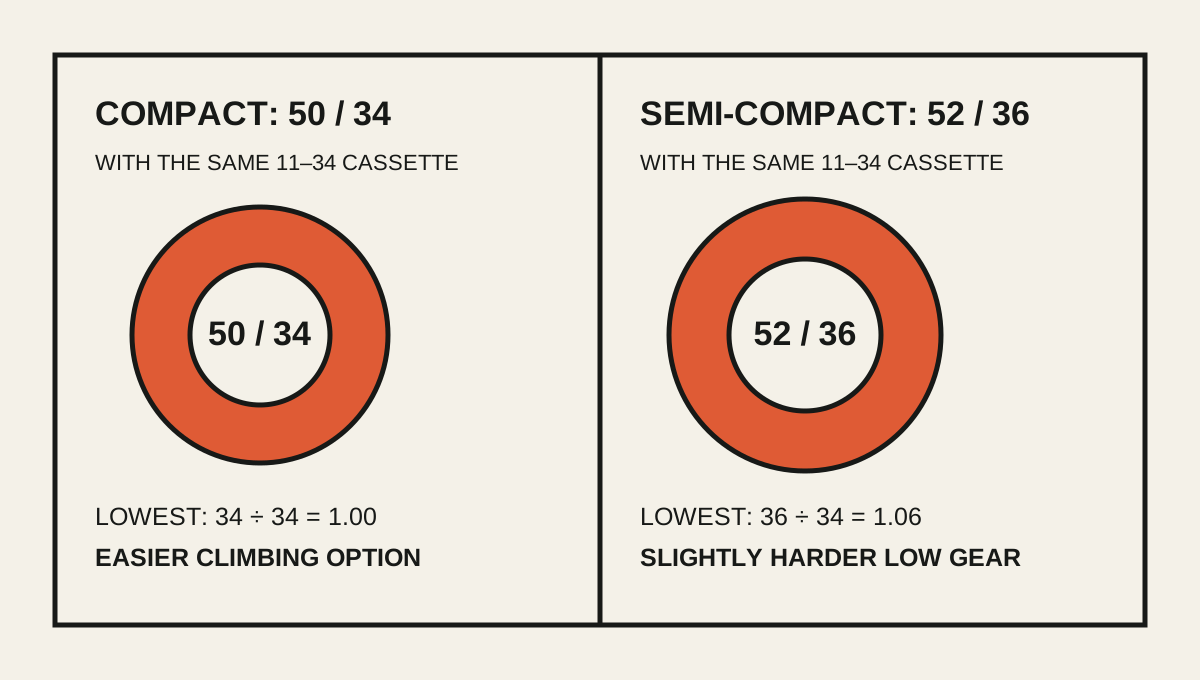
With the same cassette, moving from a 50-tooth to a 52-tooth outer ring raises the highest ratio by 4%. Changing the inner ring from 34 to 36 teeth makes the lowest ratio about 6% harder.
That trade is useful only if you regularly run out of 50×11 at a purposeful cadence. It is usually a poor exchange if you already use your easiest gear on climbs. Leg strength in the gym does not determine the right gearing; cadence, gradient, wind, duration, fatigue, and the full cassette range do.
Read 50/34 vs 52/36 before buying parts. If your problem is that a flat-bar bike feels under-geared, diagnose spinning out from the actual tooth counts first.
Verify five separate limits
1. The frame limit
Find the service manual or FAQ for the exact model year and frame generation. Do not transfer a specification from a carbon version to an aluminium version, or from one generation to another. Frame size can matter too.
If the public documents conflict or appear ambiguous, send the serial number, frame size, model year, crank model, and proposed chainring pair to the manufacturer. Keep the written answer.
2. The crank and chainring pair
Match the precise crank model, bolt-circle diameter or direct-mount interface, fixing hardware, speed, and approved tooth pair. Modern outer and inner rings use coordinated ramps and pins. Two rings that attach independently are not automatically a supported shifting pair.
Shimano’s FC-R7100 exploded view lists 50/34 and 52/36 as pairs with different identifiers. That is a reason to buy the documented pair, not to mix one new ring with whichever inner ring is already fitted.
3. Front-derailleur capacity and position
The derailleur cage must sit at the height and angle specified by its maker and still remain inside the adjustment range of the braze-on slot or clamp. A larger outer ring generally requires the derailleur to move upward. Bottle bosses, a short mounting slot, cable entry, or an integrated cover may stop that movement.
Confirm the derailleur supports both the large-ring size and the tooth difference between the two rings. Do not file a mount or operate a derailleur outside its published range.
4. Chain length and rear-derailleur capacity
A larger chainring consumes more chain. Size the chain using the drivetrain maker’s procedure; do not add links by guesswork. The rear derailleur must safely manage the complete difference between the front rings and rear cassette.
A chain that is too short can overload the drivetrain in the large-large combination. A chain that is too long can go slack in small-small. Our chain-length guide explains the symptoms, but the component manual supplies the sizing method.
5. Dynamic clearance
Static clearance does not prove safe clearance while pedalling hard, shifting, or riding over rough ground. Nor does a successful stand test establish every gear. If the maker approves the change, have a mechanic inspect the complete setup and shifting under controlled load.
Do not use an arbitrary internet clearance number to overrule the frame maker. The manufacturer knows the tested tolerances; a ruler beside one unloaded bicycle does not.
Better ways to get more useful speed
If 52/36 is outside the frame limit, the bike is not automatically slow. Check:
- whether you are actually reaching 50×11;
- tyre pressure and condition;
- brake rub or rough wheel bearings;
- chain cleanliness and wear;
- riding position and clothing at higher speed;
- cadence technique;
- whether a compatible cassette changes the ratios you use most.
Do not trade safe frame clearance or useful climbing gears for a theoretical top speed you rarely reach.
Your next step
Photograph the frame serial number and all drivetrain model codes. Find the frame’s exact maximum-chainring statement and the crank’s approved chainring pair. If 52/36 exceeds the frame specification, ask the bike maker in writing; absent approval, keep 50/34.
Sources and further reading
- Trek Domane AL Gen 4 FAQ: maximum chainring size
- Shimano FC-R7100 exploded view and approved chainring pairs
- r/bikewrench demand signal: upsizing chainrings beyond a listed frame maximum — used as an editorial question signal, not technical evidence.