Can you ask a bike shop to identify parts for a DIY repair?
Book a defined diagnosis, bring the complete bicycle and model details, agree on the fee and deliverable, and respect when safety or liability makes parts-only help impractical.
 Field guide / ask-bike-shop-identify-parts-for-diy-repair
Before you buy
Check the starter kit first
Print the one-page buying brief for helmet, lights, water, phone, and repair compatibility before comparing upgrades.
Yes, you can ask a bicycle shop to identify parts for a repair you intend to complete yourself—but ask for a paid, defined service rather than assuming the counter can provide unlimited diagnosis for free. Some shops will happily inspect, specify, and sell the parts. Others may decline when the fault is safety-critical, time-consuming, or impossible to separate from installation.
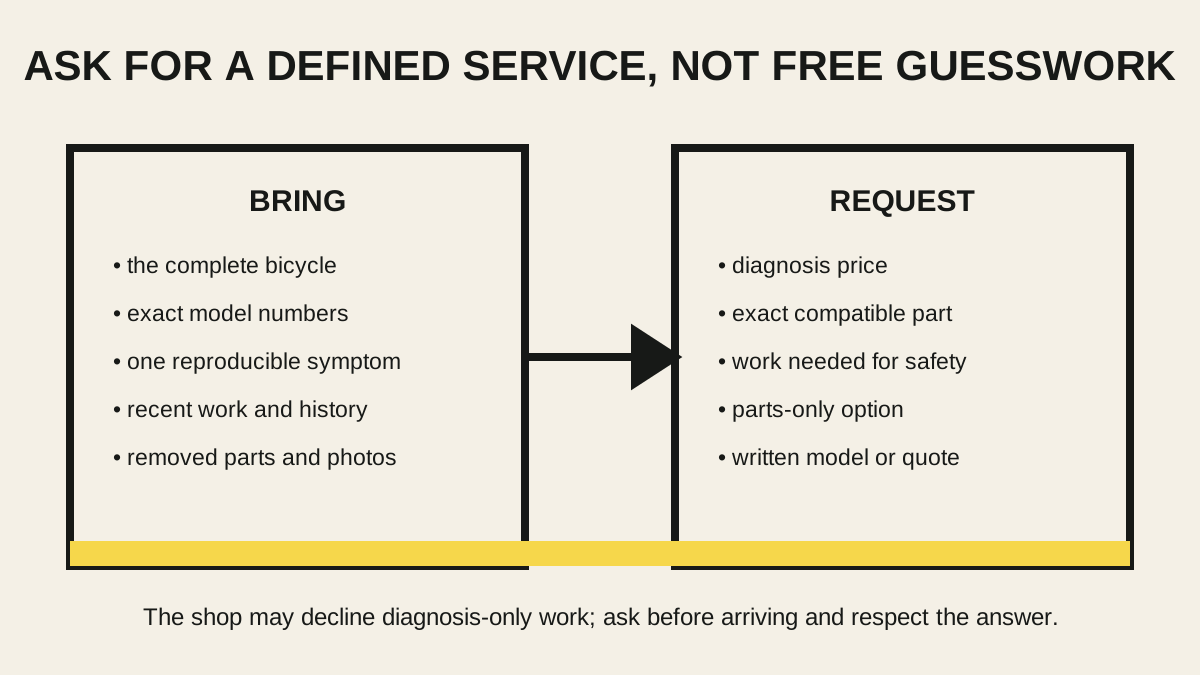
The short answer: contact the shop before visiting. Say that you want a diagnosis and exact compatible-part identification, that you plan to install the part yourself, and that you expect to pay for the inspection. Bring the complete bicycle, removed pieces, model numbers, and a reproducible symptom. Agree on what you will receive: a part number, a quote, an inspection result, or a stop recommendation.
Why this question is reasonable
In a current r/bikewrench weekly thread, a rider wanted a shop to determine which drivetrain parts were needed while keeping the installation as a home project. The concern was whether the request would offend the shop.
The request itself is ordinary. The friction comes from hidden assumptions:
- the rider thinks identification takes five minutes;
- the shop sees a diagnostic job involving cleaning, measurement, compatibility research, and liability;
- the rider expects a free part number, then plans to buy elsewhere;
- the shop assumes it will later be blamed if the home installation fails;
- neither side states whether the bicycle needs diagnosis, parts supply, installation, or a safety check.
Make those expectations explicit before the bicycle reaches the counter.
First decide what you are asking the shop to do
These are different services:
Part identification
You know the failed part and need its exact specification or manufacturer number. Example: identifying a headset bearing after removal and measurement.
Fault diagnosis
You know the symptom but not the cause. “The chain skips on climbs” could involve chain wear, cassette wear, chainring wear, cable friction, freehub behaviour, adjustment, compatibility, or several faults.
Parts planning
You know the cause and want every item required for a complete repair: main part, single-use hardware, cable, fluid, spacer, tool, or matched wear component.
Safety inspection
You want the shop to say whether the bicycle is safe to ride. This can require more work than identifying one part and may not be possible without cleaning, disassembly, or repair.
Installation coaching
You want a mechanic to teach the job. That is a class or scheduled labour service, not automatically part of buying a component at the counter.
Tell the shop which one you need.
Call before you carry the bike in
Use a short script:
“I have a [year, make, model] with [exact symptom]. I want to do the installation myself, but I need the cause checked and the exact compatible parts identified. Do you offer diagnosis-only or parts-specification appointments, what does that cost, and what should I bring?”
Ask:
- whether the complete bicycle is required;
- current diagnostic or minimum labour fee;
- whether the fee is credited toward parts or repair;
- expected turnaround;
- whether you will receive a written part number or only a verbal recommendation;
- whether the shop sells the required part;
- whether it will inspect your work afterward and at what price.
A shop can say no. It may lack access to the brand, be fully booked, avoid partially completed work, or require installation for safety-critical components. That boundary is not an insult.
Bring enough evidence to make diagnosis efficient
Bring the complete bicycle unless the shop explicitly says a loose part is enough. A bearing, chainring, derailleur, or brake pad can depend on the frame, mating component, spacers, generation, and installation.
Prepare:
- bicycle brand, model, year, size, and serial information where relevant;
- every readable component model code;
- original specifications or manual links;
- the old part, spacers, washers, fasteners, and packaging;
- clear photographs before disassembly;
- what changed before the symptom began;
- when and in which gear, load, temperature, or weather the fault appears;
- work already attempted and adjustments already changed.
Do not clean away fracture surfaces or impact evidence. For ordinary drivetrain dirt, ask whether the shop charges a cleaning fee or needs the area cleaned enough to inspect.
The replacement-part identification guide helps you gather the labels and dimensions before the appointment.
Expect to pay for knowledge, not only the box
Correct identification can require:
- measuring threads, diameters, widths, offsets, angles, or wear;
- checking a frame or component technical document;
- comparing generations with similar names;
- removing a cover or part to expose the actual interface;
- checking whether the visible failed part is secondary to another fault;
- pricing unavailable, obsolete, or proprietary pieces.
The shop sells time, tooling, experience, and responsibility. Buying the resulting part there may support that work, but it does not automatically make a complex diagnosis free. Ask the price and decide before authorising it.
If you only want a quick measurement, say so. If the shop finds that a full diagnosis is required, it should pause and ask before expanding the labour—provided you agreed on that boundary at intake. Use how to avoid surprise bike-shop charges to write a clear authorisation limit.
Ask for an actionable deliverable
Before leaving, confirm:
- exact manufacturer part number or complete specification;
- compatible alternatives, if any;
- single-use bolts, olives, barbs, pins, seals, cables, or other required small parts;
- torque, fluid, grease, thread treatment, and tool references from the exact manual;
- whether connected wear parts should be measured or replaced;
- safety checks required after installation;
- the reason the shop recommends professional installation, if it does.
“You need a new headset” is not enough for online ordering. “Upper bearing: maker code X, lower bearing: code Y, crown race Z; frame seat is undamaged” is actionable. The shop may reasonably charge more to reach that level of certainty.
Parts supply is not repair approval
A component sold over the counter has not been installed, torqued, adjusted, or tested. The rider performing the repair owns those steps.
Before paying, ask about:
- returns after packaging is opened or grease marks the part;
- warranty boundaries for home installation;
- whether special tools are rented, sold, or unavailable;
- whether the shop will perform only the difficult stage;
- whether a post-install inspection is possible.
Do not ask the shop to certify a home repair by glancing at it while another customer waits. Book the inspection and expect the mechanic to repeat any checks necessary.
Jobs that may not suit diagnosis-only help
The shop may insist on full service or decline when the work involves:
- brake hydraulics, contaminated friction surfaces, or uncertain braking faults;
- fork, steerer, stem, handlebar, headset, or wheel-retention problems;
- cracks, impacts, carbon damage, or frame alignment;
- stripped threads or seized structural parts;
- electronic diagnostics or manufacturer-only tools;
- press fits where the frame interface needs inspection;
- unclear e-bike electrical or regulatory status;
- a bicycle assembled from incompatible or unidentified components.
That does not mean home mechanics can never learn these jobs. It means a shop is not obliged to split one safety-critical process into fragments it cannot stand behind.
Use when a road bike needs a mechanic to identify the stop conditions before booking.
Make the relationship work for both sides
Good habits are simple:
- arrive at the agreed time with the agreed items;
- describe symptoms, not your preferred diagnosis;
- disclose every adjustment and removed part;
- ask before filming or watching in the workshop;
- pay the diagnosis fee even if the answer is “do not repair this”;
- do not demand the shop match an unknown marketplace seller;
- keep the written model and receipt for the next service;
- return if the part supplied does not match before modifying it.
If you want ongoing teaching, ask about maintenance classes, community workshops, or a paid one-to-one session. That is a clearer route than turning every parts purchase into an unscheduled lesson.
A useful split repair
Sometimes the efficient answer is to divide the job deliberately. For example, the shop can diagnose a worn drivetrain, verify the hanger and compatibility, and supply the exact chain and cassette; you can clean and replace approved wear parts if you have the correct tools and process. Or you can remove accessories while the shop handles a seized bottom bracket.
Write down who is responsible for each stage and which final checks remain. The safe maintenance learning guide provides a repair card for documenting the baseline, manual, tools, stop conditions, and test.
Your next step
Write a three-sentence service request with the bicycle identity, one reproducible symptom, and the exact deliverable you want. Call two local shops, ask their diagnosis-only policy and price, then choose the one whose boundary is clear—not automatically the one that says the quickest yes.
Sources and further reading
- r/bikewrench reader context: asking a local shop to identify drivetrain parts for a home repair — used as a current service-etiquette and repair-planning signal; individual shop opinions were not treated as universal policy.
- Park Tool: repair-help library for identifying the procedure and tools before starting