Why do wider road-bike tyres feel slower after an upgrade?
Separate tyre width from casing, pressure, brake rub, fit, route conditions, and unreliable average-speed comparisons.
 Field guide / wider-road-bike-tyres-feel-slower
Before you buy
Check the starter kit first
Print the one-page buying brief for helmet, lights, water, phone, and repair compatibility before comparing upgrades.
A wider road tyre is not automatically slower, and a lower average speed after changing tyres does not prove that width caused the difference. Tyre construction, actual fitted width, pressure, tubes or sealant, brake rub, wind, posture, fatigue, and route conditions can all change at once.
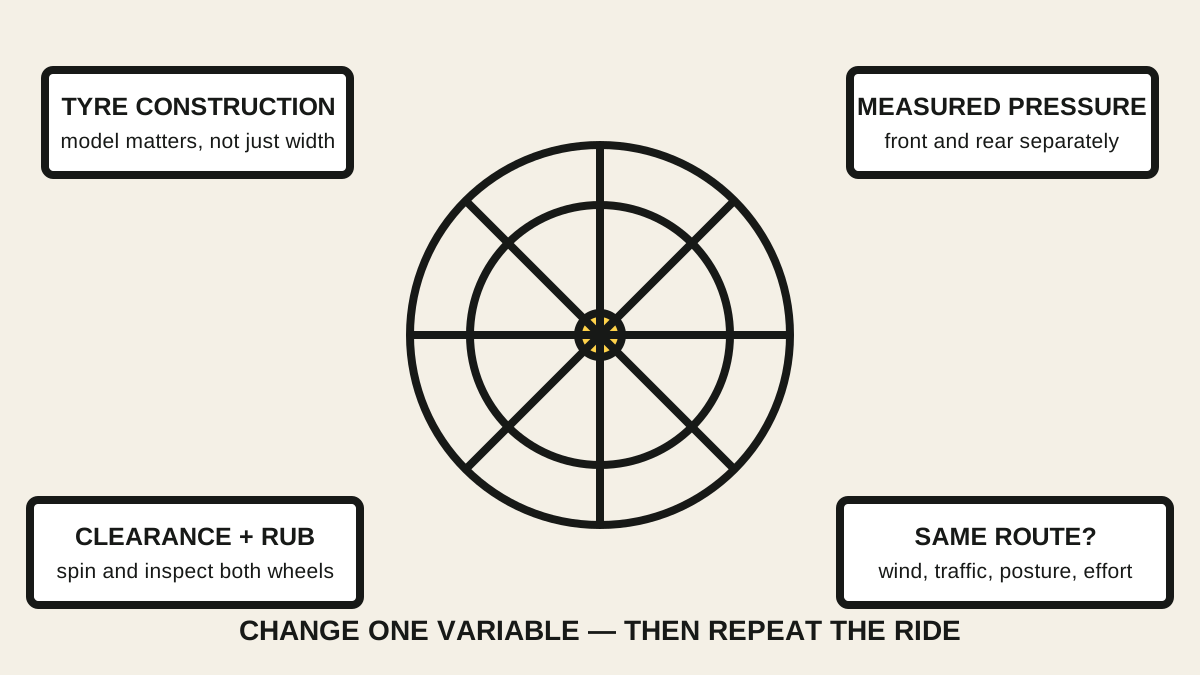
The short answer: first confirm safe installation and free-spinning wheels. Then compare the old and new tyres as complete systems—not just 25 mm versus 28 mm. Set pressure from measured tyre width and total load, repeat the same route at similar effort and conditions, and change one variable at a time.
Do the safety checks before the speed test
A recent road-tyre upgrade discussion described a move from old narrow tyres at high pressure to wider tyres at lower pressure, followed by a large change in average speed and unrelated fit adjustments. The useful question is not whether the anecdote proves one tyre is slow. It is how to isolate the cause safely.
Before riding again:
- Confirm the tyre size is approved for the rim and fits the frame and brakes.
- Inspect the bead all the way around on both sides.
- Verify the tube is not trapped beneath the bead, or the tubeless system holds pressure.
- Spin each wheel and listen for brake, frame, mudguard, or sensor rub.
- Check that directional arrows, if the maker specifies them, face correctly.
- Measure front and rear pressure with the same gauge.
If the new tyre barely clears when the bike is unloaded, it may rub during cornering, sprinting, or wheel flex. Use the older rim-brake tyre-clearance guide before assuming nominal width equals installed width.
Width is not a tyre model
Two tyres marked 28 mm can use different casings, puncture-protection layers, rubber compounds, tread, bead types, and actual amounts of material. Those construction choices affect flexibility, grip, durability, mass, and rolling resistance.
Changing from a supple performance tyre to a heavier durability-focused tyre can change ride feel even when the new tyre is wider. The correct comparison is:
- exact old and new tyre models;
- actual fitted width on the rim;
- tube material or tubeless setup;
- total rotating mass;
- measured pressure;
- road surface and temperature.
Do not attribute a model change to width alone.
Lower pressure changes sensation
High pressure can feel fast because impacts and vibration reach your hands and saddle. A calmer ride can feel less urgent even when the bike is conserving speed well over imperfect asphalt.
Schwalbe’s technical guidance explains that rolling resistance depends on pressure, diameter, width, construction, and tread. It also notes that wider tyres can use lower pressure to absorb uneven surfaces. That is not permission to choose an arbitrary low number: insufficient pressure can cause unstable handling, rim strikes, pinch flats with tubes, tyre damage, or unsafe support.
Start with a reputable pressure calculator that accepts total system weight, measured tyre width, surface, and tyre type. Treat its output as a starting point, remain within the rim and tyre makers’ limits, and adjust in small steps. Record front and rear separately; the loads are different.
The beginner tyre-pressure guide explains why the sidewall maximum is not a target.
Rule out installation drag
A tyre change involves removing and reinstalling wheels. That can introduce other faults:
- a rim-brake wheel not centred in the frame;
- a brake caliper left closed against a wider rim or tyre;
- a disc rotor rubbing after the wheel was reseated;
- a quick release or thru-axle installed incorrectly;
- a mudguard or speed sensor touching the tyre;
- a wheel bearing preloaded incorrectly on some systems.
Lift one end of the bike at a time and spin the wheel. Compare left and right gaps. A wheel does not need to spin for an internet-approved number of seconds, but it should rotate freely without a repeating scrape or abrupt stop. Fix a wheel-retention concern before riding.
Average speed is a noisy measurement
Comparing two ordinary rides by average speed mixes together wind, traffic, junctions, temperature, clothing, posture, fatigue, drafting, route direction, tyre warm-up, and how hard you chose to pedal. A change in handlebar or saddle position makes the comparison even less useful.
For a practical field check:
- Choose a safe, low-traffic loop with few stops.
- Use the same bike, clothing, luggage, and riding position.
- Ride on similar days, ideally in both directions.
- Hold similar perceived effort, heart rate, or power—whichever you already use.
- Repeat each setup more than once.
- Compare the pattern, not one personal record.
Do not chase a test speed in traffic. This is a troubleshooting exercise, not a laboratory result.
Change one thing at a time
If the installation is sound, use this order:
- Record both pressures and actual tyre widths.
- Repeat a familiar ride without changing fit.
- Adjust pressure in small, equal-method steps while staying within limits.
- If possible, compare tubes or sealant amount only after pressure is settled.
- Re-check wheel and brake drag.
- Accept that a durable tyre may trade some liveliness for protection and longevity.
Do not lower the saddle or raise the bars to compensate for a tyre sensation unless a separate fit problem justifies it. That creates a second experiment and can introduce discomfort.
Your next step
Write down the exact tyre models, measured widths, tube or tubeless setup, and front/rear pressures. Perform the spin-and-clearance check, then repeat one familiar route at a controlled effort before buying another set of tyres.
Sources and further reading
- Reddit: recent discussion about a wider-tyre change feeling slower — editorial demand signal only; the rider’s result was not treated as a controlled test.
- Schwalbe: factors affecting bicycle tyre rolling resistance
- Schwalbe: tyre pressure, load, comfort, and limits