Why do my knees hurt after cycling? Front, back, and outer knee pain explained
Diagnose cycling knee pain by location: anterior (front), posterior (back), medial (inner), and lateral (outer IT band) pain, with exact bike fit and cadence adjustments.
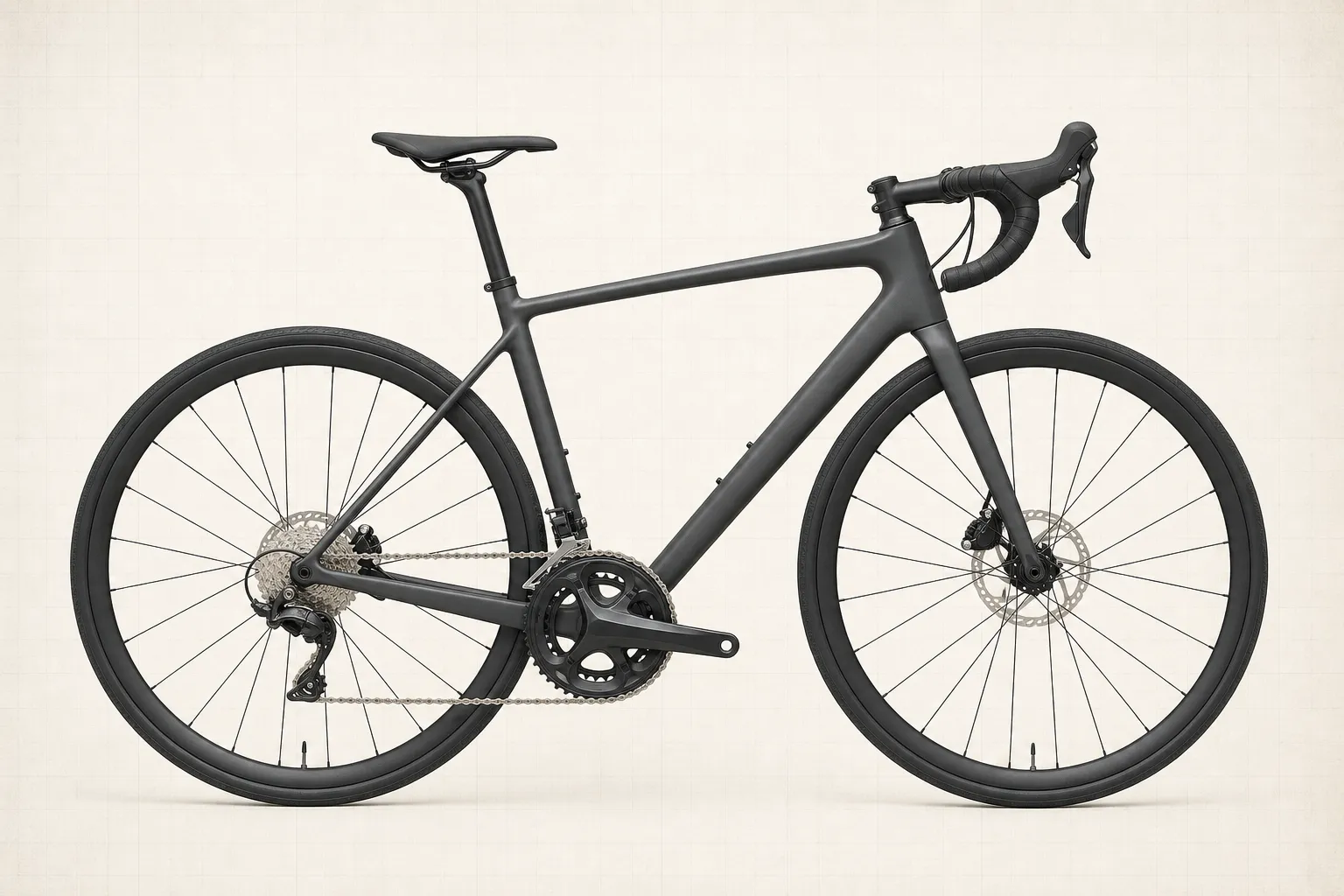 Field guide / why-knees-hurt-after-cycling
Knee pain after road cycling is not an inevitable rite of passage or a sign that your body is unsuited for the sport. Because the foot is locked into a fixed pedal path while your legs repeat 5,000 pedal revolutions every hour, the knee joint acts as a mechanical fuse between your hips and your pedals. When saddle height, cleat rotation, or gear selection are even slightly off, that repetitive load concentrates into localized irritation.
The short answer: Cycling knee pain is almost always a directional clue. Pain at the front (patella) means your saddle is too low, too far forward, or you are mashing heavy gears at a low cadence. Pain at the back (hamstrings) means your saddle is too high or set too far back. Pain on the outer side (IT band) or inner side points to cleat alignment, inadequate float, or incorrect stance width. Isolate the exact spot, spin lighter gears at 85–95 RPM, and adjust your bike in 2–3 mm increments.
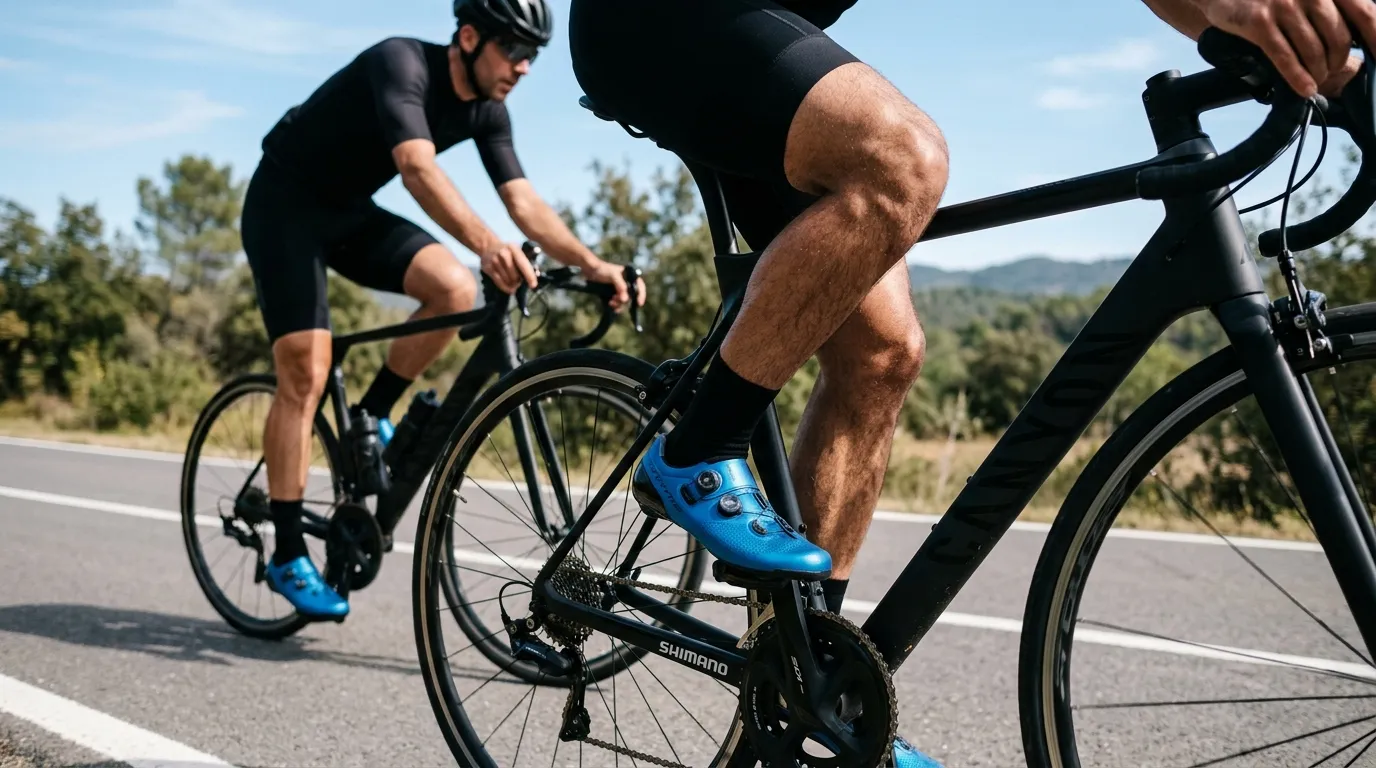
The 4-quadrant knee pain diagnostic map
Before making random adjustments to your bike, identify the precise anatomical zone where you feel discomfort. Cycling-induced knee pain rarely occurs throughout the entire joint at once—it almost always concentrates in one of four distinct zones.
| Pain Location | Anatomical Structure | Primary Bike Fit Cause | Primary Riding Habit Cause | Initial Field Fix |
|---|---|---|---|---|
| Front (Anterior) | Patellar tendon, quadriceps tendon, patellofemoral joint | Saddle too low, saddle too far forward, cranks too long | Mashing heavy gears at low cadence (under 75 RPM), excessive climbing | Raise saddle 2–3 mm; shift to easier gears; spin at 85–95 RPM |
| Back (Posterior) | Biceps femoris, semimembranosus tendon, popliteus muscle | Saddle too high, saddle too far back, excessive heel drop | Overreaching at the bottom of the stroke, locked knee extension | Lower saddle 2–3 mm; check for rocking hips |
| Outer Edge (Lateral) | Iliotibial (IT) band, lateral femoral epicondyle | Cleats pigeon-toed (heels out), zero cleat float, saddle too high | High-tension pedaling with rigid foot positioning | Increase cleat float; align heel angle naturally; lower saddle 2 mm |
| Inner Edge (Medial) | Pes anserine tendons, medial collateral ligament (MCL) | Cleats duck-footed (heels in), stance width (Q-factor) too wide/narrow | Pedaling with knees diving inward (valgus collapse) | Realign cleat angle to neutral; support foot arch with cycling footbeds |
If your discomfort is accompanied by general muscle fatigue rather than localized joint pain, read soreness versus pain on a new bike to differentiate between healthy training adaptation and mechanical overload.
1. Front of the knee (Anterior / Patellofemoral pain)
Anterior knee pain is the most common complaint among beginner road cyclists. It typically presents as a dull ache directly behind the kneecap (patella) or a sharp tenderness along the patellar tendon right below the kneecap.
Why it happens
When your knee bends past 60–70 degrees at the top of the pedal stroke (the 12 o’clock position), the patellofemoral compressive force spikes dramatically. If your saddle is set too low or shoved too far forward on its rails, your knee remains in deep flexion throughout the entire power phase (1 o’clock to 4 o’clock).
Every pedal stroke drives the underside of your kneecap against the femur with high mechanical pressure. If you also push large, hard-to-turn gears (“mashing” at 50–65 RPM), you multiply that compressive stress by hundreds of kilograms of force on every rotation.
Common causes
- Saddle height is too low: Your knee angle remains too bent at the bottom of the pedal stroke.
- Saddle is pushed too far forward: Your knee pushes excessively ahead of the pedal spindle during the power downstroke.
- Grinding heavy gears: Pushing heavy gears forces your quadriceps to generate peak torque at a sharp knee angle.
- Cranks are too long: Standard 172.5 mm or 175 mm cranks on smaller frame sizes force deep knee flexion over the top of the pedal circle.
How to fix front knee pain
- Raise your saddle by 2–3 mm: Mark your seatpost with a pencil or tape first, then raise it slightly. Test on a 15-minute flat spin.
- Increase your cadence: Drop 1 to 2 gears easier than you normally ride. Aim for a smooth, fluid spin between 85 and 95 RPM. Read our guide on how to use road bike gears to keep your cadence high on rolling terrain.
- Nudge the saddle back 2 mm: If raising the saddle does not relieve the pressure, sliding the saddle slightly rearward opens the hip angle and eases patellar tension.
2. Back of the knee (Posterior / Hamstring strain)
Pain behind the knee is less frequent than front knee pain, but it tends to be sharper and can linger for days if left unaddressed. It is felt in the hamstring tendons (biceps femoris or semitendinosus) or deep in the popliteal crease behind the joint.
Why it happens
Posterior knee pain is almost universally caused by hyperextension. When your saddle is set too high, your leg must fully straighten to reach the bottom of the pedal stroke (the 6 o’clock position).
As the pedal swings past the bottom dead center, the hamstrings and calf muscles are forced into an aggressive eccentric stretch under load. To maintain contact with the pedal, your pelvis rocks from side to side across the saddle, which over-stretches the posterior knee tendons and irritates the popliteus muscle.
Common causes
- Saddle height is too high: The leg is forced to reach for the pedal, locking out the knee joint.
- Saddle is set too far rearward: Moving the saddle back increases the total distance from pelvis to pedal.
- Cleats positioned too far forward on the shoe: Placing the cleat under the toes increases the lever arm of the foot, forcing the Achilles and hamstring to overextend at the bottom of the stroke.
How to fix back knee pain
- Lower your saddle by 3–5 mm: This is the single most effective adjustment for posterior knee discomfort. A slightly lower saddle reduces hamstring tension immediately without harming pedaling power.
- Check for hip rocking: Have a friend watch you ride on a stationary trainer or follow behind you on a quiet road. If your hips tilt side-to-side with each pedal stroke, your saddle is definitely too high.
- Slide your shoe cleats backward 2–3 mm: Moving the cleat toward the heel stabilizes the ankle joint and prevents excessive calf and hamstring strain.
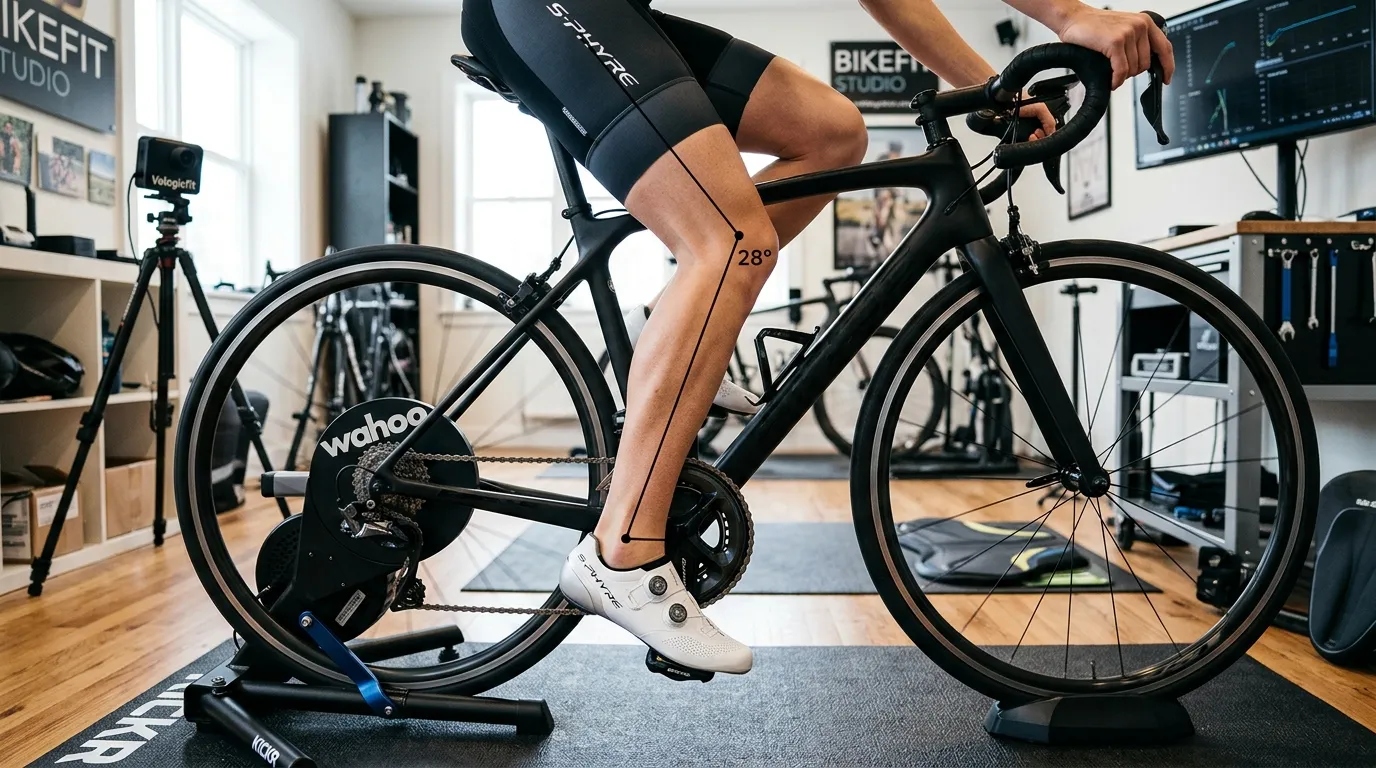
3. Outer edge of the knee (Lateral / IT Band friction)
Lateral knee pain presents as a sharp, burning, or rubbing sensation on the outside of the knee joint. It is frequently caused by Iliotibial (IT) Band Friction Syndrome.
Why it happens
The IT band is a thick fibrous band of connective tissue running down the outside of your thigh from the hip to the shin. As the knee bends and straightens through approximately 30 degrees of flexion, the IT band glides back and forth over a bony protrusion on the side of the femur (the lateral femoral condyle).
If your foot is locked into an unnatural rotation or your saddle is too high, the band rubs aggressively against the bone on every single pedal stroke—roughly 5,000 friction cycles per hour.
Common causes
- Cleats rotated pigeon-toed (heels pointed outward): Forcing your heels outward twists the tibia internally, pulling the IT band taut against the lateral condyle.
- Cleats with zero angular float: Using fixed cleats (such as Shimano red or Look black) locks the foot rigidly, transmitting all rotational forces directly into the lateral knee ligaments.
- Saddle set too high: Overextending the leg repeatedly drags the IT band through the 30-degree friction zone under maximum tension.
- Stance width too narrow: If your pedals sit too close to the crankarms for your hip width, your legs must angle inward, creating lateral tension.
How to fix outer knee pain
- Switch to floating cleats: Always ride with cleats that offer 4.5° to 6° of angular float (such as Shimano SPD-SL Yellow or Look Keo Grey). Float allows your lower leg to find its natural rotational path.
- Align cleats with your natural standing stance: Stand naturally on a flat floor in bare feet and look down at your toes. If your feet naturally flare outward by 5 degrees when standing, adjust your cycling cleats so your heels point slightly inward on the pedals.
- Lower the saddle 2–3 mm: Reducing the extension angle at the bottom of the stroke prevents the IT band from snapping tightly across the lateral condyle.
4. Inside of the knee (Medial / Pes Anserine & MCL stress)
Medial knee pain is felt along the inner joint line, near the medial collateral ligament (MCL) or slightly below the joint where the pes anserine tendons insert.
Why it happens
Medial pain is almost always a tracking and alignment issue. When you press down on the pedal, your knee should move up and down in a clean vertical plane, like an engine piston. If your foot or cleat setup forces your knee to collapse inward toward the top tube during the downstroke (valgus collapse), the connective tissues on the inside of the joint undergo excessive stretching.
Common causes
- Cleats rotated excessively duck-footed (heels pointed inward too far): Pointing the heel inward twists the lower leg externally and tensions the medial joint capsule.
- Collapsed foot arches (overpronation): Standard cycling shoe insoles are flat and flimsy. Under pedaling pressure, an unsupported foot arch collapses, causing the ankle and knee to roll inward toward the frame.
- Stance width (Q-factor) too wide: If the pedals are spread too far apart relative to your pelvic width, the knees splay awkwardly on the upstroke.
How to fix inner knee pain
- Rotate the cleat toward neutral: Loosen the cleat bolts slightly and rotate the cleat so your heel moves 1–2 mm outward away from the crankarm.
- Install supportive cycling footbeds: Replace stock flat shoe liners with rigid or semi-rigid arch-support cycling insoles to stop your foot from pronating under load.
- Check knee tracking: Ride on a stationary trainer or record yourself from the front on a phone. Ensure your knee travels in a straight line over your second toe, not diving inward toward the top tube.
Cadence vs. force: Why “mashing” destroys beginner knees
You cannot fix cycling knee pain through bike adjustments alone if your riding technique is putting excessive torque through the joint. ```text Power = Pedal Force (Torque) × Pedaling Speed (Cadence)
To ride at 25 km/h (15.5 mph), you can choose to:
- **Grind heavy gears at 55 RPM:** Generating massive peak pressure on every stroke, compressing patellofemoral cartilage under high mechanical load.
- **Spin smooth gears at 90 RPM:** Generating low peak pressure per stroke, distributing the work across your cardiovascular and aerobic energy systems.
+—————————————————————––+ | THE BIOMECHANICAL TRADEOFF | | | | Low Cadence (50-65 RPM) Optimal Cadence (85-95 RPM) | | ———————– ————————— | | * High peak torque per stroke * Low peak torque per stroke | | * Maximum patellar compression * Minimal cartilage stress | | * Strains tendons & ligaments * Loaded by heart & lungs | | * Rapid muscular fatigue * Fast recovery & endurance | +—————————————————————––+
Your aerobic system (heart and lungs) can sustain high workloads for hours and recovers in minutes. Your connective tissues (tendons, ligaments, and cartilage) have limited blood supply and take weeks or months to repair when damaged by excessive torque.

Whenever you encounter a headwind or a hill, shift down into an easier gear early. For a complete guide to finding the right gears before a climb starts, see our walkthrough on [shifting before the hill, not during the struggle](/guides/shift-before-the-hill-not-during-the-struggle/).

---

## Step-by-step diagnostic checklist

When knee discomfort appears after a ride, follow this structured, reversible diagnostic sequence.
[1. Isolate Location] -> [2. Check Cadence] -> [3. Measure Height] -> [4. Check Cleat Float] | | | | Front / Back / Keep 85-95 RPM 25°-35° knee bend 4.5°-6° float & Outer / Inner Spin, don’t mash Quiet, level hips natural foot angle
### Step 1: Mark your baseline before touching any bolts
Wrap a piece of electrical tape around your seatpost flush with the frame collar, or measure the exact distance from the center of the bottom bracket to the top center of the saddle with a tape measure. Never adjust your bike without a recorded baseline to return to.

### Step 2: Make only one adjustment at a time
Change one single variable by **2 to 3 millimeters at a time**. If you change saddle height, saddle setback, and cleat angle all in the same afternoon, you will have no idea which change solved the problem or made it worse.

### Step 3: Test on a controlled 20-minute flat route
Take the bike on a short, flat, familiar loop. Keep your pedaling smooth and your cadence at 85–90 RPM. Avoid steep hills, high-intensity sprints, or long group rides while testing fit modifications.

### Step 4: Re-evaluate with a quick comfort log
Note what you feel after 10 minutes, at the end of the ride, and the following morning:
- *Did the pain fade or move?*
- *Did your hips start rocking?*
- *Did hand or neck pressure increase?*

For a complete foundation on setting up your riding position safely, consult [beginner road bike fit and comfort](/guides/beginner-road-bike-fit-and-comfort/).

---

## When is it fit vs. when to see a medical professional?

Cycling fitness involves ordinary muscular fatigue in your quadriceps, hamstrings, and calves. However, joint pain inside or around the knee cap is a signal that mechanical overload has exceeded your tissue tolerance.

### Safe to adjust with bike fit:
- Mild, symmetrical aching that disappears within 30 minutes after spinning on flat terrain.
- Vague tightness that only appears when pedaling at very low cadences on climbs.
- Discomfort that clearly correlates with a recent change in saddle, shoes, or pedals.

### Stop riding and see a physiotherapist or doctor immediately if:
- **Sharp, stabbing pain:** Any acute pain that causes you to wince or alter your pedaling stroke.
- **Visible joint swelling or heat:** Effusion (fluid in the joint capsule) indicates acute tissue inflammation or cartilage distress.
- **Pain while walking or climbing stairs:** If normal daily weight-bearing hurts off the bike, do not ride.
- **Clicking, catching, or locking accompanied by pain:** This may indicate a meniscal or cartilage tear.
- **Numbness or tingling:** Any neurological symptoms traveling down the leg or into the foot.

---

## Your next step

Knee pain after cycling is not solved by "pushing through the pain." It is solved by identifying the exact directional clue your body is giving you and making calm, millimeter-level adjustments.

1. **Check your saddle height right now:** Perform the heel-to-pedal check detailed in [beginner road bike fit and comfort](/guides/beginner-road-bike-fit-and-comfort/). At the bottom of the stroke, your heel should rest flat on the pedal with a straight leg, giving you a slight 25°–35° knee bend when clipped in.
2. **Increase your average cadence:** Make your next three rides cadence-focused. Keep your computer or mental count locked at 85–95 RPM using your small chainring and middle cassette cogs.
3. **Verify your cleat float:** If your shoes feel locked in place with zero side-to-side wiggle room, replace your cleats with standard 4.5°–6° floating cleats before your next long ride.
4. **Complete a 5-minute pre-ride check:** Ensure your seatpost clamp bolts and pedal threads are torqued to manufacturer specification by following [the five-minute pre-ride bike check](/guides/the-five-minute-pre-ride-bike-check/).