Why hand pressure changes when you pedal harder or easier
Understand why a road-bike fit may feel balanced at higher power but hand-heavy on easy rides, and test position, support, grip, and symptoms safely.
 Field guide / why-hand-pressure-changes-with-cycling-effort
It is plausible for the same road-bike position to feel hand-heavy during easy pedalling and more supported at a stronger steady effort. Pedalling force changes how the rider braces and distributes load through the pedals, saddle, and bars. That does not prove the fit is correct at high power or wrong at low power; a useful fit must work across the efforts and hand positions the rider actually uses.
The short answer: do not use “piano-light hands” as a pass/fail rule at one wattage. Test easy, steady, and moderately hard riding while watching grip, elbow lock, pelvis stability, reach, and symptoms. Reduce sustained palm pressure through position, varied hand placement, technique, and fit—not by forcing a higher power just to unload the bars.
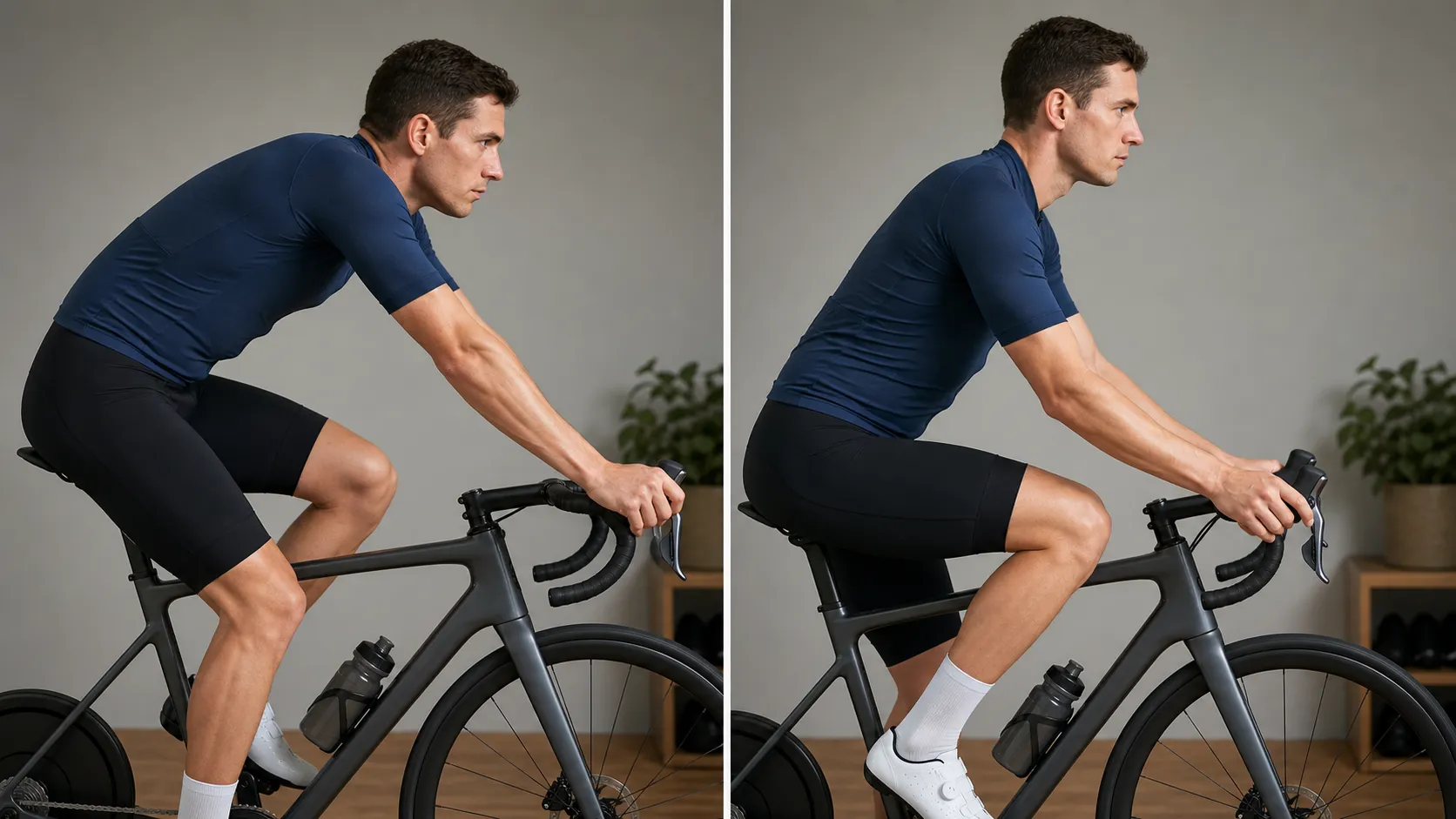
The “no weight on the hands” rule is too simple
A current r/bikefit discussion asked why the hands felt loaded around an easy effort but balanced at a substantially higher one. Advice that the hands should merely “play the piano” can be a helpful cue against death-gripping, but it is not a measurement standard.
The handlebar is a load-bearing control. Some force is normal and changes with acceleration, braking, climbing, standing, terrain, wind, body position, and power. The question is whether that load is tolerable, controllable, and free of persistent symptoms over the intended ride.
Why effort changes the contact-point balance
When pedal force rises, the rider does not simply press vertically downward. The whole body coordinates against the pedals and handlebar. Research measuring upper-limb kinetics found that crank power changed many wrist, elbow, and shoulder loading variables in both seated and standing cycling.
At a stronger steady effort, you may:
- create more supporting force through the pedals;
- stabilise the pelvis and trunk differently;
- pull or push on the bar rather than passively leaning on it;
- rotate the pelvis or trunk to a different position; and
- grip more firmly without noticing.
The result may feel like less passive palm pressure even though upper-limb forces are not necessarily lower. “My hands feel lighter” and “my arms are doing less work” are not identical claims.
Easy riding can expose a fit limitation
On a recovery ride, the pedals provide less counterforce. If the torso sits forward of a supportable position, more body weight may settle through the saddle and hands. Locked elbows, shrugged shoulders, or a pelvis that rolls backward can amplify the sensation.
That matters because beginners often spend long periods at easy power. A setup that feels acceptable only while producing a demanding effort is not automatically suitable for endurance, recovery, commuting, or social riding.
Check whether the easy position also involves:
- sliding toward the saddle nose;
- pushing backward on the hoods;
- straight, locked elbows;
- wrists bent sharply upward or inward;
- shoulders creeping toward the ears;
- inability to use the tops or drops; or
- repeated shaking of numb fingers.
These observations are more useful than a target hand-weight percentage.
Separate pressure from numbness
Pressure is a sensation. Numbness, tingling, burning, weakness, or loss of coordination suggests nerve or tissue irritation and deserves more caution.
A laboratory study of 36 experienced cyclists found that hand position changed pressure near the ulnar nerve, with the drops producing the greatest measured pressure and wrist extension in that test. Padded gloves reduced pressure, but they did not eliminate it.
That study does not prove which glove or hand position will solve an individual’s symptoms. It supports two practical ideas: sustained loading matters, and changing hand position can reduce how long one area is loaded.
Read the full numb-hands guide for finger patterns, road vibration, gloves, bar tape, and medical red flags.
Run a controlled three-effort test
Use a trainer or a quiet, familiar flat road. Keep the same hand position and normal cadence. After warming up, ride five minutes at each of:
- Very easy: recovery pace.
- Steady: normal all-day pace.
- Moderately hard: controlled, not a test or sprint.
At each effort, record:
- palm-pressure location;
- grip tension;
- elbow bend;
- shoulder tension;
- wrist angle;
- pelvic movement; and
- any tingling or weakness.
Do not lift both hands to “prove” core strength while moving. On a trainer, a brief one-hand-at-a-time relaxation can reveal whether you are gripping unnecessarily, but it cannot certify fit.
Change the low-risk variables first
Before moving components, try:
- relaxing the grip while keeping fingers ready for the brakes;
- softening rather than locking the elbows;
- changing between hoods, tops, and drops where traffic and control permit;
- standing briefly on a safe straight section;
- checking tyre pressure against tyre, rim, load, and road conditions; and
- inspecting worn or compressed bar tape and gloves.
Then verify setup:
- hood angle and transition to the bar;
- lever reach to the fingers;
- handlebar rotation;
- saddle tilt and tendency to slide;
- cockpit reach and height; and
- left-right symmetry.
Change only one variable and preserve the baseline. A sharply nose-up saddle can hold the rider back but create other pressure; a sharply nose-down saddle can make the rider brace on the bars. Neither is a reliable hand-pressure cure.
Do not force core tension for an entire ride
The torso contributes to cycling posture, but “engage your core harder” is not a complete fit prescription. Constant bracing can increase fatigue and hide an unsuitable reach or saddle position for a few minutes.
A good endurance position allows breathing, looking around, braking, eating, and changing hand position. The rider should not need race-level power or continuous abdominal effort just to keep weight off the hands.
Know when the bicycle needs adjustment
A fit review is justified when pressure is one-sided, the drops are unusable, easy riding consistently causes symptoms, or low-risk technique changes fail. Bring notes from the three-effort test. The useful question is not “How much weight should be on my hands?” but “Why does this position stop supporting my intended riding at this effort?”
Do not shorten the stem, tilt the saddle, and move the hoods in one session. Use the one-change-at-a-time fit process so improvement or deterioration has a cause.
Your next step
Run the three-effort test once and log the exact hand area, position, and effort where pressure changes. If symptoms include numbness or weakness, stop using higher power as the workaround and follow the numb-hands decision guide.
Sources and further reading
- Study: influence of position and power output on upper-limb kinetics in cycling
- Study: glove and hand-position effects on pressure near the ulnar nerve
- NHS: when recurring pins and needles need medical advice
- r/bikefit reader context: hand pressure changing with power and cadence
Reddit was used to identify the fit question. Individual diagnoses and fit rules in the discussion were not treated as evidence.