Why do bicycle bottom brackets use ball bearings?
Ball bearings suit bottom brackets because they package radial and axial load support, low friction, speed, sealing, and standardized races into a compact unit.
 Field guide / why-bottom-brackets-use-ball-bearings
Most bicycle bottom brackets use cartridge ball bearings—or loose balls in older adjustable systems—because the application needs more than raw radial load capacity. It needs low friction at pedalling speeds, some axial-load control, practical sealing, compact dimensions, predictable preload, and economical standardized parts.
The short answer: needle rollers can carry high radial load in little radial space, but a basic needle bearing does not locate the crank spindle axially. It also needs suitable hardened, accurately finished race surfaces. A bottom bracket would need extra thrust-bearing and sealing solutions, so “more contact area” does not automatically make it a better bicycle system.
Start with the loads, not the bearing shape
Pedalling bends and turns the crank spindle. The bearings experience mainly radial loads from the rider’s force and drivetrain, but the complete system must also control side-to-side position. Out-of-saddle movement, frame and spindle deflection, installation tolerances, and the crank’s preload arrangement can all create axial demands.
Ball-bearing arrangements can support radial load and, depending on groove and contact geometry, axial load. Deep-groove cartridge bearings commonly used in bicycle components are compact, low-friction, widely available, and easy to seal as a replaceable unit.
This does not mean every bottom-bracket ball bearing is identical. Systems differ in ball size, race geometry, number and orientation of cartridges, seal drag, internal clearance, preload, spindle diameter, and how the frame supports the cups.
What needle bearings do well
Needle rollers are long, thin cylinders. Their shape gives them a large contact area relative to radial thickness, so they can support substantial radial loads where space around a shaft is limited.
That sounds ideal for a bottom bracket until the rest of the design is included. A conventional radial needle roller bearing:
- primarily supports radial load;
- may require a separate thrust bearing or another locating bearing for axial load;
- needs a suitably hard, smooth, accurate inner race—or a dedicated inner ring;
- needs alignment and housing accuracy;
- still needs seals suitable for water, grit, cleaning, and long service intervals;
- must fit a crank and frame ecosystem designed around it.
SKF’s bearing guidance explicitly distinguishes ordinary radial needle bearings from combined needle-and-thrust designs. Combined designs exist, but they add another bearing function rather than proving a simple needle cartridge is a drop-in improvement.
Why ball bearings fit the bicycle compromise
They handle more than one load direction
A deep-groove ball bearing can accommodate radial load and axial load in both directions within its design limits. Paired or angular-contact arrangements can give designers more control over axial location and preload.
They run with low friction at useful speed
Bottom brackets do not rotate at motor-like speed, but low seal and bearing drag still matters. Balls have point-like contacts that become small elliptical contact patches under load. The system can run smoothly without the long sliding and alignment demands a poorly specified roller arrangement might create.
Cartridge packages are easy to seal and replace
A bearing maker can supply races, balls, cage, grease, and seals as one controlled unit. The bicycle manufacturer then designs cups or frame seats around that unit. This is cheaper and more repeatable than asking the crank spindle itself to act as a precision hardened needle-bearing race.
The ecosystem already supports them
Standard bearing sizes, manufacturing volume, service tools, and supplier knowledge all favor cartridge ball bearings. A technically possible alternative must outperform not one bearing, but the whole cost, weight, sealing, tolerance, assembly, and service system.
Bigger contact area does not settle bearing life
Bearing life depends on load, alignment, lubrication, contamination, race material and finish, internal clearance, preload, installation, and operating environment. A needle roller’s apparent contact area cannot rescue a soft or rough spindle used as a race, poor alignment, water ingress, or missing axial support.
Likewise, a large bottom-bracket spindle does not automatically leave “too little room for balls.” Designers choose bearing dimensions and locations with the expected loads, stiffness, frame interface, and service target in mind.
Premature bicycle bearing problems often begin outside the bearing catalogue:
- a frame shell outside alignment or size tolerance;
- cups installed incorrectly;
- excess or insufficient preload;
- missing or wrong spacers;
- damaged seals;
- pressure washing or contamination;
- a crank or bottom bracket combination not approved together.
Why some bicycle systems do use rollers
Roller bearings appear in some hubs, suspension pivots, pedals, headsets, and specialist bottom-bracket designs. Their presence is not evidence that every ball-bearing unit is inferior; it shows that a designer accepted a different package of load capacity, space, friction, cost, and service requirements.
A well-designed roller system can be excellent. The important word is “system.” It needs the correct races, thrust control, sealing, fit, and maintenance from the start.
Do not redesign the bottom bracket at replacement time
When a bottom bracket becomes rough or develops play, identify the exact system before ordering anything. Record:
- frame shell standard and dimensions;
- crank model and spindle specification;
- bottom-bracket model code;
- required cups, spacers, wave washers, sleeves, and preload parts;
- installation tools and torque procedure.
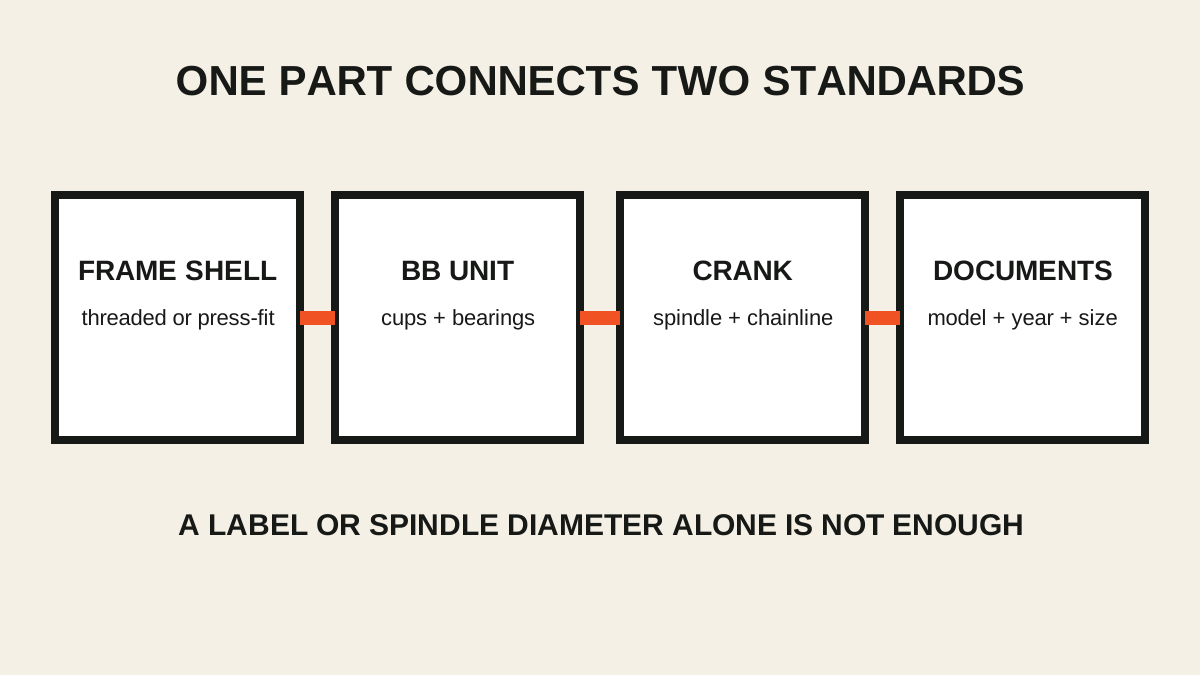
Use the bottom-bracket identification guide rather than choosing by spindle diameter alone. If the crank has side-to-side movement, follow the crank-play diagnosis before assuming the bearing itself is worn.
Pressing an “almost right” bearing into a frame or cup can damage the seat. Adding spacers to remove play can overload bearings or leave the crank incorrectly retained. The exact component documents outrank a generic bearing upgrade theory.
Your next step
If curiosity prompted the question, look up the exploded view for your crank and bottom bracket and identify how that system controls radial load, axial location, sealing, and preload. If a fault prompted it, keep the bike assembled until the exact model codes and service instructions are recorded.
Sources and further reading
- SKF rolling-bearing selection: loads and bearing types — primary bearing-manufacturer guidance on radial, axial, and combined loads.
- SKF needle roller bearing catalogue — distinguishes radial needle bearings from combined needle/thrust arrangements and race requirements.
- Shimano technical documents — model-specific user, dealer, service, and exploded-view documents for crank and bottom-bracket systems.
- Current r/bikewrench weekly questions thread — used as an editorial question signal; community explanations were not treated as engineering specifications.