What does a no-drop group ride actually mean?
A no-drop ride promises support, not a beginner pace. Ask six questions about speed, route, climbs, regrouping, the sweep rider, and your exit plan.
 Field guide / what-no-drop-group-ride-means
A no-drop group ride should not abandon a rider who cannot hold the group pace. It does not automatically mean slow, beginner-friendly, flat, or continuously together. The group might wait at hills and junctions, assign a sweep rider, or divide into pace groups. You need the procedure, not just the label.
The short answer: ask for the expected pace, distance, climbing, regroup points, named sweep, and route before you join. Choose the slowest suitable group for your first ride. Carry what you need to finish independently, and never close a gap by taking risks.
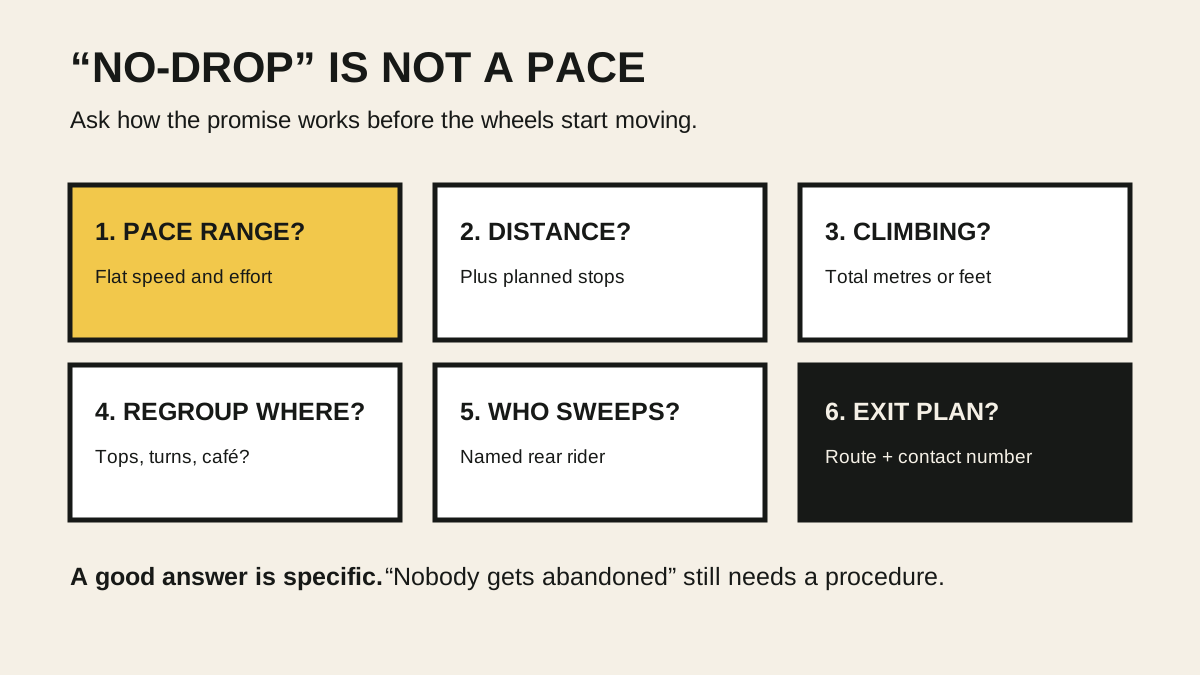
No-drop describes support, not speed
One rider’s social pace is another rider’s threshold effort. A no-drop ride can still be organised for experienced cyclists, cover a long hilly route, or move fast between planned regroup points. Drafting may make the advertised flat speed feel manageable until a climb, turn, acceleration, or mechanical problem opens a gap.
British Cycling describes a typical club run as one where faster riders wait and regroup after climbs unless the event is explicitly listed as a drop ride. That is a useful model, not a universal contract. Clubs, shops, informal groups, and online listings may use the same words differently.
Treat labels such as A/B/C, social, steady, tempo, and recovery as local vocabulary. Ask for numbers and procedures.
Ask these six questions before the start
1. What is the pace range—and where is it measured?
Ask whether the advertised speed is a moving average for the full route, a flat-road cruising speed, or the speed riders expect inside the group. Include units. “18” means very different things in mph and km/h.
Ask what happens on hills. A ride can average modestly overall but climb hard enough to split immediately.
2. How far is the route and how long does it usually take?
Distance alone misses traffic, stops, surface, wind, and climbing. Ask for typical elapsed time, planned café stops, and the latest expected return. Compare that with your longest recent comfortable ride, not your best one-off effort.
3. How much climbing and what surfaces are involved?
Request total elevation and the steepest or longest significant climb. Confirm whether “road” includes broken lanes, towpaths, hard-packed gravel, or technical descents. Tyre choice and handling confidence may matter more than average speed.
4. Where does the group regroup?
Good answers sound like “at every major turn and at the top of the two long climbs,” not “eventually.” Ask whether the whole group waits or only a sweep stays with the final rider.
5. Is there a named leader and sweep rider?
The leader sets the route and expectations. A sweep or back marker stays aware of the final riders. Ask how they communicate and what happens after a puncture, mechanical problem, or rider deciding to leave.
6. Can I have the route and a contact number?
Load the route before the ride if possible. Save the leader’s number, meeting point, train stations, and safe shortcuts. A no-drop promise should not be your only navigation or rescue plan.
Choose your first group conservatively
Join the slowest group that clearly matches your distance and handling ability. If it feels easy, move up another week. Starting low lets you learn calls, wheel spacing, rotations, junction behaviour, and local etiquette without combining every new skill with maximum effort.
Tell the leader privately that it is your first group ride. Ask where they want new riders—often near the back but ahead of the sweep—and whether you are expected to rotate through the front. The guide to finding a beginner-friendly cycling group gives more screening questions.
Avoid aerobars in a close group unless the organiser explicitly permits them and the setting is designed for their use. Keep both hands where you can brake, ride predictably, and leave a larger gap while learning. British Cycling’s beginner group-riding guidance emphasises asking questions, communicating, looking ahead, and avoiding sudden changes.
If a gap opens, do not panic-chase
The dangerous response to being dropped is often worse than the gap itself: sprinting through a junction, crossing the centre line, diving through a corner, overlapping a wheel, or descending beyond sight distance.
Instead:
- hold a controlled effort and predictable line;
- call “gap” if riders ahead can hear you;
- tell the sweep immediately if you are struggling;
- expect the advertised regroup procedure to work;
- stop safely and contact the leader if you lose the route;
- use your independent plan if the group has genuinely gone.
Being briefly behind on a climb is compatible with a no-drop ride when the group regroups as promised. Being left without notice, navigation, or contact is not.
Decide whether to continue after the first regroup
At the first stop, assess more than pride. Can you speak in full sentences? Are you eating and drinking? Are your braking and steering still calm? Is the next section harder, more remote, or farther from home?
Tell the leader early if the pace is unsustainable. A planned shortcut with a known companion may be safer than repeatedly emptying yourself to rejoin. Do not disappear without telling someone; the group may start a search.
If the ride repeatedly exceeds its published description, leave through your planned safe route and give the organiser specific feedback later: actual flat pace, where regrouping failed, and what information would have changed your decision.
Carry enough to be self-sufficient
No-drop does not mean no mechanicals. Bring a charged phone, identification, payment method, food, water, clothing for the forecast, and repair items compatible with your bike. Know how to use them or tell the leader before departure that you are still learning.
Check the bike before leaving and arrive early. The complete first group ride guide covers wheel etiquette, signals, and preparation, while five group-ride signals gives you the highest-value calls to learn first.
Your next step
Message the organiser with one compact request: “What pace range, distance, climbing, and surface should I expect; where do you regroup; is there a sweep; and can you share the route?” If the answer remains vague, choose a different ride or ask to meet the group for a shorter skills session first.
Sources and further reading
- British Cycling: what to expect on a club ride
- British Cycling: ten beginner group-riding tips
- r/cycling discussion: a first no-drop ride with an unexpectedly fast pace — used as an editorial demand signal, not as a universal definition of no-drop.