Can you store a road bike in an unheated garage?
Protect a road bike, electronic shifting battery, tyres, sealant, and metal parts from heat, cold, damp, and theft in an unheated garage.
 Field guide / store-road-bike-unheated-garage
Yes, most road bikes can live in a dry, secure, unheated garage. The frame is rarely the weak point. Persistent moisture, salt, direct sun, extreme battery temperatures, neglected tubeless sealant, and easy access for thieves matter more than ordinary seasonal temperature changes.
The short answer: store the bike clean and dry, keep it away from direct sun and corrosive chemicals, bring removable electronics indoors when the garage exceeds their published limits, and check the bike before riding after a long pause.
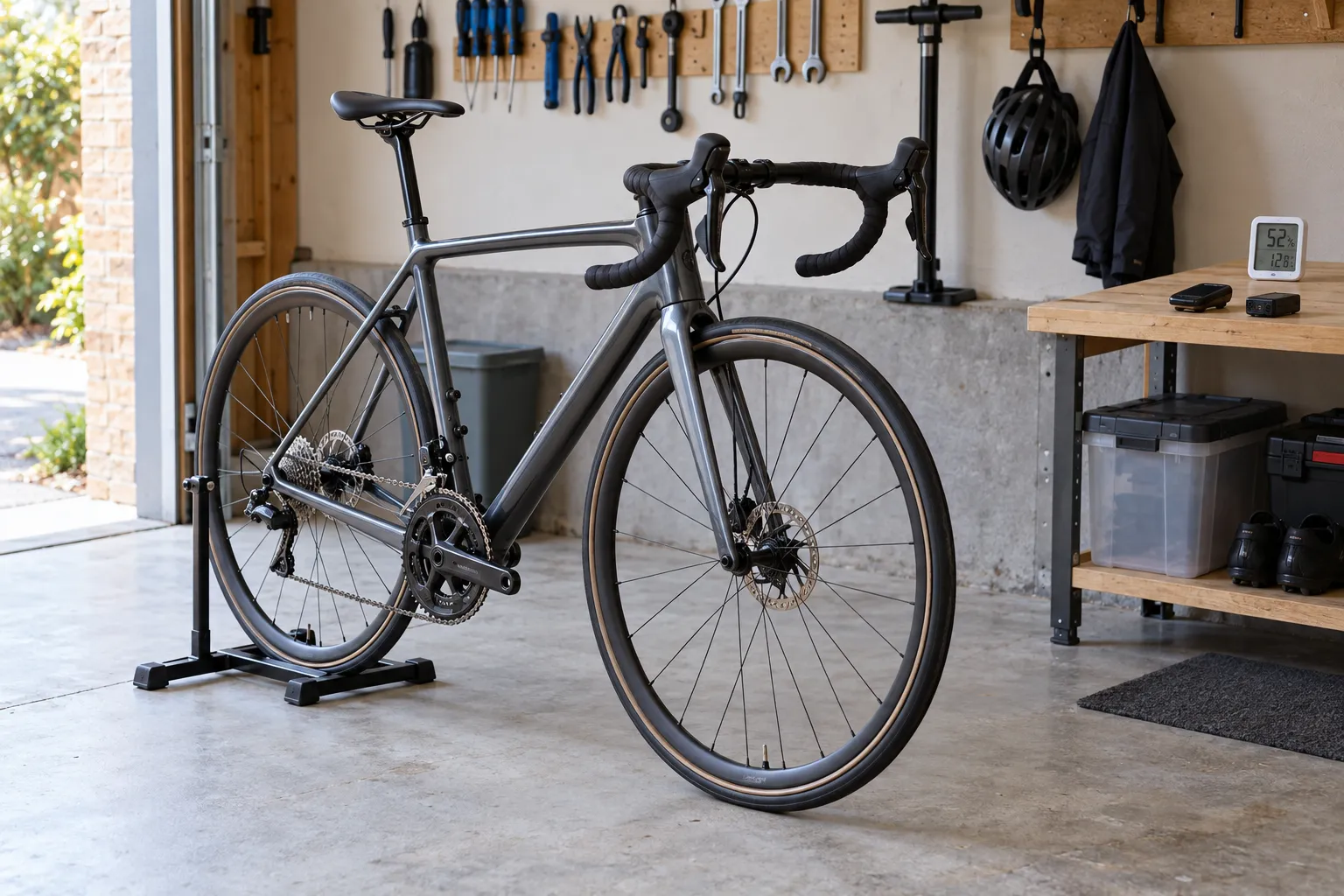
What actually threatens a stored bicycle
Temperature alone is not the whole question. Work through these risks in order:
- Theft: a closed garage is not automatically secure. Lock the frame to a fixed anchor and keep the door remote or key controlled.
- Water and condensation: a wet chain, road salt, or repeated damp-dry cycles can corrode steel fasteners, bearings, cables, and the drivetrain.
- Battery temperature: lithium-ion products have model-specific storage and charging ranges.
- Sun and chemicals: ultraviolet light, solvents, pool chemicals, fertiliser, and fuel vapours are poor neighbours for paint, rubber, and electronics.
- Long neglect: tyres lose pressure, sealant dries, batteries discharge, and existing faults become easier to miss.
A carbon frame does not need a heated bedroom. It does need protection from impacts, clamps on unsupported tubes, direct heat sources, and chemical contamination.
Treat every battery by its own manual
Electronic shifting systems do not all share one rule. SRAM publishes broad AXS storage conditions of -40°C to 70°C and says removable derailleur batteries should be removed for long storage. Shimano documentation for some built-in Di2 batteries warns that high storage temperature reduces usable time and recommends a cool indoor location for long storage.
That does not mean every garage within a published absolute range is ideal. A safer routine is:
- charge indoors within the maker’s stated charging range;
- remove SRAM-style external batteries for a long lay-up and fit their contact covers;
- leave a built-in battery installed unless its manual provides a safe removal procedure;
- bring the bike or battery indoors if the garage approaches the product’s limit;
- check charge before the next ride rather than assuming winter capacity will match summer capacity;
- store lights, cameras, radar units, and the bike computer indoors too.
Do not leave a battery permanently on a charger unless its maker explicitly permits that practice.
Control moisture before you control temperature
Put the bike away dry. After a wet or salty ride:
- Rinse contamination according to the bike and component makers’ instructions.
- Dry the frame, drivetrain, brake calipers, bolts, and exposed metal.
- Let trapped water drain before covering the bike.
- Lubricate the chain after it is dry, then wipe the outside plates.
- Use a breathable cover only if dust is a problem; do not seal a damp bike in plastic.
If the garage smells musty, tools rust, or cardboard feels damp, improve ventilation or use a dehumidifier suitable for the space. Keep the bike away from the path of a wet car, melting snow, and road-salt spray.
Tyres and tubeless sealant still need attention
Tyres slowly lose pressure in storage. That is normal, but do not leave the rim resting on a completely flat tyre for months. Inflate periodically to a modest pressure within the tyre and rim limits.
Tubeless sealant continues to age while the bike is parked. Heat can accelerate drying. Use the sealant maker’s inspection interval as a starting point, then shorten it if your climate is hot or dry. Our tubeless sealant check guide explains how to inspect without guessing.
Do not hang a bike by a hook that damages a deep-section rim or crowds a valve. A suitable wheel hook, floor stand, or padded wall rack is fine when installed correctly.
A practical garage-storage setup
- Anchor the frame with a quality lock, even behind a closed door.
- Keep the bike clear of car doors, hot exhausts, heaters, and falling tools.
- Do not clamp a carbon top tube in a repair stand for storage.
- Store torque tools, lubricants, and brake cleaners so they cannot drip onto rotors or pads.
- Put a simple thermometer or temperature logger near the bike if the garage becomes very hot.
- Keep a small card with battery model, charging range, tyre type, and last sealant check.
For outdoor storage, where rain and security risks are much harder to control, use the separate guide to storing a road bike outside.
Before the first ride after storage
Run the post-storage safety check: inflate and inspect both tyres, squeeze both brakes, check wheel retention, test every gear, inspect the chain, and confirm all electronics are charged. If you find corrosion, seized controls, battery damage, or a tyre that will not stay inflated, fix the cause before riding.
Your next step
Measure the garage’s hottest and coldest conditions, then compare those numbers with every battery manual. Set one recurring reminder for tyre pressure, battery charge, and tubeless sealant rather than relying on memory.
Sources and further reading
- SRAM eTap AXS user manual: storage and operating conditions
- SRAM guidance for storing an AXS-equipped bike
- Shimano battery storage guidance
- r/cycling demand signal: storing a high-end bike in a non-climate-controlled garage — used as an editorial question signal, not technical evidence.