Service the old bike hub or replace the wheel?
Inspect bearing type, cups, cones, axle, freehub, rim, spokes, and parts availability before paying to rebuild an older bicycle wheel.
 Field guide / service-old-bike-hub-or-replace-wheel
An old hub with dry or loose bearings may need only a careful service. A hub with damaged integral bearing cups may require a rebuild or complete wheel instead. The sensible decision depends on the whole wheel, not the price of a cone or a handful of ball bearings.
The short answer: adjust or service a sound, compatible hub when its bearing surfaces and wheel are healthy. Price a replacement wheel when cups are pitted, proprietary parts are unavailable, the rim or spokes are also near retirement, or labour approaches the cost of a suitable complete wheel.
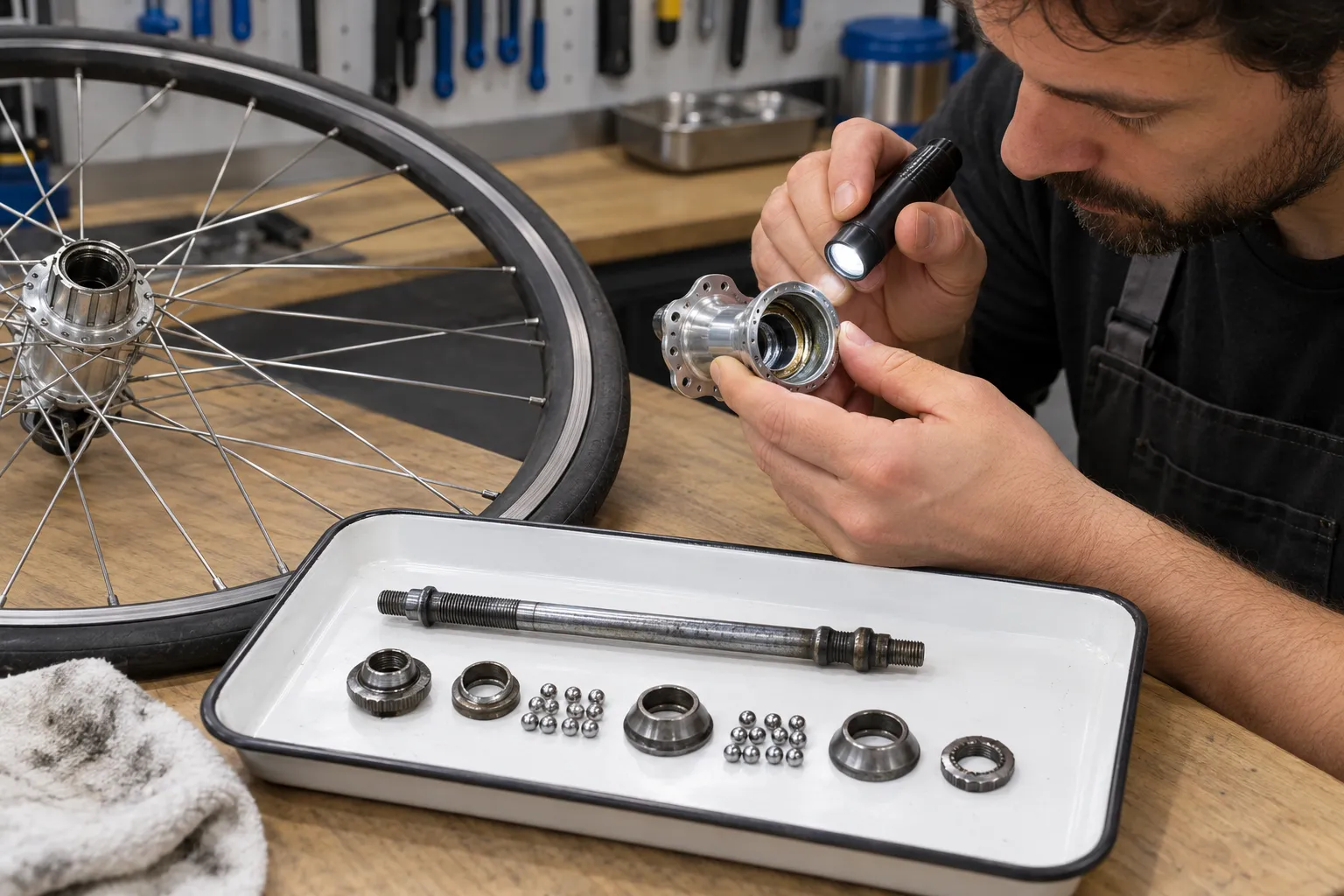
Diagnose the whole wheel before buying hub parts
A recent r/bikewrench discussion about finding a specific old hub cone drew a revealing answer from a working mechanic: the replacement cone may exist, but labour, bearings, worn races, and the condition of the rest of the wheel can make an affordable new wheel the better repair. That is not a rule to discard old wheels. It is a reminder to widen the inspection.
Start with the wheel installed securely:
- Hold the rim and push it sideways. A knock at the hub can indicate bearing play, but first confirm the axle is correctly secured.
- Spin the wheel and listen. Roughness, grinding, intermittent binding, or a freehub that slips needs investigation.
- Check whether the rim runs laterally and radially true.
- Inspect spoke tension for obvious loose or repeatedly broken spokes.
- For rim brakes, examine the entire brake track and any manufacturer wear indicator.
- For disc brakes, inspect the rim structure, rotor mount, and hub shell around spoke and flange holes.
Use our hub-play check before dismantling anything. A loose headset, brake rotor, cassette, or poorly secured wheel can imitate a hub fault.
Identify the bearing system
Two broad systems are common.
Cup-and-cone
Loose or caged balls roll between a cup in the hub shell and a threaded cone on the axle. A locknut holds the adjustment. These hubs can often be cleaned, regreased, and adjusted with cone wrenches.
Park Tool notes that cones are often replaceable, while a damaged cup is commonly integral to the shell and may mean replacing the hub. “Commonly” matters: identify the exact hub before assuming any part can or cannot be replaced.
Cartridge bearing
A sealed cartridge presses into the hub shell or an adapter. Play or roughness may require bearing replacement rather than cone adjustment. Bearing dimensions, tools, preload system, axle, and installation procedure vary by hub.
Do not turn random end caps or preload collars until you know the design. Search the hub model and read its service manual. If no model marking survives, a shop may need to measure the system directly.
Decide whether adjustment, service, or replacement is needed
Adjust only
Adjustment may be enough when grease is still present, bearing surfaces feel smooth, no contamination entered, and play comes from cones that have moved. Quick-release cup-and-cone hubs can feel slightly loose out of the frame because closing the skewer compresses the axle; adjustment must be judged in the installed state according to the hub instructions.
Overtightening to remove every trace of free movement can damage bearings. Park Tool recommends the loosest adjustment without knocking or play in the installed wheel.
Full service
Service makes sense when the hub is fundamentally sound but grease is dirty or dry. It normally includes careful disassembly, cleaning, inspection, new correct bearings where required, fresh appropriate grease, reassembly in the original spacing, and precise adjustment.
Lay parts from each side in order. Rear axle spacing affects cassette position, brake alignment, frame spacing, and whether the axle sits safely inside the dropouts. If you do not understand those relationships, stop before dismantling.
Replace parts or the wheel
Escalate when you find:
- pitted, flaking, cracked, or deeply scored cups or cones;
- a bent or cracked axle;
- damaged hub flanges or spoke holes;
- freehub slipping that cleaning or the approved service cannot correct;
- cartridge-bearing seats that are damaged or loose;
- unavailable cones, axles, seals, freehub bodies, or end caps;
- an unsafe rim, many fatigued spokes, or recurring spoke failure.
Park Tool’s cup-and-cone guide suggests tracing the cleaned bearing path with a ballpoint pen to feel pits. Replace dull bearings, but do not expect new balls to repair a pitted race.
Price the four realistic repair paths
Ask a shop to quote these separately where applicable:
- Adjustment: no full strip-down, assuming surfaces remain healthy.
- Hub service: labour, bearings, grease, seals, and any cones or axle parts.
- Hub replacement and wheel rebuild: new compatible hub, spokes, nipples, and wheel-building labour while retaining a worthwhile rim.
- Complete wheel: compatible ready-built wheel plus any cassette, rotor, rim tape, tyre, axle adapters, or setup labour.
A hub rebuild preserves a good rim and may be worthwhile for a high-quality, unusual, sentimental, or period-correct wheel. A complete wheel often wins when every part is ordinary and tired.
Do not compare a repair quote with the cheapest wheel-shaped object online. Compare compatibility, spoke count, rim width, tyre system, brake interface, axle standard, freehub body, cassette speeds, rider/system weight limit, warranty, and serviceability. Use our compatible replacement-wheel guide for that checklist.
Check compatibility before choosing a complete wheel
Record:
- wheel diameter and rim/tyre standard;
- front or rear position;
- rim-brake or disc-brake use;
- rotor interface and maximum/minimum rotor requirements where relevant;
- axle type, diameter, width, and required end caps;
- cassette or freewheel type and number of sprockets;
- freehub standard and any required spacer;
- internal rim width and tyre range;
- tubed or tubeless requirements;
- frame, fork, brake, tyre, and mudguard clearance;
- system weight rating.
If a rear wheel changes cassette position slightly, shifting may need indexing. A rotor can also sit differently between hubs, so a second wheel is not guaranteed to swap silently. Our two-wheelset setup guide explains those tolerances.
Know when this is not a beginner repair
Adjustment requires thin cone wrenches and patience. Full service adds bearing identification, axle spacing, seal orientation, freehub removal on some hubs, and contamination control. Wheel rebuilding adds spoke calculation, tension, dish, stress relief, and truing.
Use a shop when the wheel is safety-critical transport, the hub lacks documentation, the axle interfaces are unclear, damage is visible, or a mistake could compromise wheel retention. Paying for diagnosis is reasonable even if you later choose the replacement route.
If you want to learn, begin on a non-critical spare with documentation and keep a photographic record. Read how to learn bike maintenance without causing damage before opening an unfamiliar hub.
Your next step
Identify the exact hub and inspect the entire wheel. Then request an itemized service quote and compare it with one fully compatible complete wheel—not a generic price—from the same ride-ready baseline.