What is the safest time of day for road cycling?
Compare realistic ride windows by daylight, traffic, junction pressure, weather, surface visibility, and route options instead of assuming one universal safest hour.
 Field guide / safest-time-of-day-road-cycling
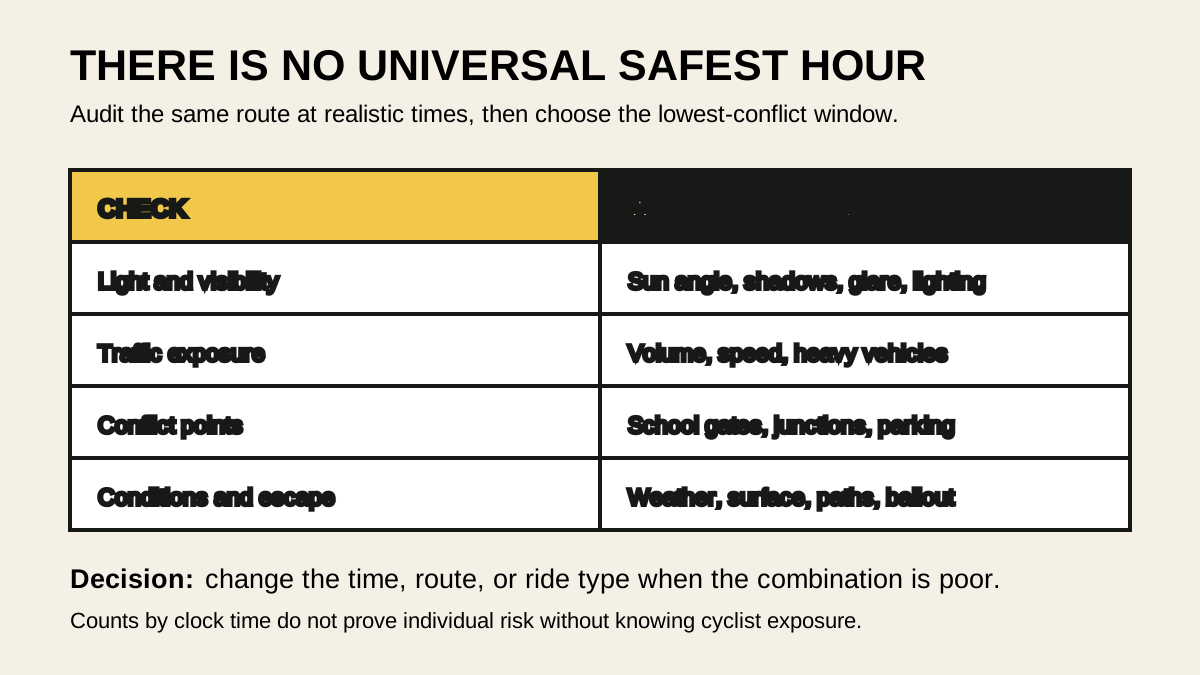
There is no universal safest hour for road cycling. A useful ride window combines enough visibility, manageable traffic speed and volume, fewer turning conflicts, suitable weather, and a route matched to your skills. Early morning is often quieter, but darkness, low sun, frost, fatigue, or impaired drivers can reverse that advantage.
The short answer: audit two or three realistic windows on the same route. Choose the lowest-conflict combination, not simply the hour with the fewest cars. If every window is poor, change the route or ride away from traffic.
Why “ride at 6 am” is incomplete advice
A popular r/cycling discussion about the days and times with least car traffic produced answers ranging from sunrise to late evening. Riders repeatedly added local exceptions: heat, rush hour, darkness, road debris, weekend patterns, and concern about impaired or fatigued drivers.
Those comments are useful demand signals, not safety statistics. Raw crash counts by clock time are also easy to misuse: without knowing how many people cycle, where they ride, and for how long in each period, counts do not reveal an individual rider’s risk.
The practical question is narrower: which available time gives this route the fewest serious conflicts for me today?
Score each realistic ride window
Choose two or three times you could genuinely use. Score each from one (poor) to five (good) for these factors.
1. Light and visibility
Can you see surface defects, debris, people, animals, and turning vehicles soon enough to respond? Can drivers see you against the background?
Dawn and dusk create changing light, long shadows, and low-angle glare. Full darkness removes useful visual information even when good lights make riding possible. NHTSA recommends bright clothing during the day, reflective gear, and a white front light plus red rear light and reflectors at night or in poor visibility. Exact legal requirements vary, so check local law.
2. Traffic volume and speed
Fewer vehicles can reduce interactions, but quiet roads may encourage higher speeds. Observe both volume and behaviour:
- Are vehicles moving in stop-start congestion or at open-road speed?
- Is there a usable cycleway or shoulder?
- Are heavy vehicles common at this hour?
- Does traffic bunch after a signal, shift change, school opening, or event?
A separated route at a busier hour may be preferable to an unlit high-speed road when nearly empty.
3. Junction and kerbside pressure
Count turning and crossing conflicts, not only passing traffic. School gates, delivery windows, commuter parking, driveways, shopping streets, and transit stops can change sharply through the day.
Watch one full signal cycle at major junctions from a safe off-road position. Note turning streams, queue spillback, cycle-signal phases, and whether drivers block sight lines.
4. Weather and surface
The coolest hour is not always the safest surface hour. Before dawn can bring frost, condensation, fog, poor drainage visibility, or debris hidden beyond the beam. Evening can bring falling temperatures and tired riders.
Check:
- rain and visibility;
- temperature and ice risk;
- wind and exposed sections;
- sun direction on key approaches;
- whether your return trip will be darker or hotter than the outward trip.
5. Your alertness and support options
A quiet road is a poor choice if you are sleep-deprived, rushing, or unable to see clearly. Consider whether shops, transit, friends, or pickup options are available if weather, a mechanical problem, or illness ends the ride.
Common ride windows and their tradeoffs
| Window | Possible advantage | Check before choosing it |
|---|---|---|
| Around sunrise | Lower heat, daylight arriving, often lighter traffic | Low sun, cold surfaces, school or commuter traffic on return |
| Mid-morning weekday | Rush hour may have passed | Deliveries, commercial traffic, heat, limited schedule access |
| Midday | Stronger daylight and open services | Heat, glare, air quality, busy shopping roads |
| Late afternoon | Good daylight in some seasons | School release, rush hour, low sun, rising traffic |
| After evening peak | Traffic may ease | Rapidly fading light, fatigue, entertainment traffic |
| Full night | Sometimes fewer vehicles | Reduced visibility, surface detection, personal security, impaired or fatigued drivers |
| Early weekend morning | Often calmer roads and lower heat | Event traffic, darkness by season, late-night drivers |
This table is a hypothesis list. Local observation decides which rows apply.
Audit without taking an unsafe test ride
You do not need to cycle every option before choosing.
- Map a short route with an off-road or low-conflict alternative.
- Visit key junctions on foot, by transit, or from a safe stationary location at candidate times.
- Check local traffic maps, roadworks, school schedules, weather, sunrise, sunset, and air quality.
- Ask a local cycling organisation about recurring hazards, without treating one person’s preference as proof.
- Make the first ride short and easy, with a bailout route.
- Re-score the window immediately afterward.
Start with the first road-cycling route planner and favour physical separation, low-speed streets, simple junctions, good surfaces, and easy turnaround points.
Use lights as equipment, not permission
Working lights and reflectors matter in darkness and poor visibility. They do not make every road or speed appropriate. Aim the front light so it reveals the surface without dazzling others, make sure luggage and clothing do not obscure either light, and carry enough battery for delays.
The bike-light guide separates a light that helps others detect you from one that lets you see an unlit road. If the route requires more light, handling, or battery margin than you have, choose another route or time.
Prefer route changes over tiny timing gains
Moving a ride by 30 minutes may help, but a parallel low-speed street, protected cycleway, path, or start point beyond the busiest section can remove more conflict. Consider:
- taking transit or driving the bike to a safer start;
- riding short local loops instead of one exposed road;
- reversing the loop to avoid low sun at critical junctions;
- doing the interval portion indoors and the easy portion outside;
- using a group only when its pace and road behaviour suit you.
The goal is not to prove road bravery. It is to build a repeatable ride with fewer demanding decisions.
Recheck by season and direction
A good summer window can become a dark winter commute. Construction, schools, shift patterns, vegetation, and road surfaces also change. Repeat the audit when:
- sunrise or sunset moves across your normal ride;
- the weather changes materially;
- a route is resurfaced or rebuilt;
- you lengthen the ride into new traffic periods;
- your return direction places low sun behind or ahead of drivers;
- a previously calm window begins to feel unpredictable.
If riding near traffic still feels too exposed, use the road-cycling risk-reduction guide to separate controllable choices from risks you cannot eliminate.
Your next step
Choose one familiar short route and two realistic times. Score light, traffic speed and volume, conflict points, weather and surface, alertness, and bailout options. Use the stronger combination for a short test ride, then update the score from what you observed. If neither is acceptable, change the route—not your definition of acceptable risk.
Sources and further reading
- NHTSA: bicycle safety and visibility guidance
- Physical Activity Guidelines: choosing safe environments, times, and conditions
- UK Highway Code: current rules and visibility guidance for cyclists
- r/cycling reader context: discussion of lower-traffic ride times — used as an editorial question signal; anecdotes were not treated as verified safety outcomes.