How to return to cycling after an illness
Use symptoms and your response to a short easy ride to rebuild cycling gradually after an acute illness without chasing old power numbers.
 Field guide / return-to-cycling-after-illness
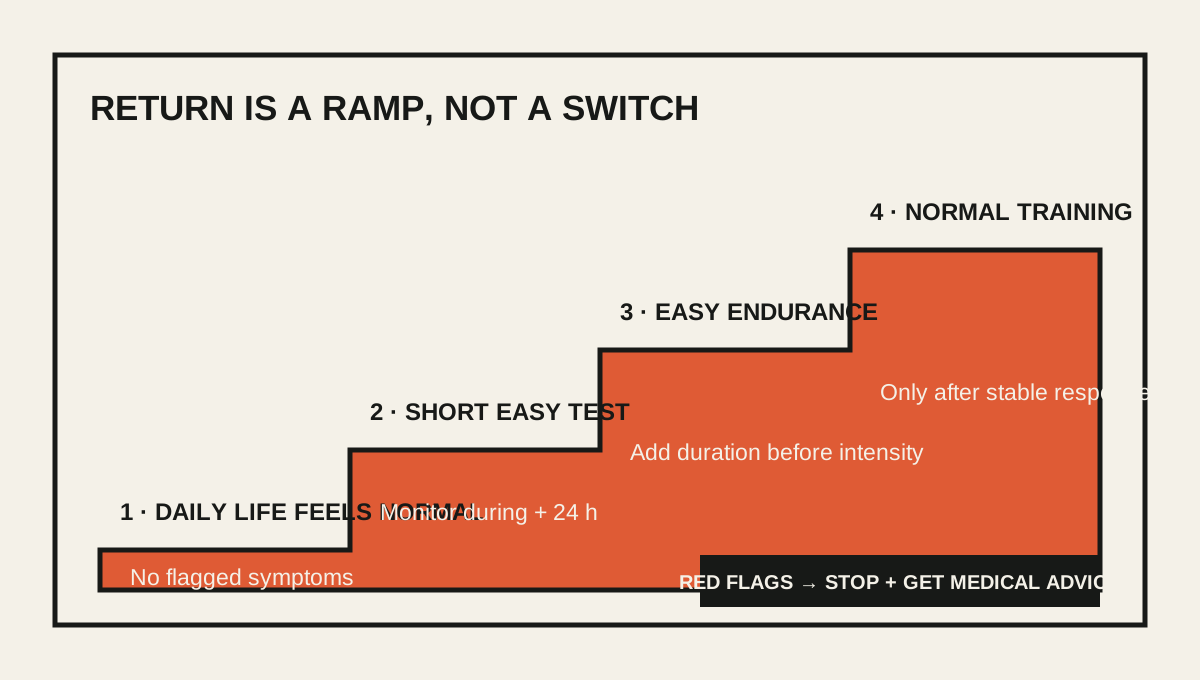
After an uncomplicated acute illness, return to cycling as a progression: normal daily activity, a short easy test, easy endurance, and only then normal training. Do not start by proving that your old power, pace, or distance is still there.
The short answer: resume only when symptoms are resolved or very mild and no concerning signs are present, then use an easy exercise challenge and monitor how you feel during the ride and afterward. Add load gradually when the response is normal. New chest symptoms, fainting, unusual breathlessness, palpitations, or deterioration need medical assessment—not a tougher recovery ride.
Do not use a fixed number of rest days
“Wait three days” or “anything above the neck is safe” is too crude to clear every illness. Cause, severity, duration, medical history, complications, medication, and the response to daily activity all matter.
The International Olympic Committee’s consensus on acute respiratory infections treats return to sport as a continuum. It recommends screening symptoms and risk first, then using an exercise challenge when appropriate and monitoring the response as training increases. Severe illness or possible involvement beyond the respiratory tract needs clinical assessment.
This guide is a conservative framework for rebuilding after an acute illness that has resolved. It is not a diagnosis and does not cover every infection, long-term condition, surgery, medication effect, or post-viral syndrome.
Clear the health question before the training question
Before riding, ask:
- Are normal daily tasks comfortable again?
- Are symptoms resolved or mild and improving rather than worsening?
- Are fever and systemic symptoms gone?
- Can you eat, drink, and sleep adequately?
- Has a clinician given specific restrictions that override a general guide?
- Is there any new chest pain or pressure, fainting, unexplained racing or irregular heartbeat, or breathlessness that feels disproportionate?
Do not train through a red flag to see whether it warms up. If the illness was severe, required hospital care, affected several organ systems, or left continuing symptoms, ask a clinician familiar with your situation before returning.
For COVID-19 specifically, guidance has evolved and personal risk varies. The American College of Cardiology recommends further evaluation when cardiopulmonary symptoms such as chest tightness, worsening exertional shortness of breath, palpitations, light-headedness, or syncope are present. Follow current local public-health rules as well as medical advice.
Stage 1: let ordinary activity become ordinary again
Walking around the home, climbing normal stairs, working, and completing routine tasks should not produce an alarming or worsening response. This is not a fitness test. It is a check that everyday load is tolerable.
Avoid “making up” missed training with extra sessions. Fitness loss after illness can be real, but one hard ride cannot restore it. It can only add stress before you know how recovery is progressing.
Use this pause to make the bike ready: inflate the tyres, check brakes and wheel security, and prepare an easy bailout route. The five-minute pre-ride check keeps the first ride from becoming a mechanical test too.
Stage 2: use a short, easy exercise challenge
Choose a flat, familiar route close to home or a well-ventilated indoor setup. Ride alone or with someone who understands that the session may end early. Avoid traffic complexity, technical descents, remote roads, heat, and a hard group pace.
Keep the effort conversational and deliberately easier than normal. The purpose is to observe, not train. Pay attention to:
- breathing relative to the easy workload;
- chest sensations;
- dizziness, light-headedness, or unusual coordination problems;
- palpitations or a heart response that feels unfamiliar;
- muscle weakness or fatigue far beyond the task;
- recurrence or worsening of illness symptoms.
Stop if anything is concerning. A shortened ride is a successful decision, not a failed workout.
Power, speed, and heart rate may differ from pre-illness values. Wind, temperature, hydration, medication, sleep, detraining, and incomplete recovery all affect the numbers. Do not force the old output to make a screen display look normal.
Stage 3: monitor beyond the ride
The session is not cleared simply because nothing happened in the first ten minutes. Record how you feel later that day and the next day: symptom recurrence, unusual exhaustion, sleep disruption, excessive soreness, or a marked drop in normal function are reasons not to progress.
If the response is normal, repeat or modestly extend easy riding. If it is unclear, hold the same load or rest. If it is worse, step back and consider medical advice, especially when the pattern repeats.
A simple log needs only date, ride duration, perceived effort, relevant symptoms during the ride, and the later response. Avoid turning one wearable metric into a medical verdict. HRV, recovery scores, and training-readiness numbers can add context, but they do not diagnose recovery or overrule symptoms.
Stage 4: add load in an order you can interpret
Build one dimension at a time:
- Duration: extend easy riding while the response remains stable.
- Frequency: add another easy day only when recovery between rides is normal.
- Moderate work: reintroduce steady effort before maximal efforts.
- Intensity and group demands: return to intervals, sprints, long climbs, racing, or fast groups last.
This order is not a prescription with fixed percentages. It is a way to know what changed if symptoms return. Your illness, baseline, age, medical history, and time away can justify a faster or slower progression.
When you are ready to rebuild a week, returning after a long break and how many days a beginner should ride provide conservative scheduling ideas.
Do not compare recovery power with peak power
Peak form is a poor baseline immediately after illness. It encourages riders to turn an observation ride into a test. Instead, use process goals:
- complete the easy ride without flagged symptoms;
- finish with energy in reserve;
- recover normally by the next day;
- repeat a stable week before adding a demanding session;
- stop while the decision is still yours.
Your first lower power number is not a forecast of your final level. Return to performance follows return to participation; they do not happen on the same day.
Common mistakes
Joining a group for motivation: the pace, distance, weather, and social pressure are harder to control. Begin with a route you can shorten.
Testing on a climb: gradient can force intensity even when your intention is easy. Use flatter terrain or very low gearing.
Stacking several good days: feeling better can tempt you to restore full volume and intensity at once. Keep one change at a time.
Treating fatigue as a character problem: persistent or disproportionate symptoms are information, not laziness. Get qualified advice rather than trying to out-discipline an illness.
Changing the bike during recovery: a new saddle, cleat position, or aggressive fit introduces another source of discomfort and fatigue. Keep the setup familiar unless a safety issue requires repair.
Your next step
If daily activity feels normal and you have no red flags or medical restrictions, plan one short, flat, easy ride with an immediate bailout option. Record your response during the ride and through the following day. Progress only after a normal response; if symptoms recur or the response is concerning, stop and seek appropriate medical advice.
Sources and further reading
- IOC consensus statement on acute respiratory infections in athletes
- American College of Cardiology expert consensus on cardiovascular symptoms and return to play after COVID-19
- r/cycling discussion: returning after illness and a major performance setback — used as an editorial demand signal, not medical evidence.
- r/cycling discussion: returning after a six-month break — used as a recurring rider-question signal, not training evidence.