How to replace short car trips with a bike—one reliable trip at a time
Audit routes, choose a practical bicycle, test work and grocery trips, add secure carrying and locking, and keep a backup until the routine is dependable.
 Field guide / replace-short-car-trips-with-bike
Before you view or pay
Check fit, condition, and starter gear first
Use the buying checklist to choose the right path: used-bike viewing, first-bike fit and type, hidden repair costs, or starter gear.
Replacing car journeys with bicycle journeys works best as a series of small operational tests. You do not need to sell the car, buy a cargo bike, or promise to ride through every storm before learning whether one commute or grocery trip works.
The short answer: list your shortest, most frequent trips and choose one low-consequence route to test. Use a bicycle that fits, stops, accepts the required cargo, and can be locked at both ends. Ride the route without a deadline, then repeat it on a normal day. Expand only after the journey is reliable in both directions.
Start with the trips, not a bike category
A current r/bicycling discussion asked how to begin replacing work and grocery travel with a bicycle. A separate commuter discussion asked whether a short, mildly hilly journey required a road bike or hybrid. The answers named many bicycle types, but the useful decision starts with the journeys.
Make a seven-day trip list:
| Trip | One-way distance | Cargo | Arrival constraint | Secure parking | Hardest condition |
|---|---|---|---|---|---|
| Work | |||||
| Groceries | |||||
| Station | |||||
| Local appointments |
Circle the shortest trip with daylight, flexible timing, low cargo, and a clear bailout. That is the first test. Do not start with the journey whose failure makes you late for a 12-hour shift.
Audit the route in both directions
The shortest map line may use the fastest traffic, most difficult junction, or steepest hill. Compare alternatives using:
- traffic speed and volume;
- protected lanes, calm streets, and shared paths;
- junction complexity and door zones;
- lighting and personal visibility after dark;
- surface, drainage, leaves, ice, or debris;
- gradient in both directions;
- railway, bus, taxi, or walking bailout;
- shops, repair help, and safe places to stop.
Walk, drive, or use street imagery to inspect uncertain sections, then make the first ride at a quiet time. NHTSA’s general bicycle-safety guidance recommends route planning and notes that a route with less and slower traffic—or one away from traffic—may be safer.
Use the first-route planning guide for the turn-by-turn audit.
Choose the simplest bicycle that completes the job
For a short work or grocery journey, a sound hybrid, flat-bar road bike, older mountain bike with suitable tyres, gravel bike, road bike with mounts, folding bike, or city bike may all work. The label matters less than these functions:
- Fit and control: you can start, stop, look behind, signal, and operate both brakes.
- Gearing: the easiest gear suits the longest hill with work clothes and cargo.
- Tyres: they fit the surface, load, and clearance and can be repaired locally.
- Cargo: the frame safely accepts a rack, basket, or approved bags if you need them.
- Weather: full-length mudguards, lights, and corrosion-resistant practical parts are available.
- Parking: the bicycle’s value and locking plan match where it will wait.
- Support: wear parts, manuals, and local service are available.
A road bike is attractive when the route is longer, speed matters, and you enjoy drop bars. A hybrid or city bike often makes short, stop-start trips easier to equip. A gravel bike can combine drop-bar efficiency with mounts and wider tyres, but it is not mandatory for a four-mile commute.
Compare the complete deal with road bike or gravel bike for commuting and weekend rides and the first-bike buying checklist.
Price the transport system, not only the bicycle
Your ready-to-use total can include:
- bicycle inspection or assembly;
- front and rear lights plus charging routine or dynamo system;
- locks appropriate to the parking risk;
- rack, basket, panniers, straps, or approved trailer;
- mudguards and weather clothing;
- pump, tube or repair kit, and a practised recovery plan;
- helmet where you choose or are required to use one;
- workplace storage, locker, or spare clothing;
- an initial service and consumables.
Do not spend the entire budget on frame or groupset. A less glamorous bicycle with secure cargo and a dependable lock replaces more trips than an unprepared race bike.
Carry the load on the bicycle when possible
A backpack is simple for a first test, but heat, weight, and long shifts can make it unpleasant. A rack and pannier keep the load stable and off your body. A front basket can work for small loads when the bicycle is designed and approved for it.
Check the load rating for the frame, rack, bags, wheels, tyres, and any child or cargo attachment. Keep heavy items low, balanced, and secured so nothing can enter a wheel. Then practise:
- starting on a slight hill;
- controlled braking from normal speed;
- looking behind without swerving;
- low-speed turns;
- lifting or parking the loaded bicycle.
Never discover at the supermarket that a bag swings into the spokes.
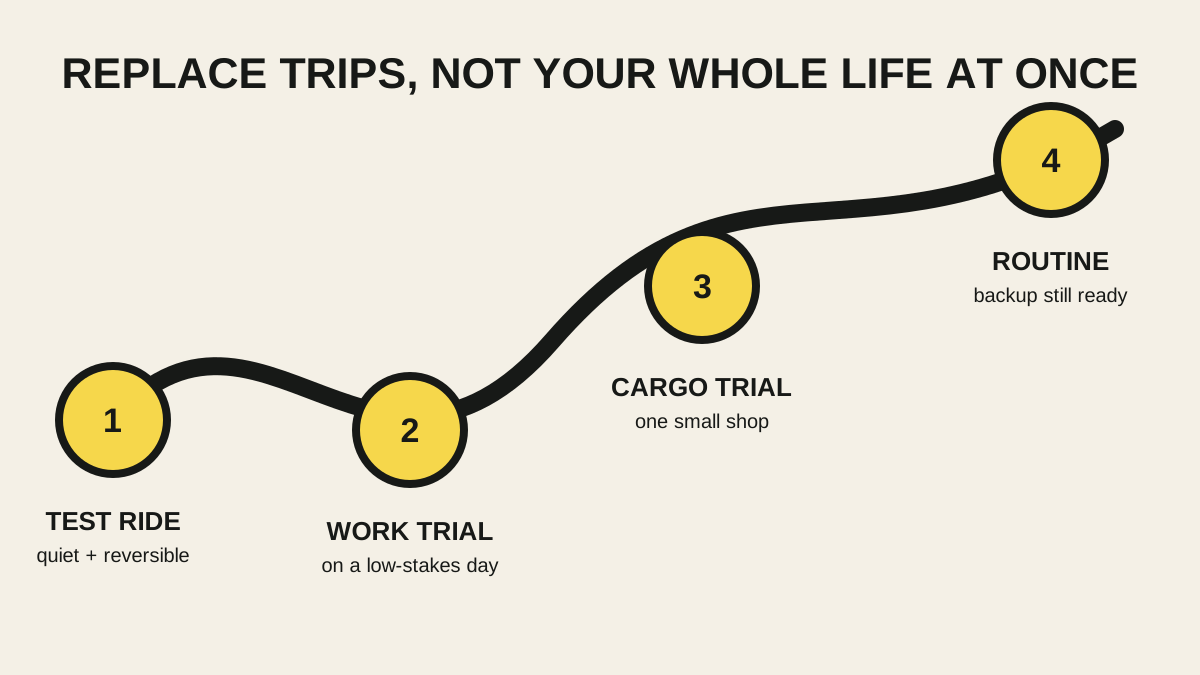
Run four low-risk trials
Trial 1: route only
Ride the journey at a quiet time with no deadline and almost no cargo. Mark confusing junctions, poor surfaces, hard climbs, and places to stop.
Trial 2: realistic clock
Ride at the actual departure time, but on a day when being late has no consequence. Include dressing, unlocking, loading, parking, and changing—not only moving time.
Trial 3: realistic load
Carry the normal work bag or buy one small grocery load. Confirm the bicycle remains stable and the lock fits the real stand.
Trial 4: round trip
Test the return when you are tired and conditions differ. A morning downhill can become an evening climb; daylight can become darkness; a quiet shop car park can fill.
Only after all four work should the trip become the default.
Keep a deliberate backup
Reliable transport includes failure paths. Decide in advance:
- what happens after a puncture you cannot repair;
- where the bicycle can stay overnight securely;
- whether public transport accepts it;
- who can collect you and the bicycle;
- what weather or fatigue triggers another mode;
- how work clothes, laptop, or groceries stay dry;
- when the bicycle gets its next condition check.
Keeping a car, transit pass, taxi budget, or lift option during the trial period is not failure. It makes the experiment reversible and prevents one mechanical problem from ending the habit.
Use the commuting adaptation guide to scale frequency without turning every ride into a test.
Expand by reliability, not enthusiasm
Add only one new difficulty at a time:
- another day per week;
- a longer trip;
- darkness;
- heavier cargo;
- colder or wetter weather;
- a second destination.
Track simple outcomes for a month: door-to-door time, whether you arrived composed, failures, repair cost, and which trips you still avoided. Do not invent savings by ignoring locks, maintenance, or backup transport. Do not invent fitness gains either; the first success metric is that the journey happened safely and repeatably.
Your next step
Choose one round trip under an hour total. Inspect the route, confirm secure parking, and ride it this week without a deadline or important cargo. Write down the single largest friction point and solve that before shopping for upgrades.
Sources and further reading
- NHTSA: bicycle fit, working brakes, visibility, and lower-traffic route planning
- r/bicycling reader context: gradually replacing car journeys with bicycle trips — used as a current trip-planning signal; product opinions were not treated as universal recommendations.
- r/bikecommuting reader context: choosing a bicycle for a short work journey — used as a recurring practical-demand signal.