Older high-end or newer entry-level used road bike?
Compare fit, tyre clearance, braking, parts support, condition, and immediate repair cost before choosing specification over age.
 Field guide / older-high-end-vs-newer-entry-level-used-road-bike
Before you view or pay
Check fit, condition, and starter gear first
Use the buying checklist to choose the right path: used-bike viewing, first-bike fit and type, hidden repair costs, or starter gear.
An older race bike is not automatically better value because it once cost more, and a newer entry-level bike is not automatically safer because it is newer. For a first road bike, fit, condition, serviceability, useful tyre clearance, and the complete ride-ready cost matter more than its old place in a product range.
The short answer: choose the bike that fits, passes a condition and recall check, accepts tyres and gearing suitable for your roads, and remains affordable after immediate service. Prefer the newer bike when it reduces hidden risk and proprietary-part problems; prefer the older high-end bike only when its condition and support are genuinely verified.
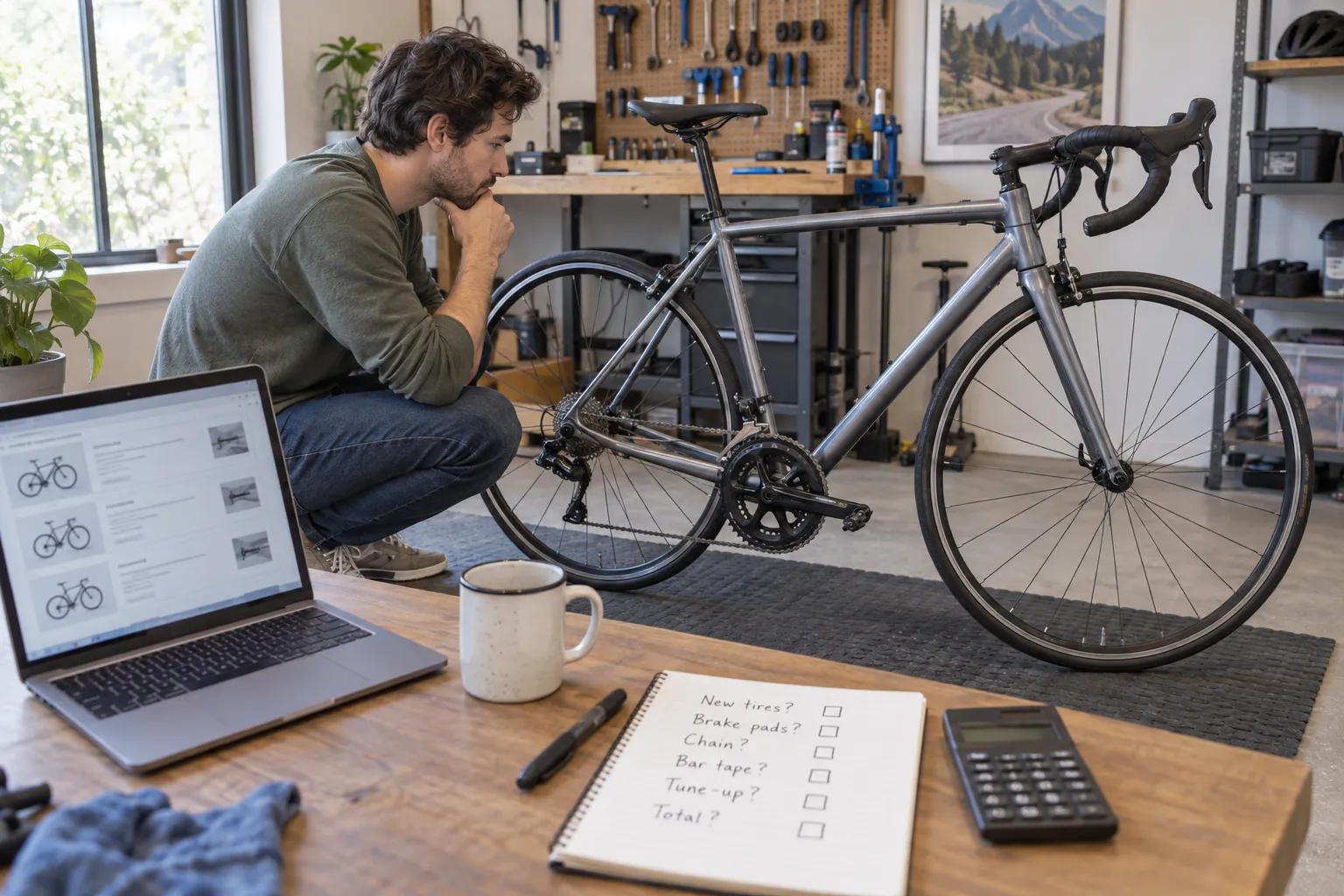
Why old retail price is a weak guide
A current used-bike thread compared road bikes from the mid-2000s through 2023 within a small first-bike budget. The list included older performance models and newer entry-level endurance bikes. That is a common search problem: should the buyer purchase yesterday’s premium equipment or today’s simpler platform?
The original price does not tell you:
- whether this frame is the right size;
- how it was crashed, stored, or serviced;
- how much braking surface or drivetrain life remains;
- whether replacement hangers, bearings, rims, and cockpit parts exist;
- what tyre size actually clears the frame and brakes;
- whether a recall applies to this model and serial range.
Compare present utility and risk.
Start with five non-negotiables
Reject any candidate that fails one of these:
- Fit: you can achieve a sensible saddle position and reach both brakes securely.
- Structure: frame, fork, wheels, cockpit, and seatpost have verifiable condition and no unresolved damage.
- Braking and wheel security: controls, pads, rims or rotors, axles, and tyres can be made safe within budget.
- Ownership and identity: serial number, seller story, model, and specification are credible.
- Repair path: a compatible worn or damaged part can still be sourced and fitted.
A prestigious logo does not compensate for one failed non-negotiable.
Where the newer entry-level bike often wins
A newer, simpler road bike may offer:
- more generous tyre clearance;
- easier access to current consumables;
- less accumulated corrosion and wear;
- geometry intended for a wider range of recreational riding;
- documented original specification and current manuals;
- a better chance of finding matching wheels, hangers, and drivetrain parts;
- remaining seller paperwork or transferable support, where applicable.
None of these is guaranteed. Some newer bikes use proprietary cockpits and hidden routing that increase service cost. Confirm the exact model rather than assuming “modern” means simple.
Where the older high-end bike can win
A well-kept older performance bike may have a light frame, good wheels, precise mechanical controls, and excellent ride quality for the price. It can be a strong choice when:
- it fits without extreme stems or saddle positions;
- its history and structural condition are credible;
- consumables have measurable life remaining;
- the gearing suits your terrain;
- the tyres clear your required width with safe margin;
- critical replacement parts are still available;
- a mechanic’s inspection does not erase the price advantage.
Buy it for the verified bike it is now, not because a review called it superb fifteen years ago.
Compare the constraints that affect every ride
Tyre clearance
Older rim-brake race bikes may have limited space at the frame, fork, and brake calipers. A nominal tyre size does not guarantee measured width on a particular rim. If you want wider tyres, inspect actual clearance rather than trusting comments about a whole model family.
Gearing
Older race gearing can be unnecessarily demanding for a beginner in hilly terrain. Price the compatible cassette, chain, derailleur, and possibly crank changes as a system—not as one cheap sprocket.
Brakes and wheels
Inspect rim braking surfaces for wear and damage, or disc rotors and pads for remaining thickness and contamination. A premium wheel with a worn-out rim is not a premium asset.
Proprietary parts
Check the derailleur hanger, seatpost, headset bearings, fork hardware, cable guides, and cockpit. One unavailable small part can retire an otherwise functional frame.
Build a ride-ready price
Add the asking price to everything required now:
| Item | Candidate A | Candidate B |
|---|---|---|
| Purchase and travel | ||
| Mechanic inspection | ||
| Tyres and tubes or sealant | ||
| Chain, cassette, and cables | ||
| Brake pads, rotors, or rim issue | ||
| Bearings and wheel service | ||
| Fit parts such as stem or saddle | ||
| Pedals and essential gear | ||
| Ride-ready total |
Keep a contingency for faults that cannot be tested at the viewing. If the budget only works when every consumable is perfect, the bike is outside the budget.
Check recalls by exact identity
Search the manufacturer’s safety notices and your national recall database using the exact model, year, and serial information. The US Consumer Product Safety Commission provides a searchable recall database and notes that affected ranges can be specific to model and serial number.
Do not conclude that an entire brand is unsafe because one model was recalled, or that a similar-looking bike is clear because its name is slightly different. Follow the notice exactly and verify whether the remedy was completed.
Use a weighted decision, not a specification contest
Give each bike a score out of five for:
- fit and control;
- structural confidence;
- braking and wheel condition;
- tyre and gearing suitability;
- parts availability;
- ride-ready cost;
- seller credibility.
Double the weight of fit, structural confidence, and braking. Do not give bonus points for carbon, electronic shifting, or a higher old groupset unless those features improve your actual use without adding unresolved cost.
Walk away from the unbelievable deal
A very new or high-value bike at a small fraction of normal used prices deserves more verification, not faster payment. Walk away from a hidden serial number, inconsistent ownership story, refusal of inspection, pressure to pay before viewing, stock photographs, or unexplained structural repair.
Use how to avoid buying a stolen used bike before arranging the viewing.
Your next step
Put no more than three bikes into the ride-ready table, then inspect the strongest candidate using the used-road-bike checklist. If age remains the concern, read how old is too old for a used road bike before paying.
Sources and further reading
- US Consumer Product Safety Commission recall search
- CPSC guidance on matching exact products and serial ranges to recall notices
- r/cycling reader context: comparing older performance bikes with newer entry-level bikes under €500
- r/whichbike reader context: pricing a small used road bike and its immediate consumables