How to make a gravel bike faster on the road
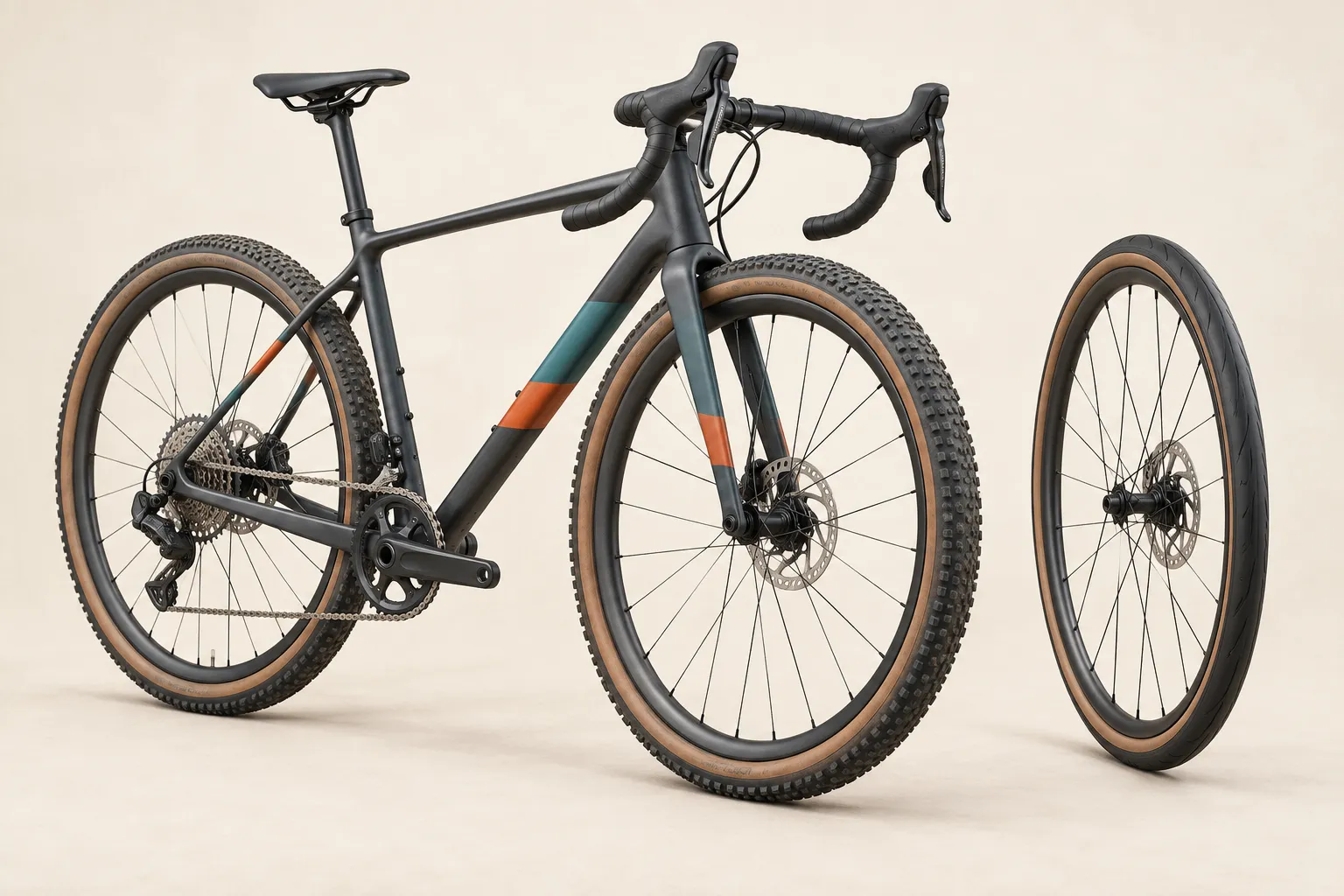
Start with tyres and pressure before buying wheels or another bike. Use this compatibility checklist to make a gravel bike feel quicker on pavement without losing the versatility you need.
 Field guide / make-gravel-bike-faster-on-road
Before you buy
Check the starter kit first
Print the one-page buying brief for helmet, lights, water, phone, and repair compatibility before comparing upgrades.
A gravel bike can become noticeably better on pavement without immediately buying a road bike. Start with a suitable slick or lightly treaded tyre and a measured pressure. Only add a second wheelset after the tyre experiment proves useful and you know exactly which compatibility problem the extra wheels will solve.
The short answer: tread, casing, compound, pressure, riding position, and gearing matter more than the word “gravel” on the frame. A fast 32–40 mm tyre can make a gravel bike feel livelier on the road. It will not turn relaxed geometry, wide handlebars, or low 1x gearing into a race bike, but those differences may not matter for solo rides, commuting, or many social groups.
Why this question keeps coming up
A current r/cycling discussion asks whether to trade a gravel bike for a road bike or fit road wheels. Other repeated questions ask whether road tyres alone are worth fitting, while a highly discussed post describes using a gravel bike with slick tyres as an all-road solution.
Those experiences show demand, not a universal speed result. Two tyres with the same printed width can use different casings, compounds, tread, and measured widths. Riders also compare different positions, routes, weather, and effort. Use the discussions to frame the decision, then test your own bike.
Change the tyre before the wheelset
If the existing tyre has tall, widely spaced knobs for loose ground, replacing it with a supple slick or low-profile all-road tyre is the cleanest first test. You keep the same hubs, rotors, cassette, and wheel fit, so fewer variables can create noise or poor shifting.
Choose by the surfaces you actually ride:
| Your normal riding | Practical starting tyre |
|---|---|
| Almost all clean pavement | Road slick in a width approved for the rim and frame |
| Pavement with rough shoulders and occasional firm gravel | Wider slick or file-tread all-road tyre |
| Regular loose gravel, mud, or rocky tracks | Keep tread and volume appropriate to that terrain |
| Frequent road and rough-gravel changes | Two wheelsets may become more convenient than repeated tyre swaps |
Do not assume narrower automatically means faster. A tyre that is too narrow or overinflated for a rough road can bounce, lose grip, and feel slower. Conversely, a large knobbly tyre can waste energy through tread movement on smooth pavement. The useful comparison is between complete tyre systems at appropriate pressures, not width alone.
Check compatibility before ordering
Read the tyre and rim makers’ current compatibility information. At minimum, confirm:
- The bead-seat diameter matches. A common road and gravel marking is
622, but the complete size matters. - The tyre width is approved for the rim’s internal width.
- A tubeless tyre and rim are explicitly compatible if you will run without a tube.
- The inflated tyre leaves the frame and fork clearance required by the bicycle maker, including room for debris and wheel flex.
- Your planned pressure stays within every relevant tyre and rim limit.
Schwalbe’s technical guidance notes that the rim can change the tyre’s actual width and that the lower maximum pressure of the tyre or rim governs. Measure the installed, inflated tyre rather than trusting the nominal label when clearance is close.
Use tyre pressure for beginner road cyclists to establish a sensible baseline. More pressure is not a free speed upgrade; the maximum printed pressure is not a target.
Decide whether a second wheelset earns its cost
A second set makes sense when you change surfaces often enough that swapping tyres becomes the reason you avoid a ride. It is a convenience upgrade first. It can also let you keep a tough gravel tyre and a road-focused tyre ready to go.
Before buying, match all of these:
- front and rear axle type, diameter, length, and hub spacing;
- wheel diameter and frame/fork clearance;
- disc rotor mounting interface and required rotor diameter;
- freehub body and cassette compatibility;
- cassette speed and range that the derailleur supports;
- rim type, internal width, and tyre compatibility;
- any manufacturer restrictions for the frame, fork, or drivetrain.
Even nominally matching wheels can place a brake rotor or cassette a fraction differently. After a swap, spin both wheels, squeeze both brakes, and shift through every gear on a stand before riding. Rotor shims or a small indexing correction may be needed. If you are not certain, use the compatible replacement wheel checklist or ask a mechanic to verify the complete system.
Know what tyres cannot change
Road-focused tyres will not alter:
- Riding position: a taller front end and wider handlebar can create more aerodynamic drag at speed.
- Steering character: frame geometry and fork trail still shape how quickly the bike responds.
- Gearing: some 1x gravel drivetrains have larger steps between gears or less high-end range than a road double.
- Mass and accessories: bags, racks, heavy tubes, and robust components remain part of the system.
These are not automatic faults. Easier gears, stable steering, and a less aggressive position can be advantages on steep, rough, or long rides. The question is whether they interfere with your actual goal.
Use a three-ride test instead of guessing
Run the same safe loop in similar conditions:
- Record the current tyre model, measured width, pressure, wind, ride time, and perceived effort.
- Fit the compatible road or all-road tyres and set an appropriate pressure.
- Ride once to check installation, braking, and handling rather than chasing a result.
- Repeat the loop twice at a controlled effort.
- Compare comfort, confidence, coasting, acceleration, gear choice, and whether you can stay with your intended group.
Average speed is affected by traffic, wind, fitness, and pacing, so do not treat one ride as a laboratory test. The most useful result may simply be that the bike feels quieter and easier to keep moving.
When a road bike is the cleaner answer
Consider a dedicated road bike when you consistently want a lower position, closer gear steps, sharper handling, race-specific equipment, or a second bike that remains ready while the gravel bike keeps its off-road setup. Try to test ride before selling a bike that already fits.
If the current bike is new and the urge to replace it comes mainly from category labels, start with the tyre test. If the frame, fit, or gearing is fundamentally wrong for your goal, stop buying upgrade parts and use the road bike buying checklist to compare the full cost of changing bikes.
Your next step
Write down your real surface split and the limitation you feel: tread drag, missing high gears, large gear jumps, riding position, or handling. If tyres are the main issue, verify tyre-rim-frame compatibility and test one road-focused set before pricing wheels or another bike.
Sources and further reading
- Schwalbe road-bike tyre and rim compatibility guidance
- Schwalbe tyre-width and inner-rim-width compatibility table
- r/cycling reader context: current gravel-to-road decision
- r/cycling reader context: repeated road-tyre question
- r/cycling reader context: high-engagement discussion of slick tyres on a gravel bike