Is a 60 mm or 70 mm stem too short for a road bike?
Decide whether a shorter road-bike stem is a sensible fit change by checking reach, steering, compatibility, installation, and the frame-size problem underneath it.
 Field guide / is-short-stem-safe-on-road-bike
A 60 mm or 70 mm stem is not automatically unsafe or “wrong” on a road bike. It is, however, a large change from a typical longer road stem, and it may be evidence that the frame, handlebar, hood position, or riding goal deserves a closer look. Judge the complete position and handling—not the number alone.
The short answer: a shorter stem can reduce reach and may make a suitable bike more comfortable. Confirm compatibility, preserve safe headset assembly, and test steering progressively. If you need an extremely short stem just to reach the brakes, or the bike still feels too long elsewhere, solve the frame-size or cockpit problem rather than stacking compensations.
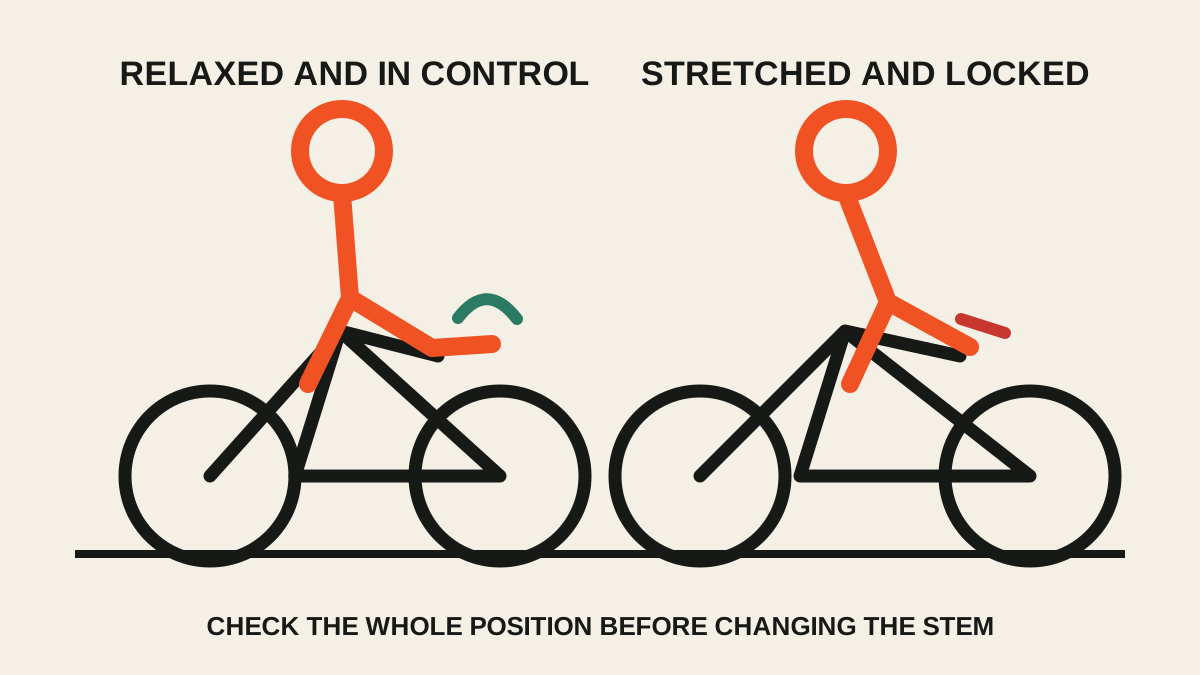
Start with the symptom, not the stem length
A current Reddit fit discussion asked whether moving from an 80 mm stem to 70 or 60 mm would be too short while adapting a gravel bike for more road use. That is a useful recurring question because a stem can be easy to buy but difficult to evaluate in isolation.
Write down what you are trying to change:
- hands cannot rest on the hoods without locked elbows;
- shoulders stay lifted or tense;
- brake levers are difficult to reach;
- the pelvis slides forward to shorten the cockpit;
- the drops are unusable even on easy roads; or
- the bike is comfortable, but the stem merely looks unusual.
Only the first five describe a functional problem. Appearance is not a fit diagnosis.
Measure the whole cockpit first
Record the existing setup before moving anything:
- stem length and angle;
- spacer arrangement above and below the stem;
- handlebar reach and width;
- hood position on the curve;
- saddle height, tilt, and fore-aft position; and
- saddle-to-hood horizontal and vertical distance.
Do not push the saddle forward solely to reach the bars. Saddle position should first support stable pedalling. Read how to set saddle fore-aft before using it as a cockpit adjustment.
A compact-reach handlebar or correctly positioned hoods can shorten the hand position without changing the stem as much. Conversely, a very long-reach bar can cancel much of a short stem’s benefit.
Understand what a shorter stem changes
Reducing an 80 mm stem to 70 mm moves the handlebar clamp roughly 10 mm closer along the stem’s axis. Stem angle and stack mean the actual hand movement is not purely horizontal.
The change can:
- reduce shoulder and elbow extension;
- alter weight distribution between saddle, pedals, and hands;
- make steering inputs feel more immediate;
- change knee clearance while riding out of the saddle; and
- require hose, cable, computer-mount, or integrated-cockpit checks.
“Faster steering” does not automatically mean dangerous handling. The outcome depends on the bike’s geometry, bar width, tyre, speed, load, terrain, and rider. A touring or gravel bike may legitimately use a shorter stem than a race bike. Test the actual bicycle rather than applying one universal road rule.
Check whether the frame is the underlying problem
A shorter stem is a reasonable adjustment when the frame’s saddle position, front-centre, handling, and height all work and the remaining reach error is modest.
Pause before buying when:
- the seatpost is also at an extreme;
- there is no safe way to achieve the required handlebar height;
- toe overlap or knee-to-bar clearance is already troublesome;
- the rider cannot use the brakes after hood adjustment;
- several stem sizes have failed; or
- the proposed setup exists only to rescue a clearly oversized frame.
Use the too-big-or-too-small road-bike checks and compare the actual geometry, not only the size label. A different model in the same named size can have a meaningfully different reach and stack.
Verify compatibility before installation
Match the stem to the exact handlebar clamp diameter and fork-steerer diameter. Confirm that the stem’s clamp height works with the available steerer and the required top-cap relationship. Integrated cable routing, proprietary spacers, one-piece cockpits, and carbon steerers may impose additional restrictions.
The Trek bicycle manual warns that incorrect headset or stem assembly and incorrect torque can damage the steerer and lead to failure. That principle applies beyond Trek: use the instructions for the exact bicycle, fork, stem, and handlebar, with the lowest applicable torque limit where components specify different maxima.
After installation, the headset must turn freely without play, the stem must align with the wheel, and every cable or hose must remain free through the full steering range.
Test one step at a time
If the hardware permits it, try a 10 mm reduction before a 20 mm reduction. Keep saddle and hood variables unchanged so the result means something.
Test in this order:
- Stationary brake access and full left-right steering.
- A quiet, flat car park at low speed.
- Normal braking, looking behind, and riding out of the saddle.
- A familiar easy route with corners and a mild descent.
- A longer ride only after control feels predictable.
Record hand pressure, elbow bend, shoulder tension, steering confidence, and whether the drops became usable. Return to the baseline if one measure improves while control or another contact point gets worse.
Know what success looks like
The successful stem is not the shortest one. It lets you use the hoods and brakes with relaxed shoulders and softly bent elbows, keeps the bike predictable, and stays within every component’s installation limits.
If the result depends on gripping harder, avoiding the drops, or moving the saddle away from a stable pedalling position, it has not solved the fit.
Your next step
Measure the present saddle-to-hood position and identify the symptom you want to change. Trial the smallest sensible, fully compatible change, then log it with the one-change-at-a-time bike-fit method.
Sources and further reading
- Trek bicycle owner’s manual: headset and stem assembly safety
- r/bikefit reader context: whether 60–70 mm is too short for a road-oriented gravel setup
Reddit was used to identify the fit question. The individual setup and health history in the discussion were not treated as fit evidence.