How to tell if your road-bike reach is too long
Separate an overlong cockpit from low bars, poor hood placement, saddle problems, and normal adaptation before buying a shorter stem.
 Field guide / how-to-tell-road-bike-reach-too-long
Reach is probably too long when you cannot use the hoods and brakes with relaxed shoulders and slightly bent elbows during ordinary riding—after saddle position, handlebar height, hood position, and riding intensity have been checked. One still photo or a feeling of “looking stretched” is not enough.
The short answer: first restore a stable saddle position, record how you ride under a normal pedalling load, and check whether you can brake from the hoods without sliding forward or locking your elbows. Only then test a modest cockpit change.
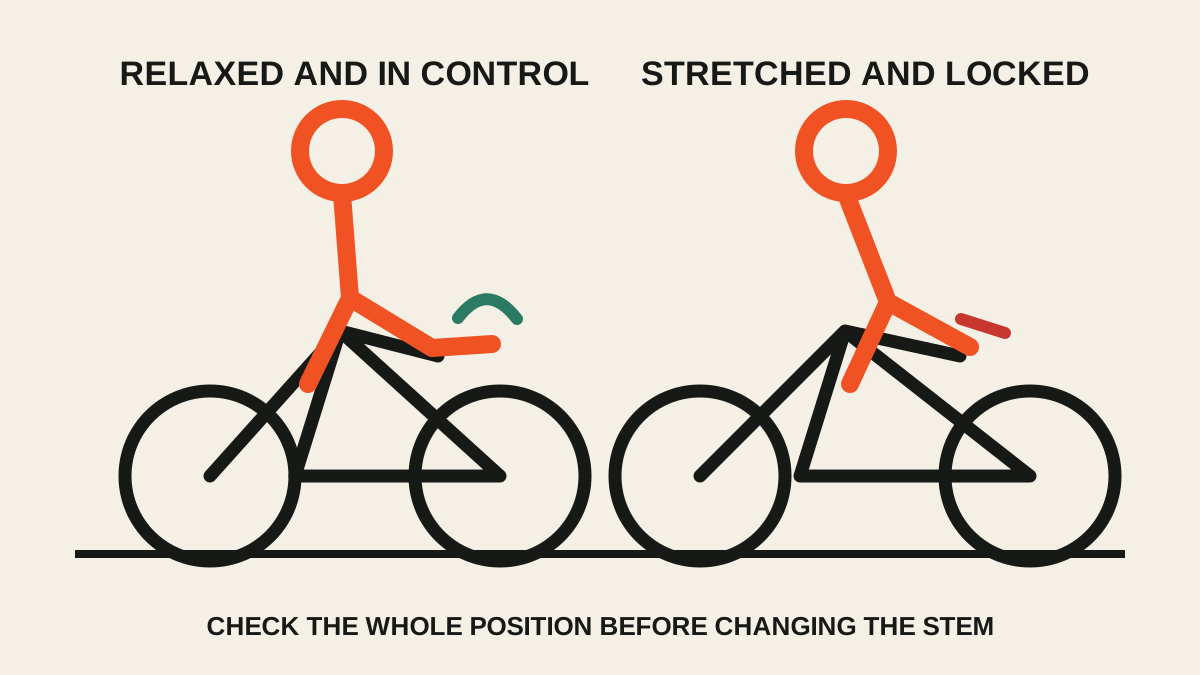
Five signs that point toward excessive reach
Look for a pattern rather than one symptom:
- your shoulders stay shrugged or pulled forward on easy rides;
- your elbows lock even when you consciously relax;
- the heel of your hand sits behind the hood instead of naturally wrapping it;
- braking from the hoods requires a second reach or a hand shuffle;
- you repeatedly retreat to the bar tops because the hoods feel unavailable.
The pattern should appear at a sustainable pace, not just while coasting. Pedalling force changes how the body supports itself. A side-on video on a stable indoor trainer is helpful, but it is evidence—not a remote diagnosis.
Rule out the lookalikes first
A saddle that is wrong
Moving the saddle forward makes the bars closer, but the saddle is primarily a pedalling-support adjustment. Using it to solve reach can change knee position, hip angle, and weight distribution. A saddle that tips down can also make you slide forward and brace against the bars, which feels like a long cockpit.
Start with saddle height and check whether you are sliding forward. Do not move the saddle several centimetres to avoid buying the correct stem.
Bars that are too low
Low and long feel similar, but they are not the same adjustment. If the hoods feel reasonable when you sit taller yet become unreachable when you hinge forward, limited drop or current mobility may be the issue. Our guide to raising road-bike handlebars explains the safe options and steerer limits.
Hoods installed too far forward
Handlebar reach, bar rotation, and hood placement all contribute to the hand position. Controls mounted far around the curve can add meaningful reach even with a sensible stem. Confirm the bar and controls are installed within their manufacturers’ markings before changing parts. Hydraulic controls or internally routed cables may make this a shop job.
A frame that is fundamentally too large
A short stem can reduce hand reach, but it cannot change standover clearance, stack, front-centre, or every handling consequence of frame size. If you need an extreme stem, cannot reach the brakes safely, or cannot obtain a stable saddle position, check the frame rather than continuing to compensate. See too big or too small.
Test one change without losing your baseline
- Mark the current saddle height, saddle setback, spacer order, bar rotation, and hood position.
- Record a side video while riding easily and then at a normal steady effort.
- Write down where discomfort begins, which hand position you use, and whether you can reach both brake levers immediately.
- Change one variable only. For a conventional stem, a small step in length or angle is easier to interpret than a dramatic jump.
- Tighten every fastener to the component maker’s torque and clamping instructions.
- Repeat the same short route or trainer session before judging the result.
Do not copy a stranger’s stem length. Two bikes with the same labelled frame size can have different frame reach, bar reach, hood shape, and stack. Two riders of the same height can have different proportions, mobility, and goals.
When a shorter stem is a reasonable answer
A shorter stem is a sensible test when the saddle is stable, the handlebar height is usable, the hoods are correctly placed, and your controls remain too far away. It may also help when a bike sits between sizes and the change remains within the bike and component makers’ permitted setup.
Expect steering to feel a little different because the hands move closer to the steering axis. That does not make every short stem unsafe, but it is a reason to avoid huge changes made by guesswork. Integrated cockpits can be expensive and compatibility-specific; test fit with a shop before ordering if possible.
Your next step
Take a 20-second side video at your normal steady effort and make a four-column note: saddle stability, shoulder tension, elbow position, and brake access. If all four point to excess reach, ask a fitter or shop to let you test the next sensible stem length while preserving the original setup.