How to store spare bicycle tyres without damaging them
Keep spare bike tyres cool, dark, dry, clean, lightly supported, and clearly labelled—without crushing beads, adding sharp bends, or exposing rubber to heat and chemicals.
 Field guide / how-to-store-spare-bicycle-tyres
Before you buy
Check the starter kit first
Print the one-page buying brief for helmet, lights, water, phone, and repair compatibility before comparing upgrades.
Store spare bicycle tyres in a cool, dark, dry place away from heaters, direct sunlight, ozone-producing equipment, fuel, solvents and sharp objects. Keep the original packaging when practical, avoid crushing the beads, and support loose tyres broadly rather than hanging months of weight from one narrow hook.
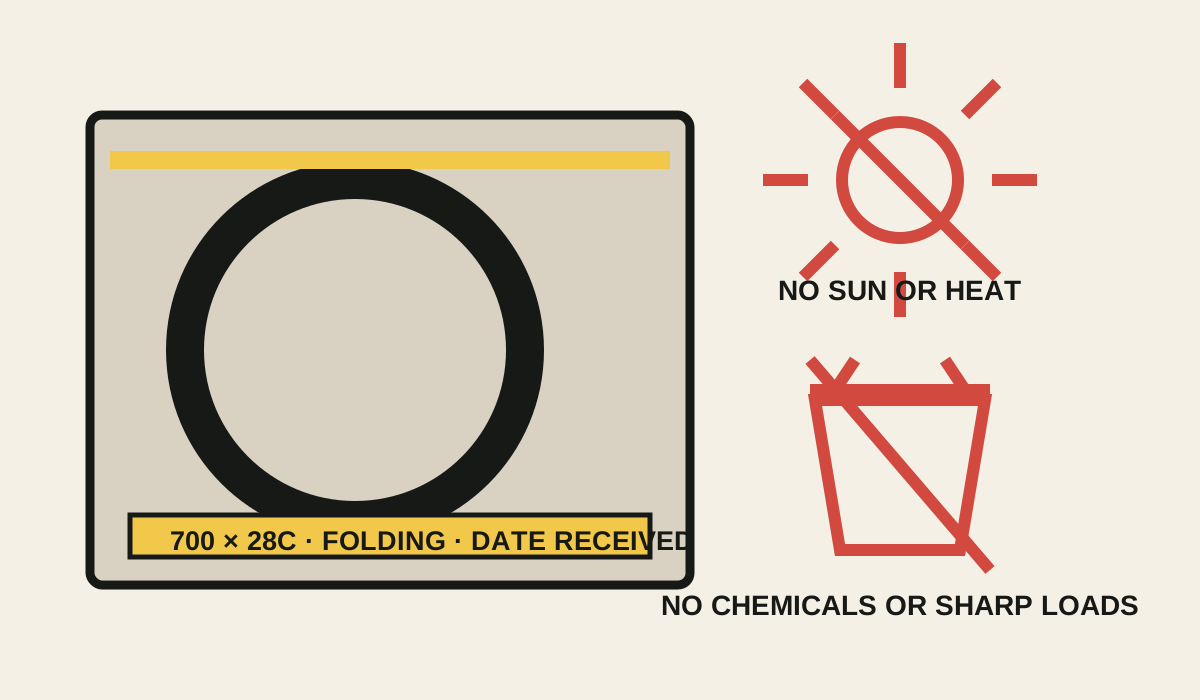
The short answer: a labelled box or clean shelf inside a temperature-stable room is better than a hot shed, sunny window or oily workshop corner. Folding tyres may stay in their factory fold; do not force a wire-bead tyre into a small package. Inspect every stored tyre before fitting because good storage slows deterioration—it does not stop time.
Pick the right place
Rubber compounds and casing materials deteriorate faster with heat, ultraviolet light, ozone and chemical exposure. Continental’s bicycle-tyre guidance notes that extreme temperatures shorten tyre life. Schwalbe advises that a bicycle stored on its tyres should remain inflated or be hung so a flat tyre is not loaded in one position.
A good home storage location is:
- indoors or otherwise protected from temperature extremes;
- out of sunlight;
- dry and ventilated without constant condensation;
- away from electric motors, welders and other potential ozone sources;
- separate from petrol, oil, brake cleaner, solvents and pesticides; and
- inaccessible to rodents and pets.
An attic under a dark roof, a boiler cupboard and a car boot may be dark but still become very hot. A garage shelf can work when temperatures are moderate and chemicals are stored separately.
Preserve the bead shape
The bead locks the tyre to the rim, so avoid storage that kinks, crushes or abrades it.
Folding-bead tyres: keep the maker’s original fold and band when possible. If repacking, use broad loops and no sharp reverse crease. Do not cinch cable ties tightly enough to mark the casing.
Wire-bead tyres: store at their full circular size. Stand them upright with broad support, lay them flat without a heavy stack, or hang them from a smooth, wide rail that distributes load. Do not fold a wire bead, squash it beneath wheels, or suspend it from a nail.
Tubular tyres: follow the tyre maker’s storage and pre-stretching instructions. Glued tubular systems add adhesive age and compatibility to the inspection; generic clincher advice is not enough.
A temporary oval after packaging may relax, but a bead with a sharp kink, exposed wire, broken fibres or permanent local distortion is not a candidate for “it will probably seat.”
Store fitted tyres differently
If the spare is already mounted on a wheel, keep enough pressure to preserve its shape without exceeding the tyre or rim limit. Check pressure periodically because every system loses air over time.
For a whole bicycle stored for months:
- keep tyres inflated to an appropriate storage pressure and check them;
- or suspend/support the bike so flat tyres are not crushed under the load;
- avoid leaving one uninflated section folded against the floor; and
- inspect tubeless sealant condition before returning the bike to service.
This does not mean inflating to the maximum printed on the sidewall. Use the lower limit of every component and the manufacturer’s storage guidance.
Label what future-you needs
Do not rely on recognising a black tyre by tread pattern. Add a simple label with:
- ISO/ETRTO size, such as 28-622;
- brand and exact model;
- clincher, tubeless-ready or tubular construction;
- folding or wire bead;
- date bought or received;
- whether it was previously mounted; and
- any known puncture, sealant or repair history.
Sort by ISO size before marketing labels such as “700C.” The ISO tyre-size guide explains why similar names can hide incompatible bead-seat diameters.
Rotate stock so the oldest suitable tyre is inspected and used first. Do not write directly on a structural casing with an unknown solvent marker; label the package or use a removable tag.
Inspect before installation
Storage condition is only one part of tyre safety. Before fitting, flex the tyre gently in good light and inspect the complete tread, sidewalls and both beads. Reject or obtain manufacturer advice for:
- cracking, hardening or a sticky surface change;
- casing threads showing through;
- a cut, bulge or separated layer;
- a kinked, stretched, corroded or exposed bead;
- chemical staining or an unknown oily residue;
- damage from rodents or sharp storage hardware; or
- a size or pressure range that does not match the rim.
After fitting, confirm the bead is even around both sides before full inflation. Stop if a section climbs out, remains unusually low, or needs force beyond the tyre and rim maker’s method. Use the tyre replacement decision guide when age and visible condition disagree.
A compact storage system that stays usable
For a small home collection, use one opaque lidded box with vertical dividers or shallow labelled boxes by ISO diameter. Keep tyres in their packaging, put heavy items below—not on top—and leave space to remove one tyre without dragging the others across a sharp shelf edge.
For several loose wire-bead tyres, a smooth horizontal rail or deep shelf works if each tyre remains round and lightly loaded. Cover them from light without sealing damp dirt inside. Clean and dry a used tyre before it joins the storage area.
Your next step
Move spare tyres away from heat, light and chemicals today. Label each by ISO size and date, then inspect the beads so you do not discover storage damage at the roadside or the night before an event.
Sources and further reading
- Continental: bicycle tyre care and storage factors
- Schwalbe: tyre wear and storage of fitted tyres
- r/bikewrench discussion: organising and supporting stored bicycle tyres — used as an editorial problem signal; storage claims were checked against manufacturer guidance.