How to stop and restart safely at traffic lights on a road bike
Approach red lights calmly, choose a visible position, shift before stopping, unclip without swerving, protect pedestrians, and restart only after rechecking the junction.
 Field guide / how-to-stop-at-traffic-lights-road-bike
Before you buy
Check the starter kit first
Print the one-page buying brief for helmet, lights, water, phone, and repair compatibility before comparing upgrades.
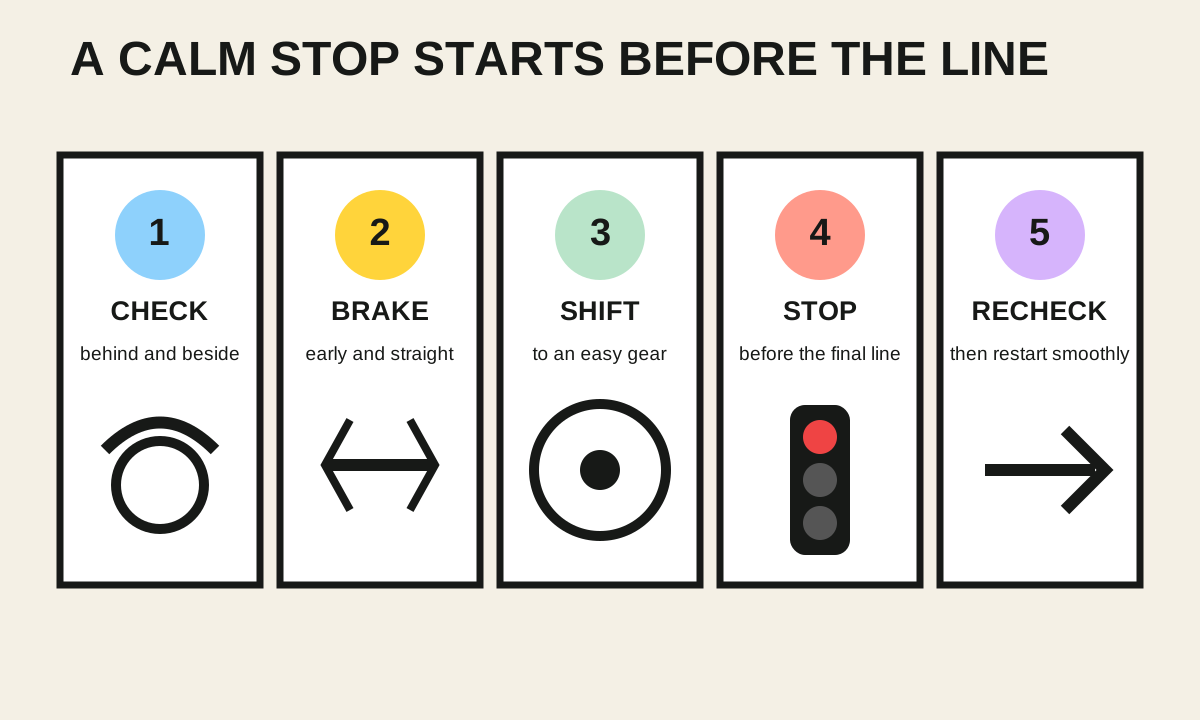
A smooth traffic-light stop starts well before the line. Check behind, brake while the bike is straight, shift into a gear you can restart, choose a visible legal waiting position, put one foot down, and look through the whole junction again before moving on green.
The short answer: never race an amber or red signal because clipping out feels awkward. Brake early and predictably. Stop before the applicable line, leave crossings clear, and restart only after checking for late traffic, turning vehicles, pedestrians, and other riders.
Why this basic skill deserves practice
A highly engaged recent Reddit discussion followed a cyclist entering a pedestrian crossing against a red signal. The comments and personal claims are not safety evidence. The useful demand signal is that signal compliance, pedestrian space, and controlled stopping remain recurring points of conflict.
For a new road rider, the pressure often comes from mechanics rather than intent: unfamiliar brake hoods, clipless pedals, a high saddle, a hard starting gear, vehicles behind, and the fear of wobbling. A repeatable stopping routine removes most of that drama.
Read the junction before braking
Lift your vision beyond the rider or vehicle immediately ahead. Identify:
- the signal that actually controls your lane or cycle track;
- the final stop line and any cycle advance box;
- pedestrian and cycle crossings;
- vehicles that may turn across your path;
- large vehicles with blind areas;
- drain covers, paint, gravel, or wet metal near the stopping point;
- an escape space if the rider ahead stops abruptly.
Signals and advance boxes differ by country. In Great Britain, Highway Code Rule 71 says cyclists must not cross the final stop line on red; a rider may enter an advanced stop area only in the permitted manner. Use the local rule where you ride rather than copying another country’s junction behaviour.
The five-step stop
1. Check behind and beside
Before changing line or braking firmly, glance behind and listen. A following rider may be overlapping your rear wheel; a driver may be close; a filtering motorcycle may be beside you. Hold a predictable line and signal if local practice and your control allow.
Do not drift to the kerb automatically. Near a junction, a more central lane position can make you visible and discourage an unsafe squeeze past. Highway Code Rules 72 and 73 explicitly describe centre-lane positioning at junctions where it is safer.
2. Brake early with both hands ready
Put your hands where you can operate both brakes. Apply braking progressively while the bicycle is upright. Reduce most speed before painted lines, metal covers, or a sharp steering input.
Keep looking where you want to stop. Staring down at the pedal or front wheel makes the bike wander. If you need more practice using both brakes, start with braking and cornering confidence in a traffic-free area.
3. Shift before the cranks stop
Select an easier rear gear while the chain is still moving and pedal lightly enough to complete the shift. Do not wait until you are stationary, stamp on the shifter, and then force the chain under a hard launch.
The aim is not the very easiest gear. Choose one that lets you move the first pedal smoothly without spinning wildly. A modest gear reduces wobble and protects the drivetrain from a high-load start.
4. Unclip one side and stop before the line
Choose a consistent “down foot” during practice. Unclip that foot while you still have balance, but keep it on the pedal until the final moment. As the bike stops, slide slightly forward from the saddle if needed and place the foot firmly on the ground.
Do not lean on a vehicle, hold street furniture that could move, or place a foot where another wheel can trap it. Leave the pedestrian crossing and tactile paving clear. If you missed the clip-out, keep braking straight and put either foot down; saving the routine is less important than staying upright.
5. Recheck before restarting
A green light gives permission, not a physical shield. Look for:
- a driver finishing late through the junction;
- a vehicle turning across the cycle lane;
- pedestrians still crossing;
- another cyclist passing on either side;
- a bus or lorry that may close your space;
- a blocked exit that would leave you stranded in the junction.
Start with the raised pedal around a strong forward position, push smoothly, bring the other foot to the pedal, and hold your lane until you are stable. You do not need to clip in instantly; place the shoe on the pedal and gain speed first.
Where to wait
Use the marked cycle area when it is legally accessible and does not place you beside a turning large vehicle. Otherwise, wait in a visible position in your chosen lane, not hidden beside a rear wheel or mirror.
Avoid stopping:
- beyond the final line;
- across a pedestrian or cycle crossing;
- immediately beside a lorry, bus, or construction vehicle;
- between two vehicles with no escape room;
- on a slick road marking when a dry surface is available;
- so close to the rider ahead that their failed start knocks you over.
If you arrive after a large vehicle has occupied the junction, stay behind it where the driver is more likely to know you are present. Do not filter into its blind area to gain one bicycle length.
Clipless pedals do not change the signal
If red lights create panic, the pedal setup is not yet traffic-ready. Practise ten to twenty controlled stops in a quiet car park or traffic-free path:
- coast at low speed;
- cover both brakes;
- unclip the same foot;
- stop beside a painted marker;
- restart without looking down;
- repeat with the other foot for emergencies.
Increase spring tension only after release is easy and consistent; many systems allow a lighter setting. Flat pedals are also a valid choice while learning. Use clipless pedals without the fear for a longer practice progression.
If the signal changes late
Do not make a violent decision solely because a light changed. If you can stop safely before the line, stop. If an emergency stop would predictably cause a loss of control or collision, continue clearing the conflict while following the law and local signal timing. The exact legal treatment of amber or yellow varies, so learn it locally.
Never use the rider ahead as proof the junction is open. They may have misread the signal, be turning, or be crossing under a cycle-specific phase that does not apply to you.
Protect pedestrians even when you have green
People may still be finishing a crossing, may not see or hear you, or may have mobility, hearing, or vision needs that are not obvious. Slow and give room. A bell or voice is a warning, not an instruction that someone must jump aside.
The Great Britain Highway Code introduction states that pedestrians have priority at light-controlled crossings when they have a green signal, and Rule H2 covers priority at junctions. Other countries express the duty differently, but the practical rule is robust: do not turn into a person or use speed to claim space.
Your next step
Choose a quiet, familiar signal and rehearse the full sequence: check, brake, shift, unclip, stop, recheck, restart. When it feels boring, add a busier junction—not a harder pedal release.
Sources and further reading
- GOV.UK Highway Code: Rules for cyclists 59–82
- GOV.UK Highway Code introduction and pedestrian-priority rules
- Reddit demand signal: discussion about a cyclist entering a pedestrian crossing against red — used to identify the recurring question; anecdotes and comments were not treated as verified facts.