How to set rear-derailleur B-gap without guessing
Identify the exact derailleur and cassette, use their specified chain position and gauge or measurement, and diagnose hanger or chain faults before turning the B screw.
 Field guide / how-to-set-rear-derailleur-b-gap
Before you buy
Check the starter kit first
Print the one-page buying brief for helmet, lights, water, phone, and repair compatibility before comparing upgrades.
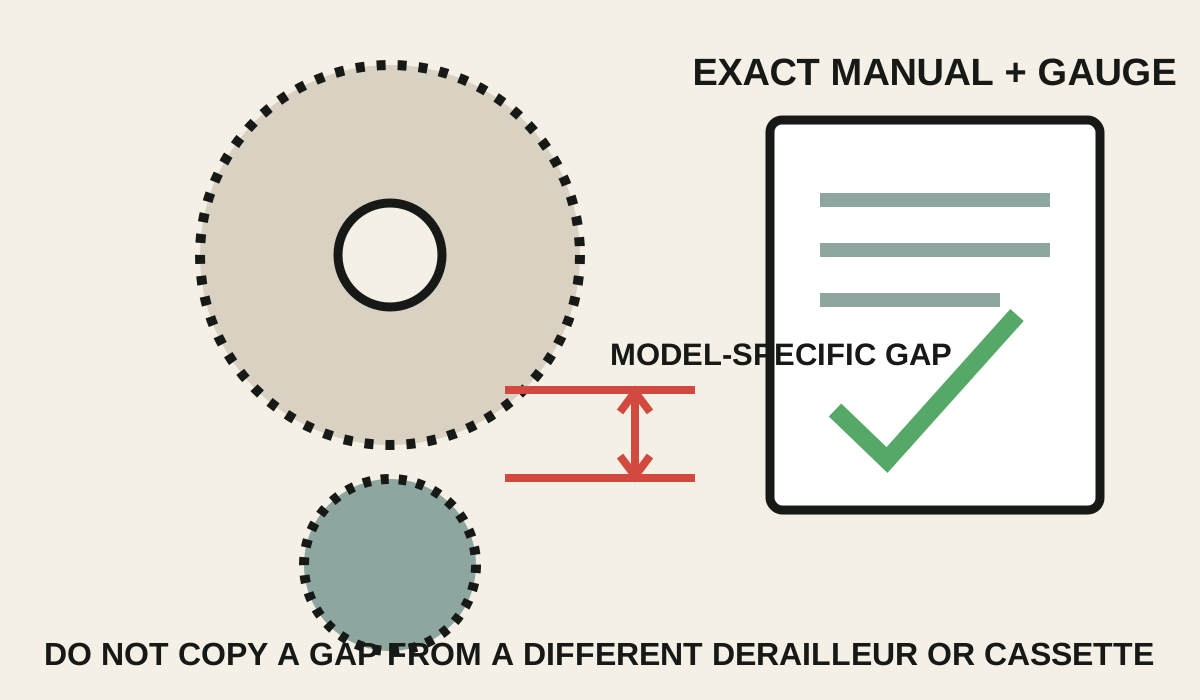
Set rear-derailleur B-gap—the distance relationship between the upper guide pulley and cassette—using the instructions for the exact derailleur, cassette size and drivetrain. Some systems use a millimetre measurement, some align a moulded mark, and others require a supplied gauge in a specific gear.
The short answer: do not copy a gap from another bike or make the pulley “as close as possible.” Verify derailleur mounting, hanger alignment, cassette, chain length and limit settings first. Then place the chain in the manual’s specified position and adjust the B screw until the correct tooth, line or gauge reference aligns.
What the B adjustment changes
The B screw or B-tension adjustment changes the derailleur body’s rotation around its hanger interface. That moves the upper pulley’s path relative to the cassette.
A gap that is too small can make the pulley or chain run roughly against the largest sprocket and may prevent a clean shift into it. A gap that is too large usually makes shifts slower and less precise because the pulley guides the chain from farther away. SRAM’s current service guidance describes this same tradeoff and stresses using the correct method for the product.
B-gap is not cable indexing, a high/low limit, or general chain tension. Turning it to cure every shifting noise can disguise the real fault and make other gears worse.
Identify the complete system first
Record:
- rear-derailleur brand and full model code;
- number of speeds;
- cassette model and largest sprocket tooth count;
- one-by or two-by crank arrangement;
- direct-mount, standard hanger or hangerless interface; and
- whether the manufacturer specifies a gauge, moulded line or measured distance.
Do not rely only on the shifter logo. A derailleur family may have several cage lengths or generations with different procedures. Search the component maker’s service site for the dealer manual, not an image search result detached from its context.
Check faults the B screw cannot fix
Before adjustment, confirm:
- the wheel and cassette are fully seated and secure;
- the cassette has no unintended play;
- the derailleur mounting stop sits against the hanger’s stop as designed;
- the derailleur and hanger are not loose;
- the hanger is aligned;
- chain length follows the drivetrain method;
- the chain is routed correctly through both pulley wheels; and
- limit screws prevent travel into the spokes or beyond the smallest sprocket.
A bent hanger can make one end of the cassette shift well and the other badly. Excess cable friction can create hesitation in one direction. A wrong chain length changes derailleur position and can invalidate the expected gap. Use the rear-derailleur reset order if several screws have already been turned.
Follow the model-specific measuring method
Gauge method
Many SRAM systems use a chain-gap tool. The manual defines the cassette, chainring and gear position, tool orientation, and reference surface. A gauge placed backward or used for a different largest sprocket can produce a plausible-looking but wrong result.
Moulded alignment mark
Some Shimano derailleurs use an indicator on the cage or body. Align the specified feature with the named tooth or sprocket in the stated gear. Cassette teeth intentionally vary in height for shifting, so measuring from a random short tooth changes the apparent gap.
Millimetre measurement
Older or simpler systems may specify a distance between the upper pulley and sprocket teeth. Measure between the exact points shown in the manual. Do not transfer an old six-millimetre rule to a modern wide-range cassette.
The same warning applies to adjustment direction. Turning the screw clockwise often increases the gap, but layout and access differ. Watch the derailleur move and use the manual rather than memorising a direction.
Adjust in a controlled sequence
- Secure the bike so the drivetrain can turn safely, keeping fingers and clothing clear.
- Shift to the exact front and rear position in the manual.
- Rotate the cranks and let the derailleur settle naturally.
- Fit the correct gauge or identify the specified measuring features.
- Turn the B adjustment in small increments while watching the relationship change.
- Rotate the drivetrain again after each change; do not measure a chain that is jammed or slack.
- Remove the gauge and shift one gear at a time across the cassette under light load.
- Recheck limits, indexing and the largest-sprocket position.
Do not tune a safety-critical limit screw by trial on the road. Complete stationary checks before a short, low-load test ride away from traffic.
Read the symptoms after adjustment
If shifts into larger sprockets remain slow even at the correct B-gap, inspect cable tension and friction, hanger alignment, chain/cassette wear and electronic trim. If the pulley approaches the largest sprocket at one wheel position but not another, check cassette seating, wheel play and hanger alignment.
If a correct gauge position cannot be reached within the adjustment range, stop. Possible causes include a wrong derailleur or cassette capacity, wrong hanger/interface, incorrect chain length, missing adapter, or damaged mounting parts. The mechanic-or-adjustment guide helps set the boundary.
Your next step
Photograph the derailleur model code and cassette marking, download the matching manual, and write down its required gear position and measurement method. Only then turn the B screw. If those identifiers do not match documented compatibility, solve that before tuning.
Sources and further reading
- Shimano: current road rear-derailleur dealer manual
- SRAM: rear-gear adjustment and model-specific chain-gap resources
- SRAM: current Road AXS and XPLR AXS chain-gap procedure
- r/bikewrench discussion: interpreting a derailleur’s B-gap alignment mark — used as an editorial question signal, not as the setting for another drivetrain.