How to pass another cyclist safely without startling them
Check behind, warn briefly, leave lateral space, pass with a controlled speed difference, and return only when fully clear.
 Field guide / how-to-pass-another-cyclist-safely
Pass another cyclist like a complete overtaking manoeuvre: check behind, give a brief warning, move out with real lateral space, hold a controlled line, and return only after your rear wheel is clear of their front wheel. If you cannot complete all five parts, wait.
The short answer: “On your left” or a single bell ring is information, not a demand. Slow enough to react, leave room for the other rider to wobble or avoid a surface hazard, and never squeeze through because you announced yourself. On roads, also account for traffic behind and oncoming traffic; on paths, pedestrians and local speed rules may remove the passing opportunity entirely.
Why a simple pass becomes a safety problem
A current r/cycling discussion about passing etiquette showed that riders disagree about bells, voice calls, and how much warning feels helpful. The universal part is smaller: nobody should be forced to swerve, brake, or guess where you are going.
A cyclist ahead may move laterally because of a pothole, debris, wind, parked car, child, dog, or momentary loss of balance. They may not hear you because of traffic, hearing loss, a helmet over their ears, or headphones. Your plan must still work if the warning gets no response.
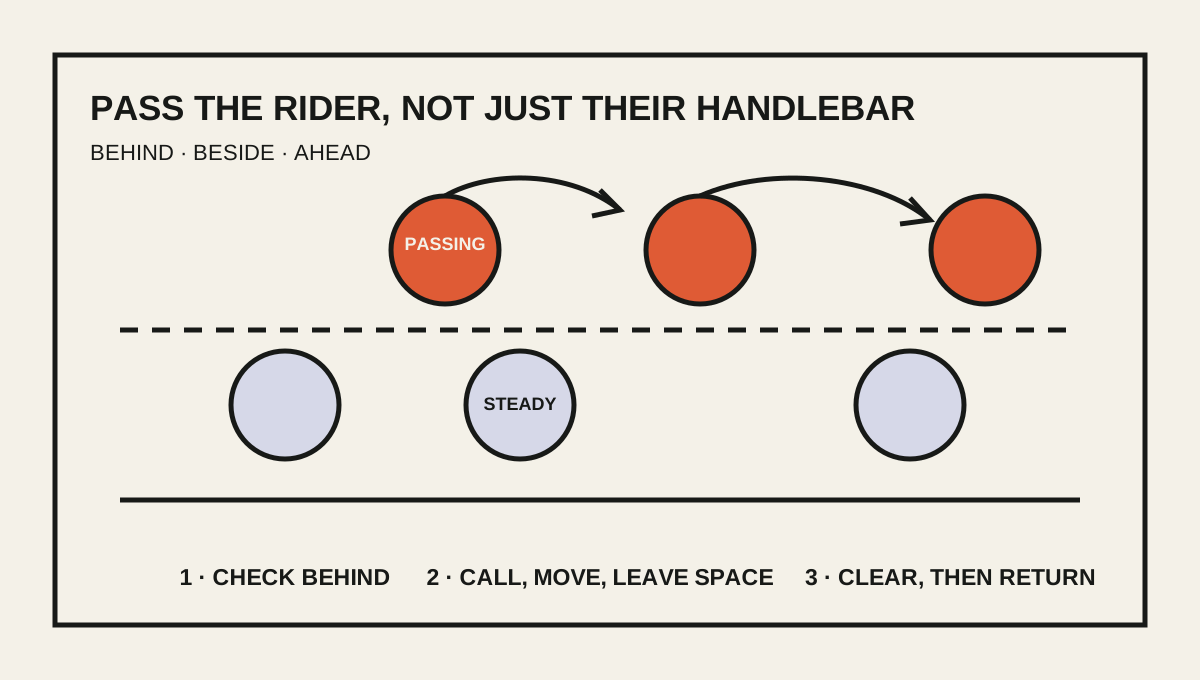
Treat every pass as three zones:
- Behind: Can you check traffic and create space before moving out?
- Beside: Can you leave a meaningful lateral gap throughout the overlap?
- Ahead: Is there enough clear distance to return without cutting in?
Step 1: decide whether this is a passing place
Do not begin where sight distance or escape space is limited. Wait at:
- blind bends, hill crests, and narrow bridges;
- junctions, crossings, driveways, and bus stops;
- pinch points, bollards, parked-car door zones, and roadworks;
- loose gravel, wet leaves, potholes, puddles, or ice;
- places where oncoming riders or walkers would have to move;
- any lane where a vehicle is already overtaking you.
The UK Highway Code tells all road users to overtake only when safe and legal, with a clear road ahead and a suitable gap in front. Local rules differ, but that sequence is a good decision model anywhere.
On a shared path, a posted speed limit, centre line, no-passing zone, or instruction to yield takes priority over your preferred pace. Read how to ride a shared-use path for mixed pedestrian and animal traffic.
Step 2: check behind before moving sideways
Look ahead first so the surface remains controlled, then make a shoulder check without steering toward the direction you look. A mirror can add information but does not eliminate blind spots.
If traffic is approaching from behind, hold position rather than drifting out and hoping the driver will make room. Signal when appropriate and legal, but remember that a signal communicates intent; it does not create a gap.
Practise the movement away from traffic using how to look behind without swerving. A pass should not be the first time you discover that your bicycle follows your head.
Step 3: warn briefly and early
Use one calm bell ring or a short phrase such as “passing left” in places where that direction is appropriate. Give the warning early enough to be understood, but not from so far away that the rider assumes it concerns someone else.
Avoid shouting a long explanation. A loud last-second call can cause the exact swerve you hoped to prevent. If the rider looks around and wobbles, reduce speed and wait.
The UK Highway Code recommends slowing when necessary and letting pedestrians, horse riders, and other road users know you are there, while recognising that some people may not hear or see the warning. Apply the same humility to another cyclist.
Step 4: create lateral space before overlap
Move out smoothly while still behind the rider. Do not thread a narrow handlebar gap at full speed. Space is what protects both riders if either one changes line.
There is no single global cyclist-to-cyclist passing distance that overrides local law and context. Use more room when:
- the speed difference is large;
- the rider appears inexperienced or is riding with a child;
- wind, surface damage, or parked cars may force movement;
- either bicycle has wide bars, bags, a trailer, or cargo;
- visibility or hearing is limited;
- you are passing a group rather than one rider.
If the available width cannot absorb a normal wobble from both bicycles, there is not enough width to pass.
Step 5: use a controlled speed difference
A pass does not need to become a sprint, but lingering beside someone also increases exposure. Choose a speed that lets you complete the move promptly while remaining able to brake for a hazard ahead.
On a narrow path, reduce the relative speed substantially. Passing a walking-speed family at road-training pace gives almost no time to respond. On the road, do not accelerate into a junction, red light, queue, or blind corner merely to finish a pass.
Pedal smoothly and hold your line. Standing suddenly, rocking the bicycle, or freewheeling inches from the other rider makes your path harder to predict.
Step 6: return only when fully clear
Your handlebar passing theirs does not complete the manoeuvre. Continue straight until your rear wheel is beyond their front wheel with useful space, then return gradually.
Do not cut back to avoid an oncoming vehicle you noticed too late. That means the pass began without enough clear distance. Brake and abandon early when possible rather than turning the other rider into your escape route.
If you plan to slow, turn, or stop soon after passing, ask whether the pass has any value. Moving ahead and immediately braking is both irritating and risky.
What to do when you are being passed
Hold a steady, predictable line. Do not speed up to contest the pass, move toward the rider, or make a sudden courtesy swerve toward the kerb. You may ease your effort slightly if that helps create separation, but only when it is safe.
If there is an unseen hazard ahead, say “pothole,” “car,” or “wait” clearly. The passing rider still owns the decision to abort.
In a group, avoid overlapping wheels and communicate before moving around another rider. Learn the five group-ride signals and the expectations in your first group ride before treating a social ride like an informal race.
Common passing mistakes
Announcing and immediately moving: the other rider has no time to process the warning. Call first, observe, then pass.
Assuming a bell grants priority: it does not. If there is no room, wait.
Passing between a cyclist and parked cars: this pushes someone toward the door zone or leaves you nowhere to go. Choose a genuinely clear side and comply with local traffic rules.
Passing inside at a junction: riders may turn or position for the junction. Stay behind unless a marked facility and local rules make the movement clearly safe.
Returning on the other rider’s front wheel: this creates an overlap where a small line change can touch wheels. Clear the complete bicycle first.
Matching a stranger’s wheel without asking: passing and then sitting close behind can feel intrusive and removes stopping distance. Create a gap unless you have agreed to ride together.
Your next step
On your next easy ride, practise the sequence at low speed with generous space: look ahead, check behind, announce, move out, pass smoothly, and wait until fully clear before returning. If any zone is missing, stay behind and try again later.
Sources and further reading
- UK Highway Code: cyclist awareness, signalling, and overtaking guidance
- UK Highway Code: overtaking rules 162–168
- r/cycling discussion: cyclist-to-cyclist passing etiquette — used as an editorial question signal; individual preferences were not presented as universal rules.