Is it okay to draft behind a stranger while cycling?
Ask before sitting on a stranger's wheel, leave room until they agree, and use clear signals, predictable riding, and a simple exit plan.
 Field guide / drafting-behind-stranger-cycling-etiquette
Do not silently attach yourself to a stranger’s rear wheel. Ride alongside at a safe distance, say hello, and ask whether they want to ride together. If the answer is unclear, stay well back or pass. Local cycling culture varies, but communication and consent remove the guesswork.
The short answer: ask first, accept “no” immediately, and only close the gap after both riders understand the arrangement. Keep your front wheel behind theirs, look through the rider rather than staring at the tyre, avoid sudden speed changes, and stop drafting before traffic, descents, junctions, rough surfaces, or any moment that makes either rider uncomfortable.
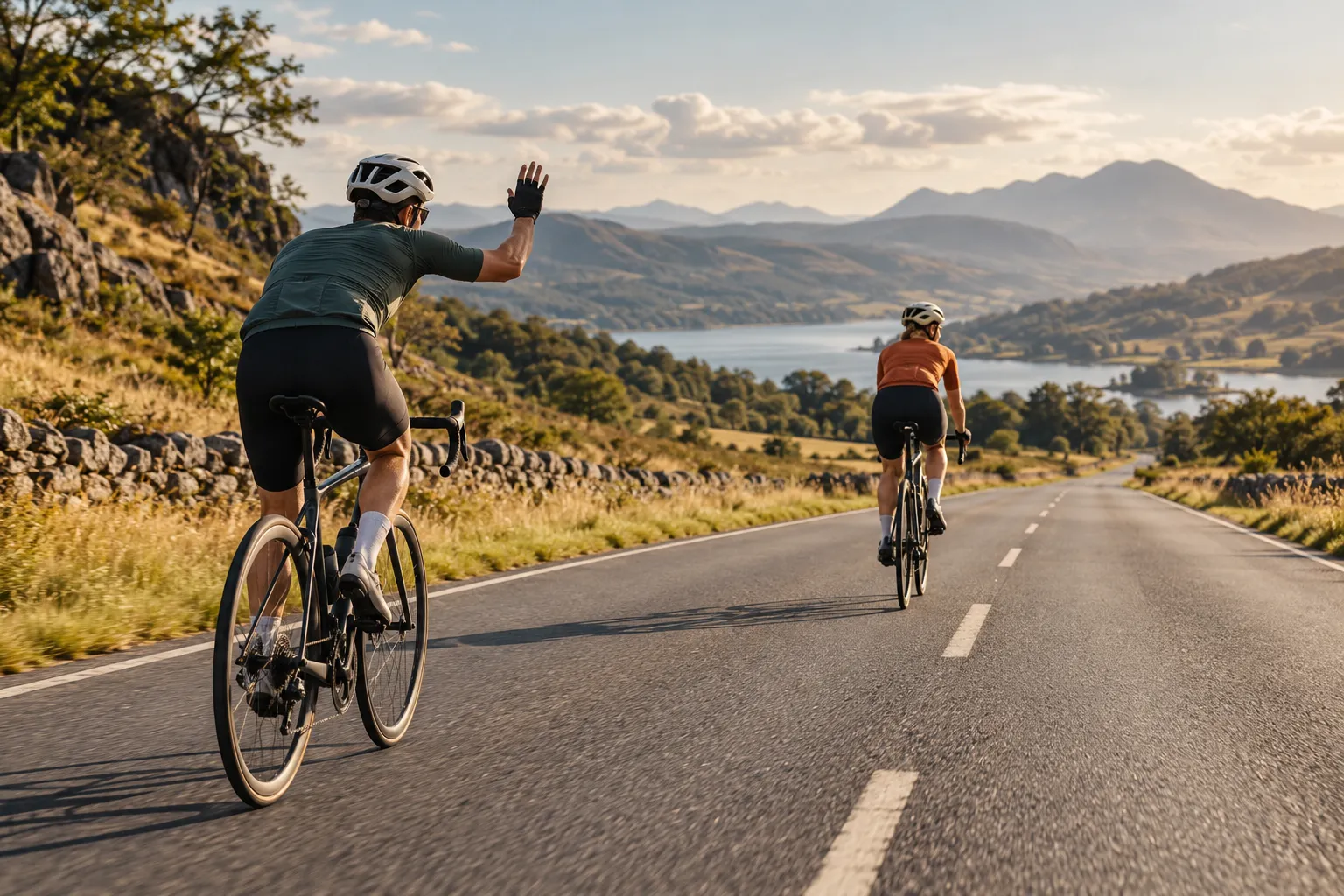
Why unannounced drafting is a real safety issue
Several highly discussed r/cycling threads this year asked whether it is acceptable to draft a rider you do not know. Some commenters described unannounced drafting as normal on busy cycling routes; others disliked having an unknown rider close behind. That disagreement is the useful signal: there is no universal social rule you can safely assume.
The mechanical risk is less ambiguous. A drafter has less time and road in which to react. The leading rider may slow for a pothole, turn off, sit up, drink, or brake without knowing that another front wheel is close behind. The follower also cannot see as much of the road surface.
USA Cycling’s paceline guidance tells riders to ride straight, avoid overlapping wheels and abrupt braking, look ahead, and communicate slowing and turning. Those skills depend on both people knowing that they are riding together. They are not a reason to form a silent paceline with an unsuspecting stranger.
Ask in one sentence
Approach with enough lateral and following space to remain independent. When it is safe to speak, try:
“Hi—would you mind if I sit on your wheel for a while?”
Or, if you have just passed a rider who seems to be matching your pace:
“You’re welcome to join me if you want.”
Do not make the conversation while squeezing between traffic, beside parked cars, through a junction, or on a descent. If you cannot communicate safely, you cannot establish a safe shared ride at that moment.
A nod, friendly reply, or specific plan is useful. Silence, a shrug you cannot interpret, headphones, or no response is not agreement. Leave space.
Agree on the minimum plan
You do not need a committee meeting, but establish four things:
- Are you actually riding together?
- Who will lead first?
- Are you taking turns, and how will the leader pull off?
- How will either person say they are leaving?
If the road, traffic side, or local convention determines which way the leader rotates, confirm it rather than copying a race video. A simple “I’ll do a short turn, then pull off on the right” is enough.
If either rider has never drafted before, say so. Use a large gap and a quiet road, or decide not to draft. Your first group ride guide is a better place to learn close riding than the wheel of a stranger whose habits you do not know.
Close the gap gradually
Drafting benefit grows as the gap shrinks, but the smallest possible gap is not the beginner target. Start far enough back that you can see, steer, and brake without panic. Reduce the distance only when the road is predictable, both riders are smooth, and you remain comfortable.
Use these rules:
- Keep your front wheel behind the other rider’s rear wheel; do not overlap wheels.
- Look through and around the rider toward the road ahead.
- Keep your hands where you can brake without changing grip suddenly.
- Hold a steady line instead of weaving across the draft.
- Let small gaps open rather than sprinting and braking repeatedly.
- Add space in wind, rain, darkness, traffic, poor surfaces, and unfamiliar corners.
British Cycling’s group-riding guidance similarly emphasises looking through the group, avoiding overlap, communicating, and being gentle on the brakes. Drafting skill is predictable control, not bravery measured in centimetres.
Lead without trapping the rider behind
Once you know someone is following, ride as though your small decisions affect two people.
- Point or call meaningful hazards early.
- Signal slowing and stopping.
- Keep pedalling pressure and line changes smooth.
- Do not surge to prove that your pull is strong.
- Do not swerve late around a hole that the follower cannot see.
- Check that the road is clear before rotating off.
You are still responsible for your own road position and legal obligations. The follower is still responsible for leaving a manageable gap. Agreement to draft is not a transfer of responsibility.
Take a short, steady turn
If you agreed to share the work, match the existing pace when you move to the front. Accelerating after the pass stretches the gap and turns a cooperative ride into repeated chases. Take a short pull, then rotate as agreed.
If you do not want or cannot take a turn, say it plainly: “I can sit in, but I can’t hold this pace on the front.” The other rider can then decide whether to continue together. Do not promise a contribution you cannot deliver merely to make the interaction less awkward.
Drafting behind an e-bike deserves extra caution. Its acceleration and assistance cut-off may feel different from a conventional bike, and its rider did not volunteer to pace you. Ask, leave space, and never treat a motor-assisted rider as public transport.
End the arrangement clearly
Say “I’m turning here,” “I’m dropping back,” or “Have a good ride” before changing direction or pace. Move out of the draft with a shoulder check and a predictable line. Do not sprint away from a rider who thinks you are still cooperating, and do not follow them through a turn simply because you missed your chance to speak.
Stop drafting when:
- traffic or junction complexity increases;
- the surface becomes rough or visibility narrows;
- the road descends or corners beyond your comfort;
- the leader’s braking, line, or signals feel unpredictable;
- you no longer know the route or intentions;
- either rider asks for space.
There is no etiquette debt that requires you to remain in an unsafe pairing.
If a stranger drafts you without asking
Do not brake-check them, swerve, or escalate. Keep a predictable line and say, when safe, “Please leave me some space,” or “I’m riding solo today.” Slow gradually in a safe place and let them pass if necessary.
If the rider ignores a clear request, create distance without racing: turn off safely, stop in a public place, or allow them to go ahead. If their behaviour feels threatening rather than merely awkward, prioritise reaching a populated place and contacting local help.
A five-second decision rule
Before following closely, ask:
- Did we communicate?
- Did they clearly agree?
- Is the road suitable?
- Can I see and react?
- Can either of us end this cleanly?
One “no” means leave a normal independent-riding gap. If you want to learn the skill in a controlled setting, choose a beginner club ride and use the five group-ride signals worth learning first.
Sources and further reading
- USA Cycling: paceline communication, wheel position, braking, and road awareness
- British Cycling: group-riding fundamentals
- r/cycling discussion: etiquette when a solo rider drafts without speaking — used as a high-engagement editorial question signal; opinions were not treated as a universal rule.
- r/cycling discussion: regional differences in drafting expectations — used to identify cultural variation, not as safety evidence.
- r/cycling discussion: a solo rider discovering the effect of drafting — used as a recurring beginner-demand signal; anecdotes were not treated as verified outcomes.