Do beginners need an FTP test before structured cycling training?
Use an FTP test only when a power-based plan needs a starting setting; beginners can build effective training with time, perceived effort, and the talk test.
 Field guide / do-beginners-need-ftp-test
Most beginners do not need an FTP test before they start cycling training. Test only when a power-based plan needs an initial setting and you have reliable equipment, a repeatable protocol, and a safe place to complete a hard effort. Otherwise, train with time, route, perceived effort, and the talk test.
The short answer: FTP is useful for scaling power-based workouts and tracking one kind of cycling performance. It is not a beginner score, a medical clearance, or a requirement for getting fitter. Several weeks of consistent riding may be more valuable than a poorly paced first test.
Decide what the number will do
Current discussions reveal two different questions. One asks whether a returning beginner should test before starting a structured plan. Others compare their first FTP numbers with strangers or ask how to hold power during an outdoor FTP test on flat roads.
The first use can be practical. The comparison use is usually noise.
FTP is a field-derived estimate used to set training intensity and describe sustained cycling performance. Different tests and platforms estimate it differently. A ramp test, a 20-minute protocol, a long time trial, and an automatic software estimate are not interchangeable just because each screen says “FTP.”
Test when all of these are true:
- your plan prescribes workouts as percentages of FTP;
- the trainer or power meter is dependable and set up correctly;
- you understand the exact protocol and can repeat it;
- you are healthy enough for a hard effort;
- the result will change a training decision.
Skip or postpone the test when you are building basic consistency, do not train with power, are recovering from illness or injury, or only want a number to compare online.
Start without FTP when the plan does not require it
A beginner plan can assign effort in plain language:
- Easy: relaxed breathing; full conversation.
- Steady: purposeful but controlled; short sentences remain possible.
- Hard: brief planned work with easy recovery, introduced after consistency.
Use the beginner plan without a power meter and learn how hard a beginner should ride. That teaches pacing, recovery, handling, and routine without making the first training week depend on a maximal test.
Power becomes valuable when it answers a real question: how to reproduce an interval, pace a long effort, or compare the same test over time. It is optional for a first event and general fitness.
If your plan needs FTP, treat the first result as provisional
Research in trained cyclists found a properly standardized 20-minute protocol repeatable, but the study included familiarization and controlled test conditions. A scoping review found the evidence base limited and mostly drawn from trained male cyclists, with large limits of agreement when FTP-derived values were compared with other physiological markers.
That means a first-time result is a setup value, not a precise statement about your biology.
Before testing:
- Choose the protocol your plan will continue to use.
- Follow the power-meter or trainer calibration instructions.
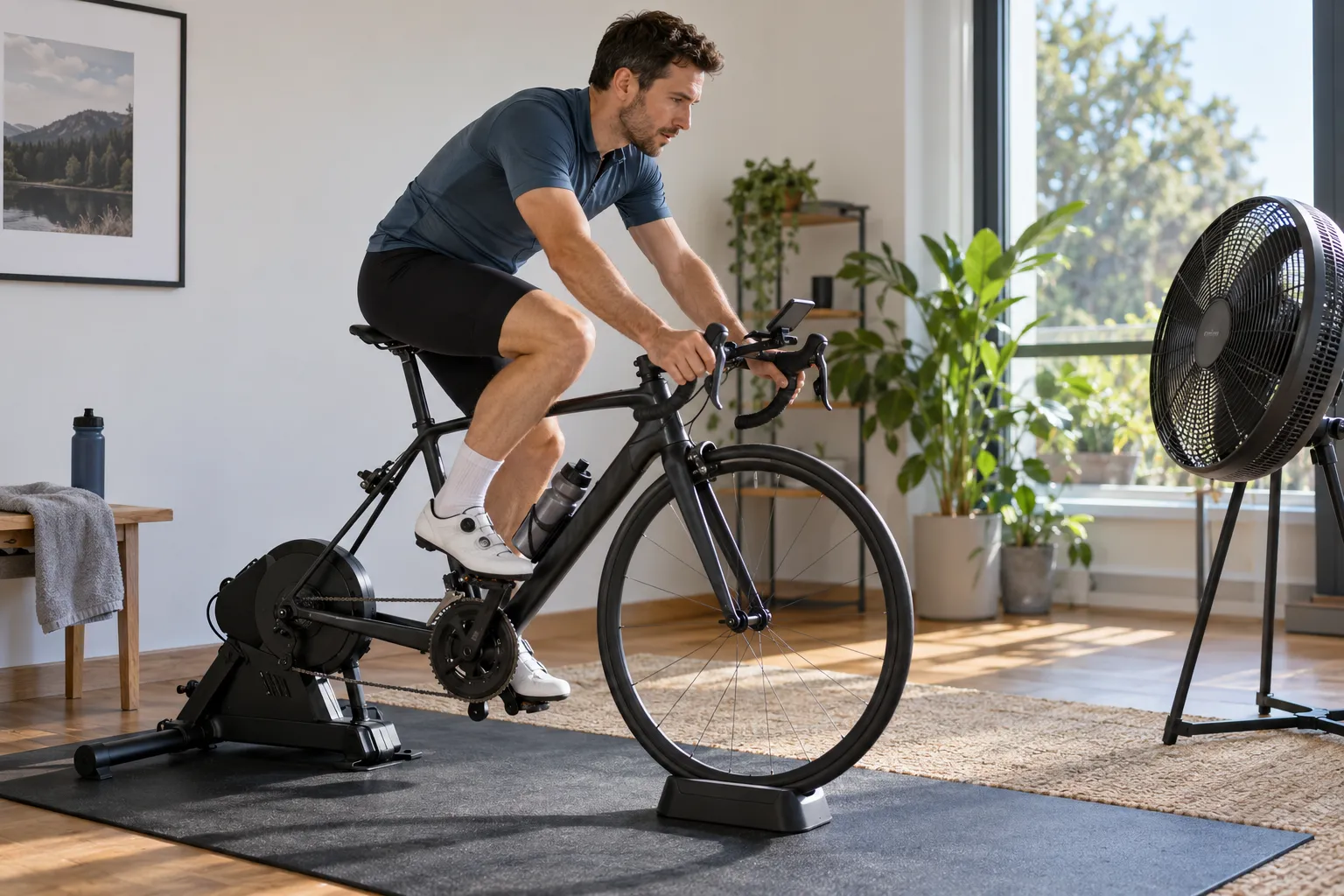
- Use strong cooling indoors and a stable, correctly fitted bike.
- Arrive rested, normally fuelled, hydrated, and free from illness.
- Complete the protocol’s full warm-up.
- Use a traffic-free indoor setup or a genuinely uninterrupted safe course.
- Record equipment, cooling, protocol, and conditions for the retest.
Do not perform a maximal outdoor test where junctions, descents, traffic, or poor visibility compete for attention. Road safety outranks a clean power trace.
Do not borrow the famous 95% rule blindly
A common 20-minute method estimates FTP as 95% of average power from the effort, but that figure belongs to a complete protocol and does not describe every rider equally. Studies have found strong relationships between 20-minute performance and other endurance measures while also finding wide individual disagreement.
If your app uses a ramp test or another calculation, use its instructions. Do not mix a warm-up from one test, the hard interval from another, and a correction factor from a third.
The best practical validation is what happens in subsequent workouts. If every “easy” session is hard or threshold sessions fail repeatedly despite normal recovery and cooling, the setting, plan, or both may be wrong. Use the failed-workout checklist before changing FTP after one bad day.
Compare yourself with yourself
Absolute watts favour larger riders in many comparisons; watts per kilogram changes the question but still does not equal bike handling, endurance, tactics, comfort, health, or event readiness. Equipment accuracy and test familiarity also matter.
Use the number to:
- scale your own power-based sessions;
- compare repeat tests using the same protocol and equipment;
- notice a meaningful trend across a training block;
- support, not replace, perceived effort and recovery notes.
Do not use it to decide whether you are “fit enough” to be a cyclist. Average speed is already a poor beginner scoreboard; FTP becomes another poor scoreboard when stripped from its training purpose.
When to retest
Retest because the current setting no longer matches training, not because the calendar or app makes you anxious. Useful triggers include completing a consistent training block, returning after a long interruption, or repeatedly finding workouts far easier or harder than intended.
Keep the method, equipment, cooling, and preparation similar. A small change can be ordinary test noise, pacing, or familiarization. Judge the block using workout completion, endurance, recovery, and riding goals as well as one number.
Your next step
Open your plan and check how intensity is prescribed. If it uses time and perceived effort, begin without FTP. If it scales sessions by power, schedule the platform’s exact test after a few familiar rides, record the conditions, and treat the result as a provisional setting to validate during training.
Sources and further reading
- Study: reliability of a standardized 20-minute FTP protocol in trained cyclists
- Scoping review: what is known about the 20-minute FTP test
- Study: FTP and lactate parameters should not be treated as equivalent
- r/cycling reader context: whether a beginner should test before training
- r/cycling reader context: comparing first FTP results
- r/cycling reader context: pacing an outdoor FTP test