Which regular shoes work best on road-bike flat pedals?
Choose normal shoes for flat pedals by sole shape, grip, stiffness, weather, and pedal pins—without damaging soft running shoes or losing control.
 Field guide / choose-regular-shoes-flat-pedals-road-bike
Before you buy
Check the starter kit first
Print the one-page buying brief for helmet, lights, water, phone, and repair compatibility before comparing upgrades.
The best regular shoe for a road bike with flat pedals has a broad, fairly firm, flat rubber sole that contacts most of the platform. Skate-style shoes and simple trainers often work better than tall, very soft running shoes. Formal shoes, smooth soles, deep lugs, and long loose laces are poor choices.
The short answer: match the shoe to the pedal surface. Look for stable rubber contact, enough sole stiffness that the pedal does not feel like a bar under your foot, a secure upper, and protected laces. Aggressive metal pins improve grip but can mark soft soles; a milder textured pedal is kinder to everyday footwear.
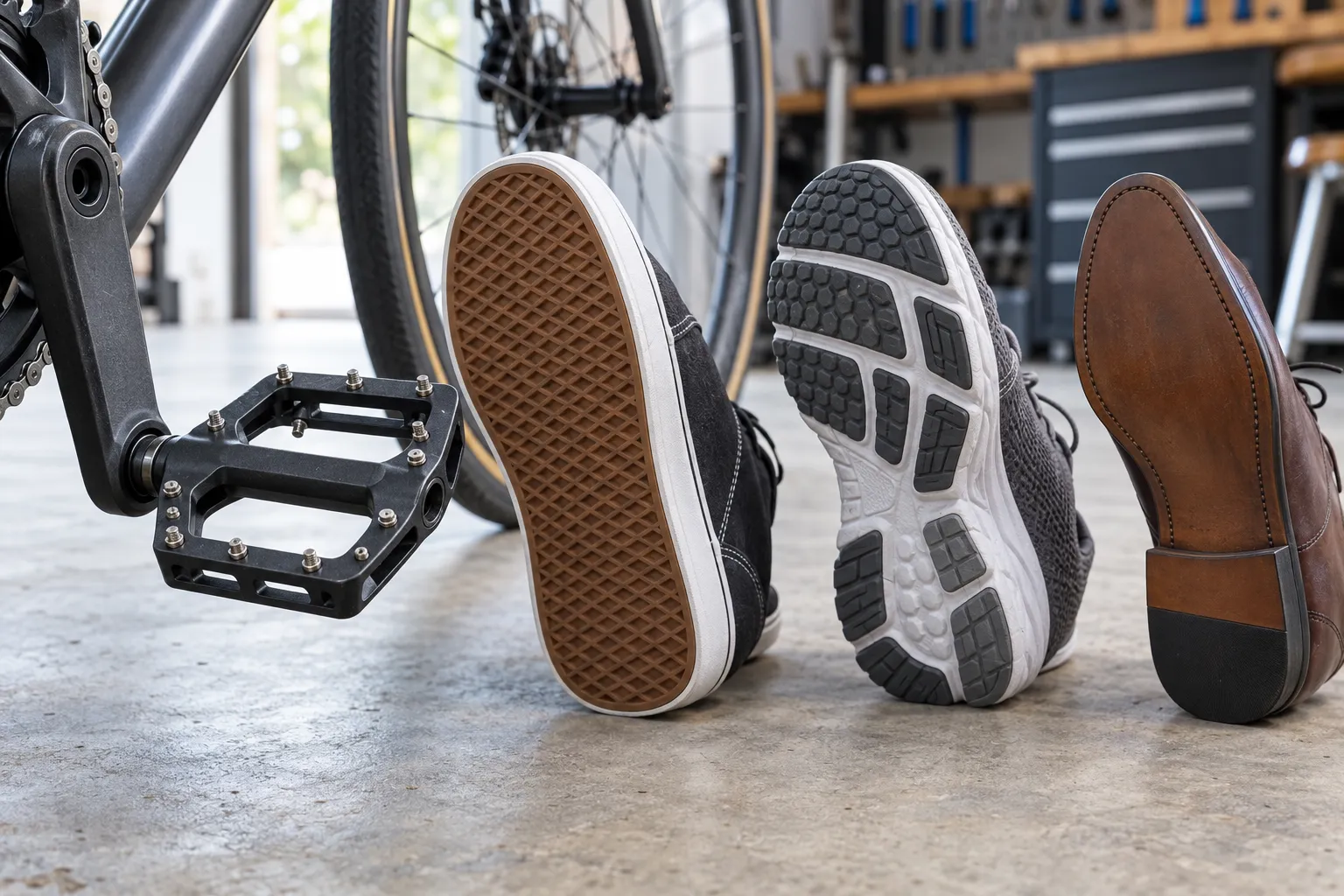
Start with the pedal, not the bike’s frame material
A current Reddit question asked for flat pedals that would suit a carbon road bike without destroying regular shoes. Carbon does not change the shoe requirement: the pedal threads into the crank, and control comes from the pedal-to-sole interface.
What does matter is the platform. A broad pedal spreads pressure and supports more of the shoe. Replaceable metal pins can grip very well in rain and over rough surfaces, but sharp or tall pins can chew visible marks into soft foam. A textured resin or aluminium platform with lower-profile grip may be the better commuting compromise.
Shimano describes its casual PD-EF205 flat pedal as a wide, textured platform designed even for formal footwear. Its more aggressive flat-pedal systems pair a grippy pedal with a solid flat shoe sole. Those are different design priorities, which is why “the grippiest pedal” is not automatically best for your favourite trainers.
The five-point shoe check
1. Flat contact
Set the shoe on the pedal by hand. The sole should contact a useful area instead of balancing on one deep tread block or a narrow waist. Rock it gently side to side. If it tips easily, the pairing is poor.
2. Moderate stiffness
Flex the shoe with both hands. It need not be a cycling shoe, but a sole that folds easily around the pedal can create a pressure hotspot and make your foot feel unstable on a longer ride. Very tall soft foam can also let pins tear the surface.
3. Rubber grip
Dry grip is not enough. Smooth leather, hard dress-shoe compounds, and worn polished rubber can slide when wet. Check the sole for contamination and wear before each ride. Never apply oil, silicone, or polish to a riding sole.
4. Secure fit
Your heel should not lift excessively and your foot should not slide inside the shoe under hard braking. Avoid open-backed footwear, sandals that expose toes to the crank or ground, and shoes so bulky that they interfere with the crank arm.
5. Contained laces
Tie laces securely and tuck the loops under the crossed laces or a keeper. Nothing should reach the chainring, chain, crank, or wheel. The UK’s Highway Code specifically warns cyclists to avoid clothing that can tangle in the chain or wheel; the same mechanical hazard applies to long laces.
Shoe types ranked for ordinary road riding
| Shoe type | Flat-pedal fit | Main tradeoff |
|---|---|---|
| Flat-soled skate shoe | Usually strong | Stable contact, but can be warm and heavier |
| Simple low-profile trainer | Often good | Check sole stiffness and wet grip |
| Dedicated flat-pedal cycling shoe | Best control | Costs more and may be unnecessary for short rides |
| Tall cushioned running shoe | Variable | Soft foam and curved sole can feel vague or show pin marks |
| Hiking shoe with deep lugs | Variable | Tread may sit between pins rather than on them |
| Formal or smooth leather shoe | Poor for sport riding | Limited wet grip and narrow contact |
This is a pairing decision, not a status ladder. A mild pedal and ordinary flat-soled shoe can be ideal for a café ride. A pinned pedal and dedicated flat shoe make more sense for wet roads, rough paths, or riders whose feet move on the platform.
How to test a pair safely
- Inspect the pedal for loose pins, play, cracks, and free rotation.
- Put the ball of the foot over or slightly ahead of the pedal axle as a neutral starting point.
- Practise ten starts and controlled stops in a dry, empty area.
- Ride seated over a few minor surface changes without pulling up on the pedals.
- Try one short familiar ride and inspect the sole afterward.
Stop if the foot slides during normal seated pedalling, the shoe folds around the pedal, the sole develops deep cuts, or the shoe contacts the crank. Wet performance may be worse than the dry test.
If you are comparing pedal systems rather than only shoes, use flat pedals vs SPD vs SPD-SL. If the pedal itself needs changing, follow how to remove and install bicycle pedals because the left pedal has a left-hand thread.
Do you need to buy dedicated shoes?
Not immediately. Ride the shoes you already own if they pass the checks. Spend only when you can name the problem: slipping in rain, foot pressure, damaged foam, poor fit, or frequent rough-surface riding.
If a purchase is justified, bring the clean pedal or a clear photo and dimensions to the shop. Choose interface and fit before colour. The starter gear checklist keeps pedals and shoes in context with more important basics such as a correctly fitted helmet, lights, water, and compatible puncture supplies.
Your next step
Compare two pairs you already own against the five-point check. Choose the flatter, firmer, grippier sole, secure its laces, and run a ten-minute start-stop test before buying anything.
Sources and further reading
- Shimano: flat-pedal design and shoe compatibility
- Shimano PD-EF205: wide platform for casual footwear
- UK Highway Code Rule 59: avoid items that can tangle in the chain or wheel
- r/cycling reader context: flat pedals that are kinder to regular shoes — used as an editorial question signal, not as product testing.