Can you reuse a bike-chain quick link? Check the exact link
Find out whether a bicycle chain quick link is reusable by checking its maker, model, speed, direction, condition, and installation instructions.
 Field guide / can-you-reuse-bike-chain-quick-link
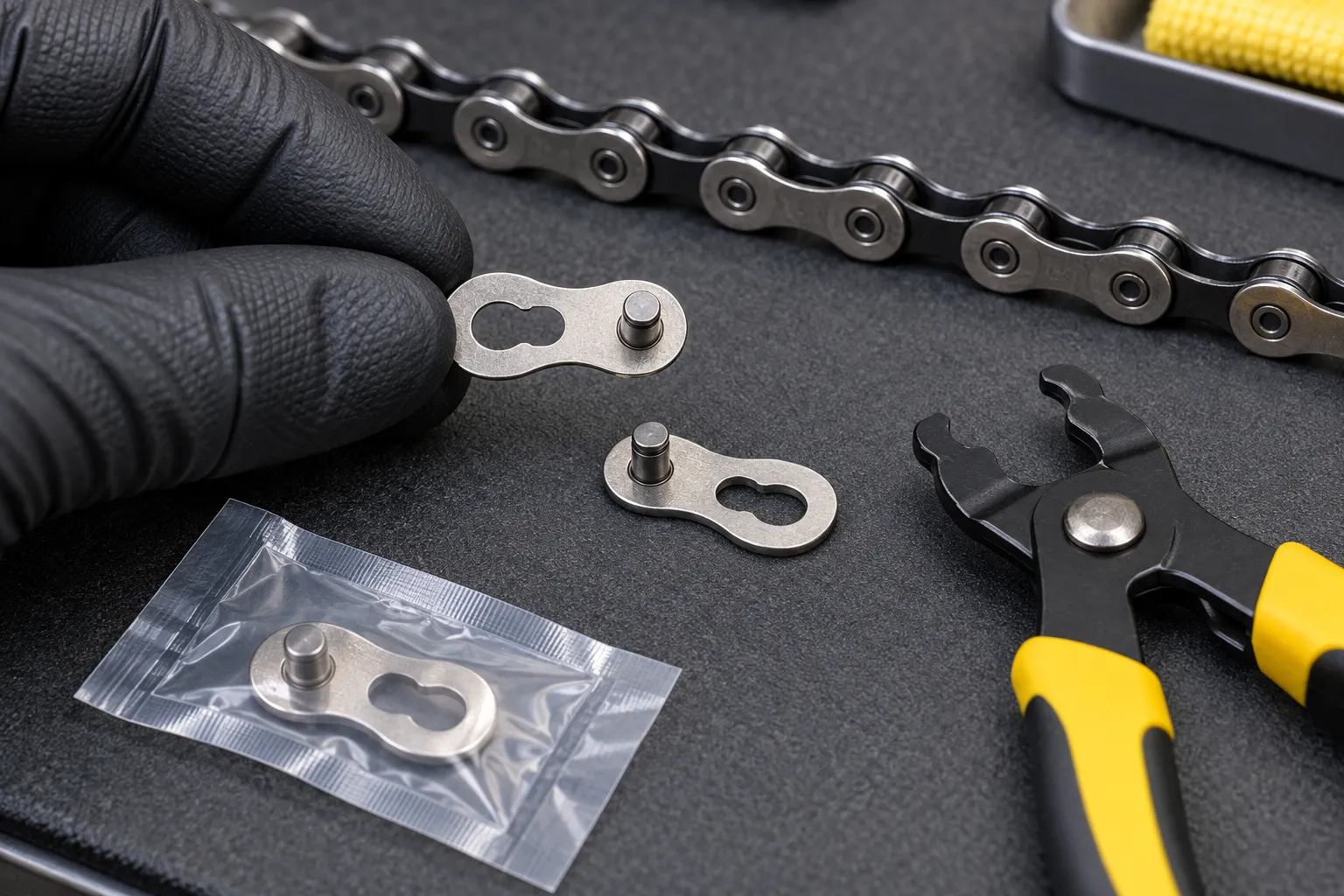
Some bike-chain quick links are reusable and others are explicitly single-use. The answer is printed in the documentation for the exact connector—not determined by the fact that another rider has opened a similar-looking link several times.
The short answer: identify the maker, model, and drivetrain speed. Shimano says not to reuse a removed QUICK-LINK, and SRAM says its PowerLock is single-use. KMC sells specific connectors marked reusable. If you cannot positively identify your link and its instructions, replace it with a new compatible one.
Why the internet gives two opposite answers
High-engagement maintenance discussions often divide into “I reuse mine” and “the manual says never.” Both may describe real experiences, but neither tells you the specification of the link in your hand.
Connector tolerances, plate shape, pin profile, chain width, and locking design vary. A link deliberately sold as reusable is a different product choice from one whose maker warns against reopening it. Personal mileage without a failure does not change that engineering instruction, and one failure story does not prove that every connector of every type is unsafe.
For a safety-critical, inexpensive joining part, the sensible rule is simple: use the documented specification.
Identify the exact connector
Before opening the chain, record:
- the chain brand and model;
- the number of rear sprockets—8, 9, 10, 11, 12, or 13 speed;
- any arrow or directional marking on the connector;
- letters or numbers stamped on both plates;
- whether the product packaging says reusable or non-reusable;
- whether the chain has a special profile, such as SRAM road Flattop.
A connector must match the chain system, not merely fit between the plates when loose. Width and shaping can differ even among chains with the same nominal number of speeds. Use the compatibility table or chain manual from the manufacturer.
If the link is covered in dirt, wipe it clean rather than grinding debris through the locking slots with pliers.
What the major instructions say
Shimano’s chain dealer manual warns not to reuse a QUICK-LINK after removal and says to install a new one with a new chain. It also specifies compatible chains and, for directional models, the orientation of the arrow.
SRAM’s current PowerLock guidance likewise says the connector is designed for one-time use and must not be reused after removal. Its road manuals require the halves to be aligned and fully clicked into place.
KMC, by contrast, lists some products with “MissingLink Reusable” in their specification. That does not make every KMC link reusable: the model suffix and product instructions still matter.
These examples show why colour, tightness, or a generic marketplace listing is not enough.
Inspect before installing
Whether a permitted reusable link is new or has been opened before, replace it if you find:
- bent plates or pins;
- cracks around a keyhole slot;
- visible corrosion or heavy scoring;
- a pin that rocks in its plate;
- damaged directional markings that prevent correct orientation;
- a connection that will not lock fully;
- a mismatch with the chain model or speed.
Do not use “it still clicks” as the only test. Positive engagement is necessary, but the manufacturer may still classify that connector as single-use.
Install it without improvising
Route the chain correctly through both derailleur pulleys before joining it. Bring the two inner chain ends together, insert each quick-link half from opposite sides, engage the pins in the slots, and follow the maker’s direction marking.
Use the documented locking procedure. This commonly involves positioning the connector on the upper chain run, applying the rear brake, and pressing the crank until it clicks, or using appropriate master-link pliers. Then inspect both sides and turn the crank slowly by hand.
Check that the connector:
- is fully seated at both pins;
- articulates freely like neighbouring links;
- faces the specified direction;
- passes through the cassette and derailleur without a jump;
- shows no gap, twist, or stiff movement.
If the chain was shortened or lengthened, also verify the complete chain-length check before riding.
Carry the correct spare
A spare quick link is small enough to live in a saddle bag, but only if it matches the chain. Keep it in labelled packaging so that an 11-speed link is not confused with a 12-speed part at the roadside. Pack a compact chain tool as well: a broken outer or inner section may need to be removed before the connector can join the usable ends.
The spare is for getting the drivetrain safely connected, not for ignoring the reason the chain broke. Shift gently and head home if the chain, derailleur, or hanger has visible damage. Use the roadside broken-chain guide for the full response.
Your next step
Find the connector on your bike, clean only enough to read its markings, and save the manufacturer’s reuse and compatibility instructions with your maintenance notes. If it is unknown, buy a clearly specified replacement and one matching spare before the next chain-off cleaning.
For routine care that does not require removing the chain, follow how to clean and lubricate a road-bike chain.
Sources and further reading
- Shimano: chain and QUICK-LINK dealer manual
- SRAM: PowerLock reuse guidance
- SRAM: road drivetrain manual with PowerLock installation warning
- KMC: example connector explicitly specified as reusable
- r/bikewrench reader context: recurring quick-link reuse question
- r/bikewrench reader context: reported failure after several reuses