What to do if a bike fit makes your pain worse
Respond to new or worse pain after a bike fit by pausing the trigger, documenting every change, arranging a follow-up, and knowing when to seek clinical help.
 Field guide / bike-fit-made-pain-worse
If a bike fit creates new pain or makes an existing problem worse, do not keep repeating long rides to “adapt.” Stop the provoking effort, preserve the before-and-after settings, and contact the fitter for a prompt review. If symptoms are severe, persistent, neurological, or present off the bike, involve a qualified healthcare professional rather than asking position changes to diagnose an injury.
The short answer: a fit is a testable starting position, not a warranty that every change is right. Treat a clear post-fit symptom as feedback: reduce exposure, document it, review the changes, and escalate appropriately.
Why this deserves a follow-up instead of internet diagnosis
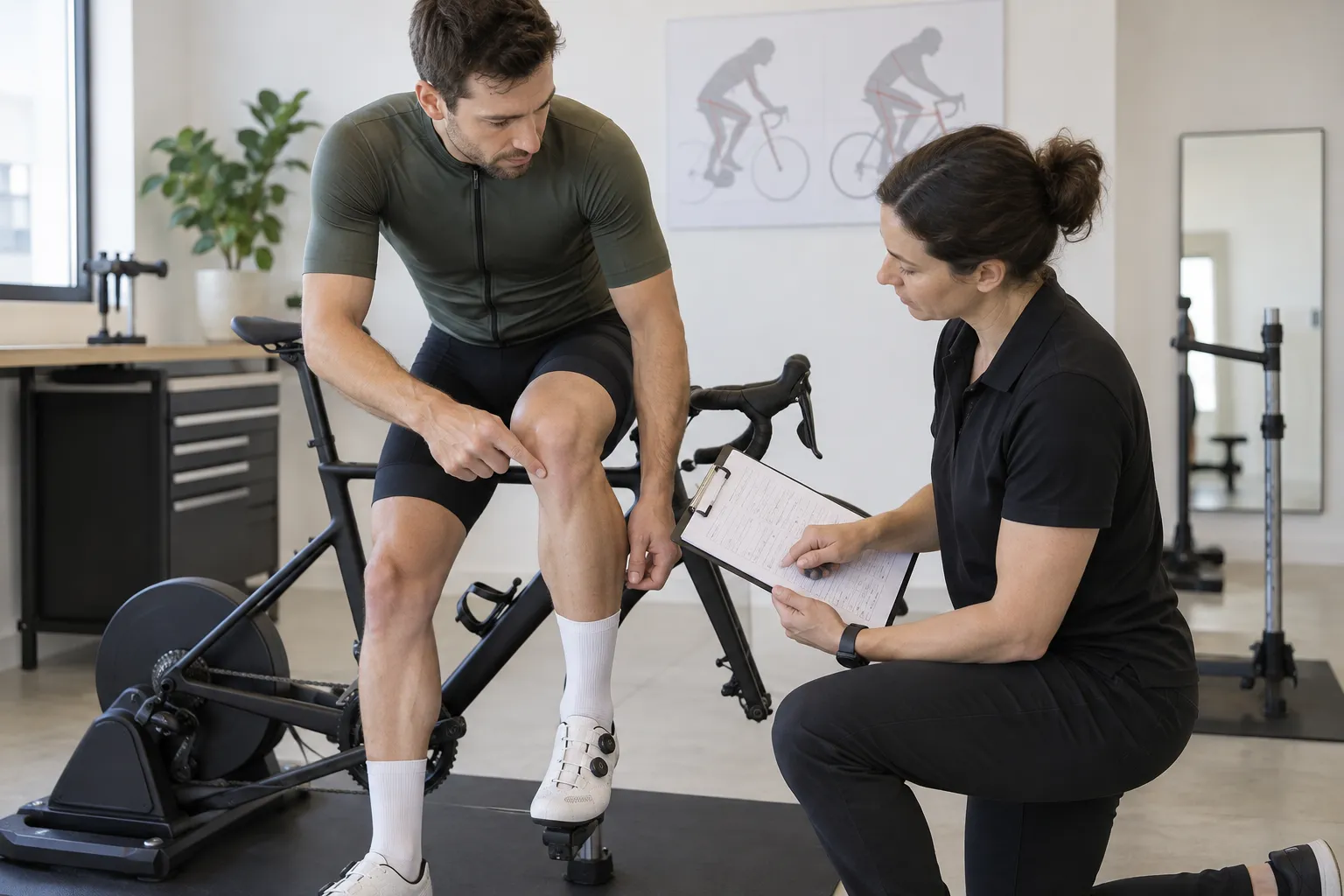
Recent cycling discussions describe new knee pain after a fit intended to reduce other discomfort and riders asking whether a post-fit position or training change explains symptoms. Those stories cannot diagnose another person, but they reveal a recurring problem: several variables changed, pain appeared, and the rider no longer knows what to trust.
Research supports modest expectations, not certainty. A 2022 prospective cohort study found lower reported pain and discomfort after a standardised kinematic fit in its group, but it studied amateur mountain bikers and did not prove that every fit or every adjustment helps every rider. A newer physiotherapy-led road-cycling study combined fitting with education and exercise, again without a comparison group. Fit is a process; it is not a medical diagnosis or a single universally correct set of angles.
Step 1: stop reproducing the pain
End the ride if pain is sharp, escalating, changes your pedal stroke, affects control, or leaves a symptom that continues after you stop. Do not test a painful knee with hill repeats or a painful hand with another hour on the hoods.
Ordinary unfamiliar muscle effort can happen after a position change. New joint pain, numbness, weakness, swelling, or one-sided pain is different. Soreness versus pain on a new bike explains the practical distinction without pretending to diagnose the cause.
If symptoms are severe, keep returning, interfere with ordinary activity, or include numbness, loss of strength, major swelling, colour change, or loss of movement, seek medical assessment. NHS guidance advises medical review for recurring exercise-related pain or numbness and urgent assessment for sudden severe symptoms. Your local urgent-care rules may differ.
Step 2: write down exactly what changed
Ask the fitter for the report if you did not receive one. Record the before and after values for:
- Saddle height, setback, and angle.
- Cleat fore-aft position, side position, and rotation.
- Stem length and angle, spacer stack, and bar rotation.
- Hood position and handlebar width.
- Crank length, insoles, wedges, shims, or replacement components.
- Tyre pressure and trainer setup if either changed during testing.
Photograph measurement reference points. “The saddle went down 5 mm” is incomplete if one measurement started at the top of the saddle and another followed the seat tube to a different point.
Also record what changed outside the fit: a new bike, longer rides, more hills, harder gears, new shoes, new pedals, or more weekly training. A position change and a sudden volume increase can happen together.
Step 3: build a symptom timeline
Give the fitter or clinician evidence they can use:
- Mark the symptom location on a simple body outline.
- Note when it begins: immediately, after a time, only uphill, or after the ride.
- Record whether it is pain, pressure, numbness, tingling, weakness, or fatigue.
- Note the gear, cadence, hand position, and effort when it appears.
- Write down how long it takes to settle after stopping.
- Compare it with the same route or trainer session before the fit, if you have reliable notes.
Do not use this log to self-diagnose a tendon, nerve, or joint. Use it to make the follow-up specific.
Step 4: check whether the test setup matched the real bike
A trainer can change how a position feels. Confirm that the bike was level in the fitting setup, the correct shoes and pedals were used, and the trainer or riser did not leave one axle higher than the other. Make sure the saddle, seatpost, stem, bar, and cleats did not slip after the appointment.
Check fasteners only using the component maker’s method and torque. If anything moved or is insecure, do not ride until it is corrected.
Step 5: arrange the follow-up
A useful follow-up should answer four questions:
- Which changes were intended to address which original symptoms?
- Which single change is the leading candidate for the new problem?
- Can the fitter reproduce the symptom at a safe, low load?
- What is the smallest reversible adjustment to test next?
Ask whether follow-ups were included in the original service. Bring the adjustment report, symptom timeline, shoes, pedals, usual shorts, and the bike as ridden outside.
If the fitter dismisses worsening pain, cannot explain the measurements, or proposes several more changes without a test plan, a second opinion is reasonable. For injury-related symptoms, favour a licensed physiotherapist, sports-medicine clinician, or other appropriately qualified healthcare professional who can assess both the person and the bike.
Should you restore the old position yourself?
If the exact previous position is documented, the parts are undamaged, and reversal does not involve safety-critical work beyond your competence, returning one setting to baseline may give useful information. Contact the fitter first when possible.
Do not reverse several undocumented changes at once. Do not guess at carbon clamp torque, move brake controls without checking their security, or change cleat rotation casually when knee pain is involved. A saddle-height change also alters reach to the pedal and can affect effective setback, so even a “simple” change has connected effects.
What a good re-test looks like
After symptoms have settled and a fitter or clinician says testing is appropriate:
- Use a short, flat, familiar route or controlled trainer session.
- Keep the effort easy and the gearing comfortable.
- End the test at the first return of the concerning symptom.
- Change only one variable between tests.
- Record the result, including whether the symptom appears later off the bike.
The goal is not to prove toughness. It is to learn whether the revised position is tolerable without creating a larger setback.
Your next step
Pause the ride that triggers the symptom and request the full before-and-after fit sheet today. Build the six-point symptom timeline, then book the appropriate follow-up: fitter for a mechanical position review, healthcare professional for persistent or concerning symptoms, or both working together. Use the beginner road-bike fit and comfort guide to understand the variables, not to diagnose yourself.
Sources and further reading
- Prospective cohort study: long-term responses after kinematic bike fitting
- Prospective observational study: physiotherapy-led fitting for cycling-related knee pain
- NHS: recurring exercise-related pain, numbness, swelling, or movement difficulty
- r/cycling reader context: new pain after a bike fit
- r/bikefit reader context: knee pain after early rides on a different setup