Why does a road-bike wheel sit off-centre in the frame?
Separate wheel seating, adjustable dropouts, wheel dish, hub assembly, tyre clearance, and frame alignment before touching the spokes.
 Field guide / why-road-bike-wheel-sits-off-centre
Before you buy
Check the starter kit first
Print the one-page buying brief for helmet, lights, water, phone, and repair compatibility before comparing upgrades.
An off-centre wheel is not automatically “out of true.” First reseat the wheel correctly, then separate three different relationships: the rim to the hub (wheel dish), the hub to the frame (axle, end caps, or dropouts), and the tyre to the rim (mounting or casing). Do not start turning spokes until you know which one is wrong.
The short answer: secure the wheel exactly as the bike maker specifies and measure the rim—not the tyre—against both sides of the frame. If practical and compatible, reversing the bare wheel in the frame can help distinguish a dish error from a frame or dropout error. A proper dishing gauge is the conclusive check. Hub parts, adjustable horizontal dropouts, intentional offset designs, and frame damage can all imitate bad dish.
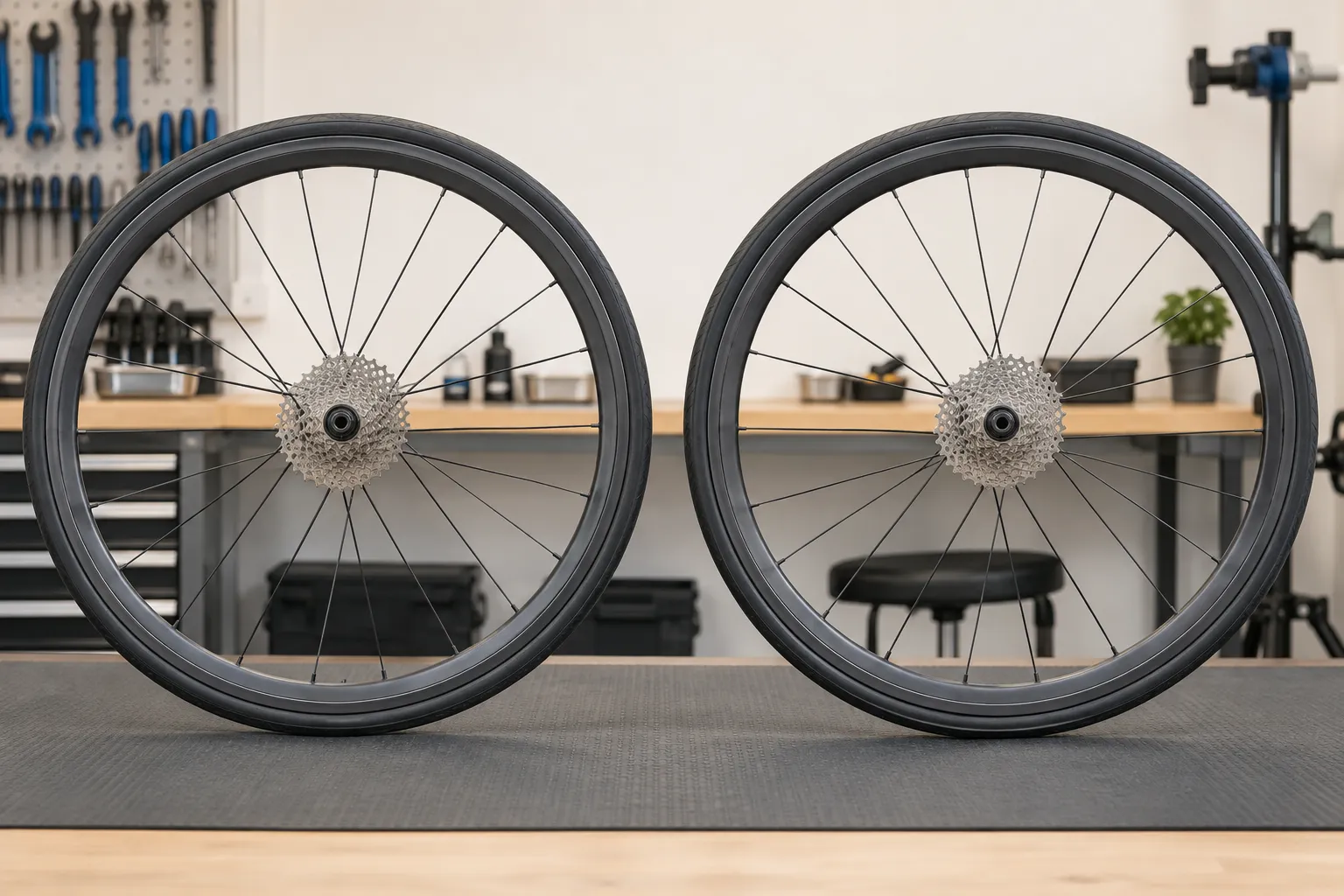
Why “the wheel is straight” is not enough
A recent r/bikewrench discussion showed a rear wheel sitting markedly to one side while appearing to run straight. Replies raised wheel dish, adjustable dropouts, hub assembly, and a frame-specific offset. That range is useful: a wheel can be laterally true yet still be centred incorrectly over its hub.
- Lateral trueness asks whether the rim moves side to side as it rotates.
- Radial trueness asks whether it moves toward and away from the axle.
- Dish asks whether the rim is centred between the hub’s frame-contact faces.
A perfectly straight circle can still have incorrect dish.
Start with the free checks
1. Confirm the wheel is fully seated
Follow the exact quick-release or thru-axle instructions. For a vertical quick-release dropout, place the bike upright, open the skewer, let the axle settle fully into both dropouts, and close it with the documented method. For a thru-axle, inspect that the axle, threads, and hub end caps are correctly engaged.
Check that quick-release centring springs have their narrow ends facing inward and are not trapped over the axle ends. Springs help with skewer handling; they do not locate the load-bearing axle in the frame.
2. Release false visual references
Open a rim brake or remove its influence from the visual check without riding. A mis-centred brake can make a centred wheel look wrong. Likewise, a poorly seated tyre or crooked reflective strip can mislead you.
Measure from the rim edge to the same point on each seatstay or chainstay. Compare at several wheel positions. If the rim gap is stable but the tyre gap changes, diagnose the tyre rather than the dish.
3. Inspect the hub ends
Missing, reversed, loose, or damaged end caps and axle spacers can shift the hub relative to the frame. This is especially plausible after hub service, wheel conversion, or installing a used wheel. Identify the exact hub manual before moving any spacer.
Do not place an improvised washer on one side of the axle. It can reduce thread engagement, change brake and cassette alignment, or prevent safe wheel retention.
Use the flip test carefully
On a symmetrical frame with a wheel that can physically be installed backward for a stationary measurement, remove the chain from the equation and reverse the wheel in the dropouts without riding it.
- If the rim offset changes sides with the wheel, wheel dish or hub assembly is implicated.
- If the rim remains offset toward the same side of the frame, dropout position or frame alignment is implicated.
This is only a diagnostic comparison. Many modern disc, thru-axle, freehub, rotor, or asymmetric systems cannot or should not be clamped backward. Do not force incompatible parts or operate the bike this way.
Check for special frame designs
Some bicycles intentionally use asymmetric rear triangles, adjustable horizontal dropouts, sliding dropout hardware, or frame-specific offset wheel builds. A wheel dished for one of those systems can sit off-centre in a conventional frame even though it was correct on its original bike.
Before paying for redishing, record:
- bicycle make, model, size, and year;
- wheel, hub, and freehub model;
- axle standard and hub width;
- every hub end cap or adapter;
- whether the frame uses adjustment screws; and
- whether the wheel came from another bicycle.
The frame and wheel manuals decide whether an offset is intentional.
What a dishing gauge proves
Park Tool defines dish as centring the rim between the hub contact faces. A dishing gauge touches the rim and one hub contact face, then compares the same setting from the other side. This measures the wheel independently of the frame.
If dish is wrong, correcting it changes spoke tension across the wheel. It is not simply “tighten every spoke on one side.” Overall tension, lateral true, radial true, rim limits, spoke condition, and stress relief all matter. A beginner should use a competent wheel builder for a large correction, a carbon rim, damaged parts, or a wheel without known tension specifications.
Decide from the result
| Finding | Likely next step |
|---|---|
| Wheel was not seated evenly | Reinstall and secure it correctly; recheck brakes |
| Rim centred but tyre offset varies | Deflate and inspect tyre seating or casing |
| Offset follows wheel in a valid flip test | Measure dish and inspect hub assembly |
| Offset stays with frame | Inspect dropout adjustment and frame alignment |
| Hub width or end caps do not match bike | Fit only the documented compatible parts |
| Frame or rim damage is visible | Stop riding and arrange professional inspection |
After any correction, confirm axle security, tyre clearance under load, brake alignment, cassette and rotor clearance, and normal shifting. A wheel that merely spins in a stand has not completed the safety check.
Your next step
Reseat the wheel, photograph both hub ends, and measure the rim-to-frame gap on both sides at the same height. Then find the exact frame and hub manuals. If the wheel remains significantly off-centre, ask a shop to measure dish and inspect hub assembly before anyone adjusts spokes. For a different kind of movement, use the wheel, tyre, or balance wobble diagnosis.
Sources and further reading
- Park Tool: wheel dishing and centring
- r/bikewrench reader context: a wheel sitting to one side in an older time-trial frame
- r/bikewrench reader context: an off-centre wheel traced beyond dish to a hub end part
Reddit supplied recurring diagnostic questions. Its suggested repairs were not treated as specifications.