Why do your bike spokes keep breaking?
A second broken spoke is evidence, not bad luck. Check wheel tension, rim and hub damage, spoke fatigue, and whether a rebuild or replacement is the sensible repair.
 Field guide / why-bike-spokes-keep-breaking
If a wheel breaks a second spoke, do not keep replacing isolated spokes without checking the whole wheel. Repeated failures commonly point to uneven tension, fatigue in same-age spokes, damage at the rim or hub, a bent rim, or an earlier repair that restored straightness without restoring balanced tension.
The short answer: one broken spoke needs a wheel inspection and repair. Several failures, or a new failure soon after repair, need a root-cause decision: targeted repair, complete rebuild, or wheel replacement. The straightest-looking wheel is not automatically the healthiest wheel.
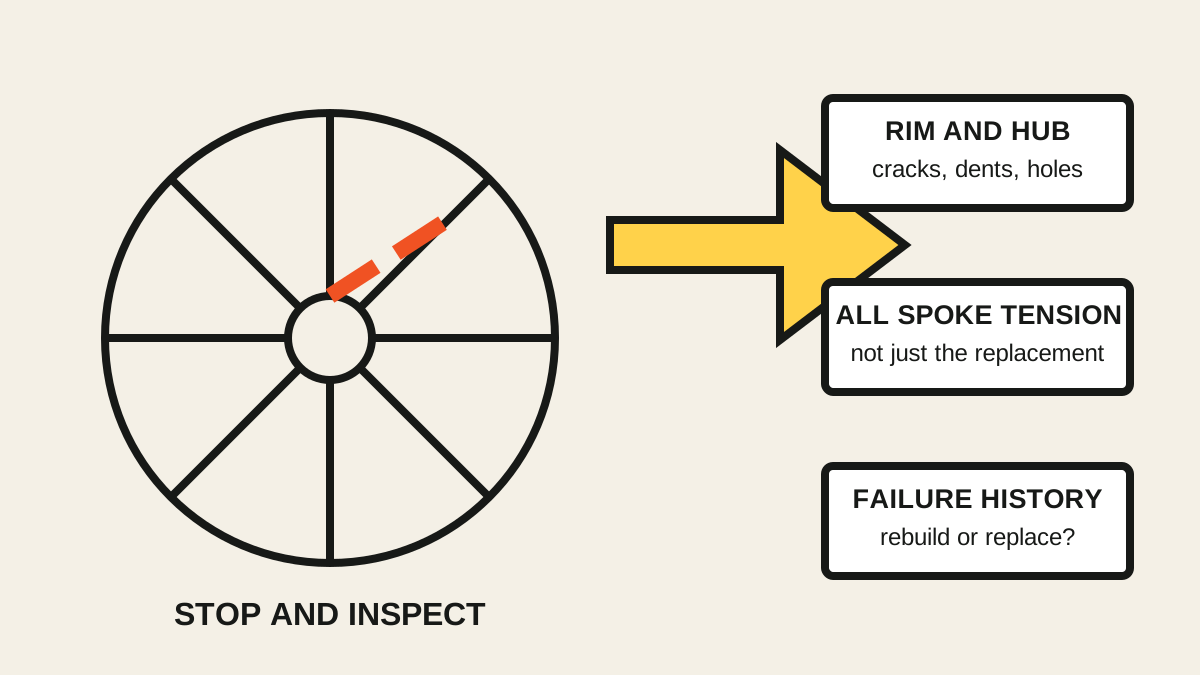
Treat the second failure as a pattern
A recent cycling discussion described a rear wheel with five broken spokes and a proposed rebuild. The useful signal is not the individual rider’s outcome; it is the recurring question of when spoke replacement stops being enough.
Park Tool explains that spokes support a rim through opposing tension. When one breaks, its load is redistributed and the rim may move out of true. Its wheel-truing guidance says a single broken spoke can be replaced and the wheel re-trued, while repeated failures can justify a rebuild or replacement.
Count and record every failure. Note the wheel, side, location, riding event, and where the spoke broke:
- at the J-bend or straight-pull head near the hub;
- in the middle, often after impact or external damage;
- at the threads or nipple near the rim;
- at the same location as an earlier failure;
- on the drive side or non-drive side of a rear wheel.
That pattern helps a wheel builder distinguish fatigue, abrasion, corrosion, impact, and local component damage.
Stop before the wheel causes a second problem
Use the single broken-spoke safety guide for immediate roadside triage. With repeated or multiple failures, the default becomes more conservative.
Do not ride when the rim touches a brake pad, caliper, frame, or fork; when a loose spoke can enter the drivetrain; or when the tyre bead no longer sits evenly. A broken drive-side rear spoke may also be trapped behind the cassette. Do not pull it through the sprockets or bend the derailleur to reach it.
If one spoke has just broken and the wheel is otherwise stable, secure the loose end to an adjacent spoke only to prevent flailing while you arrange recovery. This does not restore wheel strength or tension. Do not open rim brakes and continue a planned ride merely because the wheel can now rotate.
Inspect more than the broken spoke
Remove and inspect the wheel according to its manufacturer instructions. A complete assessment includes:
- Rim: look at each spoke hole for cracks, pulled eyelets, distortion, corrosion, impact dents, and delamination on a composite rim.
- Hub: inspect flanges for cracks, enlarged spoke holes, damage from crossed spokes, and incorrect spoke seating.
- Spokes: look for notches, chain damage, corrosion, loose nipples, twisting, and mixed replacement types.
- Tyre and tape: check that the impact or spoke failure did not disturb the bead, tube, tubeless tape, or internal nipple bed.
- Wheel shape: measure lateral true, radial true, dish, and tension rather than judging only by spinning it between brake pads.
A rim can be pulled visually straight by adding too much tension in one area and leaving too little elsewhere. That creates a wheel which passes a quick spin test but continues cycling individual spokes through damaging stress changes.
Tension balance matters more than a magic number
Spoke-tension targets depend on the rim, hub, spoke, lacing, nipple, and wheel design. The rim or wheel maker’s maximum and procedure take priority. Do not copy a tension value from another wheel of the same diameter.
A tension meter lets a mechanic compare spokes on each side. Rear wheels and disc-brake front wheels are often intentionally asymmetric, so the two sides may not share one number. The useful questions are whether each side is reasonably even, whether the wheel is correctly dished and true, and whether every value stays within the applicable specification.
Turning the nipple beside a break until the rim looks straight can hide the symptom. Random quarter-turns across the wheel can also erase evidence and make the professional repair longer.
Why spokes repeatedly fail
Fatigue across a same-age spoke set
Spokes repeatedly unload and reload as the wheel rotates. If several similar spokes have accumulated the same service history and one reaches fatigue life, its neighbours may be close behind. This is especially plausible when failures occur without a fresh impact and keep appearing at similar points.
Low or uneven tension
Park Tool notes that too-low tension can let spokes relax excessively under load, increasing stress; excessive tension can damage rims, hubs, or spokes. A poorly balanced repair can therefore begin another failure cycle even if the wheel looks straight.
Bent or damaged rim
A permanently bent rim may require extreme spoke-tension differences to appear true. If correct tension cannot coexist with acceptable shape and dish, the rim is not a sound foundation for a rebuild.
Chain or external damage
A chain dropped behind the cassette can score drive-side spokes. That damage may fail later rather than during the original incident. Inspect derailleur-hanger alignment and the low limit before returning the wheel to service; the chain-behind-cassette guide covers that failure path.
Incorrect replacement or build details
Wrong spoke length, type, lacing path, nipple, thread engagement, or seating can concentrate stress. Proprietary wheels may need model-specific spokes and procedures. “It fits through the hole” is not a compatibility test.
Repair, rebuild, or replace?
Choose a targeted spoke replacement when the wheel has one explainable failure, the rim and hub are sound, the remaining spokes inspect well, and the finished wheel can meet its true, dish, and tension requirements.
Choose a complete rebuild when the rim and hub remain serviceable but several same-age spokes are suspect, tension history is poor, or repeated replacements have become a cycle. A rebuild normally means the wheel is disassembled and relaced with a planned compatible spoke and nipple set—not simply swapping the visibly broken pieces.
Choose a replacement rim or wheel when the rim or hub is cracked or permanently deformed, proprietary parts are unavailable, the repair cannot meet specifications, or parts and labour approach the cost of a better supported wheel. Cost alone does not decide safety, but it should include all required spokes, nipples, rim tape, bearings, labour, and future parts availability.
Ask the shop for the diagnosis, not just the price
Useful questions are:
- Where did the spokes fail, and what does that pattern suggest?
- Were rim and hub spoke holes inspected?
- Was tension measured across the complete wheel?
- Can this rim be true, round, and correctly dished at acceptable tension?
- Are the original spoke and nipple specifications available?
- What makes another isolated replacement reasonable—or unreasonable?
A clear answer does not need false certainty. It should connect observed damage to the proposed repair.
Your next step
Mark this failure in your maintenance log and stop riding the wheel. Ask for a complete rim, hub, spoke, dish, and tension assessment. If this is not the first broken spoke, say so before authorising another one-spoke repair; that history is part of the diagnosis.