Where should grease go in a threadless bike headset?
Grease the headset surfaces named by the bike or headset manual, keep the stem clamp clean, and avoid turning a simple bearing service into a steering fault.
 Field guide / where-to-grease-threadless-bike-headset
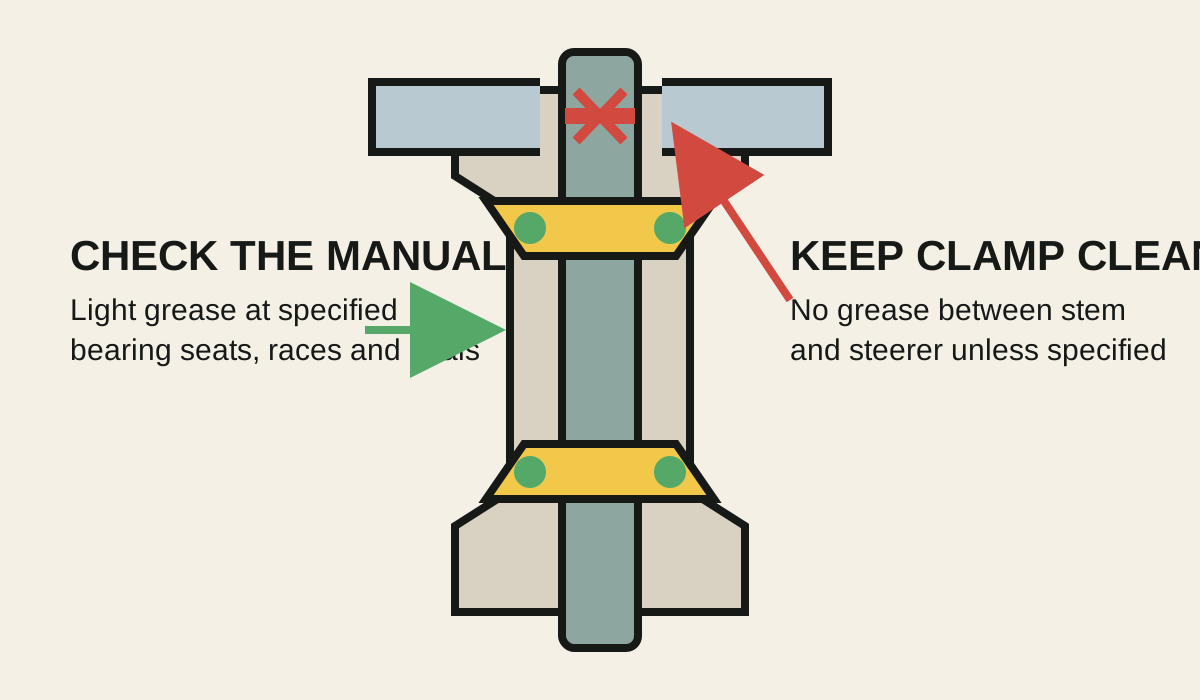
In a conventional threadless headset, a light film of the specified grease commonly goes on bearing contact surfaces, races, cups, and sealing interfaces. It does not automatically go everywhere: keep the stem-to-steerer and stem-to-handlebar clamping faces clean and follow the exact bike, fork, stem, and headset instructions.
The short answer: grease protects the bearing system from corrosion and water, but grease on a dry-specified clamp can reduce friction and let a safety-critical part move. Use enough to coat the named surfaces, not enough to fill the head tube, and never substitute a forum’s universal rule for a proprietary headset manual.
Start by identifying the headset you actually have
“Threadless headset” describes the preload system, not one universal stack of parts. A road bike may use loose balls in pressed cups, cartridge bearings in an integrated frame, a split compression ring, a moulded crown-race seat, proprietary seals, or brake hoses routed through the upper bearing.
Before disassembly, record the bike model, year and size, then find the technical manual. Photograph every layer as it comes apart. Keep the top cover, shims, compression ring, upper bearing, lower bearing, seals and crown race in order and note each bearing’s orientation.
If you still need to identify the parts, use the headset-bearing identification guide first. Internally routed brake hoses can turn bearing access into hydraulic-brake work; that is a sensible shop job when you lack the routing diagram and bleed tools.
Where grease commonly belongs
Park Tool’s conventional threadless-headset procedure tells mechanics to grease bearing retainers and bearing race cups, while explicitly saying not to grease the steering column. Its broader lubricant guide also identifies crown races and headset cups as interfaces that can benefit from grease before installation.
For a conventional, manual-compatible assembly, a thin continuous film may be appropriate on:
- loose bearing balls or their retainers;
- cup and cone bearing tracks;
- the contact seat between a cartridge bearing and its cup or frame;
- the crown-race contact surface;
- the compression ring or top-cover contact surface when specified; and
- seal lips or the outer edge beneath a cover when the maker uses grease as a water barrier.
“Thin film” means the metal looks evenly wet. Large packed voids do not create better preload and make later inspection messier. Wipe away squeeze-out so it cannot collect grit.
Sealed cartridge bearings are different from loose balls. Do not pry their seals open merely because the outside of the cartridge is being greased. The serviceability of the bearing itself depends on its design and manufacturer instructions.
Where grease usually does not belong
Do not grease the outside of a threadless steerer where the stem clamps unless the exact manufacturer procedure says to. Do not grease the handlebar where the stem faceplate clamps it. These joints depend on controlled friction, surface condition, hardware preparation and torque.
Also keep grease away from:
- brake rotors, pads and rim-brake tracks;
- the top-cap preload bolt when its manual specifies a different preparation;
- carbon clamping faces that call for dry assembly or carbon assembly compound; and
- hydraulic hoses, rubber parts, painted surfaces or plastics unless the grease is confirmed compatible.
The bolt threads may have their own requirement even when the clamp face stays dry. A stem manual might specify grease, threadlocker, pre-treated bolts or dry threads. Follow the grease-or-threadlocker decision process rather than transferring grease from the bearings to nearby hardware.
Grease cannot repair a bad headset stack
If the headset still knocks, binds or leaves an unexplained gap, more grease is not the answer. Check for:
- a bearing installed upside down;
- a missing or reversed compression ring;
- the wrong bearing height or contact angle;
- a top cover touching the frame before the bearing is preloaded;
- insufficient clearance between the steerer and top of the stem or spacer stack;
- a loose crown race or damaged bearing seat;
- cable or hose tension pulling the steering; or
- a worn, corroded or indexed bearing.
Use the loose-headset diagnosis if the bike knocks under front braking. Do not compensate by overtightening the top cap: it is a preload adjuster, not the fastener that secures the stem while riding.
A careful service sequence
- Read the exact instructions. Confirm grease type, part order, bearing orientation, preload method and stem torque.
- Secure the fork before loosening the stem. Once the top cap and stem release the stack, the fork can fall from the frame.
- Clean and inspect. Remove old contaminated grease using products compatible with the frame, fork, seals and bearings. Stop for corrosion, cracks, fretting, crushed carbon or a rough bearing.
- Apply a controlled film. Coat only the specified bearing, race, seat and seal surfaces.
- Reassemble in photographed order. Do not omit thin shims or swap upper and lower bearings.
- Set preload, then secure the stem. Eliminate play without creating steering drag, align the bars, and tighten stem bolts in the documented sequence and torque.
- Run stationary checks. Hold the front brake and rock the bike; then lift the wheel and turn the bars. There should be no knock, notch or hose pull.
Recheck after a short, low-speed ride. Stop if the bars move relative to the wheel, the headset loosens, steering does not self-centre smoothly, or a hose becomes taut.
Your next step
Find the exploded diagram for your exact headset and mark two columns: bearing/seal surfaces and clamp surfaces. Apply only the named preparation to each. If the manual is unavailable or hoses pass through the headset, have a qualified mechanic confirm the stack before riding.
Sources and further reading
- Park Tool: threadless headset service and grease placement
- Park Tool: guide to bicycle lubricants and compounds
- r/bikewrench discussion: grease between headset covers, bearings and races — used as an editorial question signal; individual comments were not treated as universal specifications.