Can your smart trainer use a different cassette from your outdoor wheel?
Check speed count, sprocket range, chain length, derailleur capacity, freehub, spacing, indexing, and wear before using two different cassettes.
 Field guide / use-different-cassette-on-smart-trainer
Your direct-drive trainer cassette does not always need the same smallest and largest sprockets as the cassette on your outdoor wheel. It does need to match the drivetrain’s shifting standard, fit the trainer’s freehub correctly, stay within derailleur limits, and work with a chain sized for the largest combination you will use.
The short answer: an 11-28 outdoor cassette and an 11-25 trainer cassette can often share a correctly sized 11-speed chain when both cassettes, the shifters, freehub, and derailleur are compatible. Reversing the ranges can be dangerous if the chain was sized only for the smaller cassette. Tooth count is one check; speed, interface, spacing, chain design, spacers, wear, and indexing matter too.
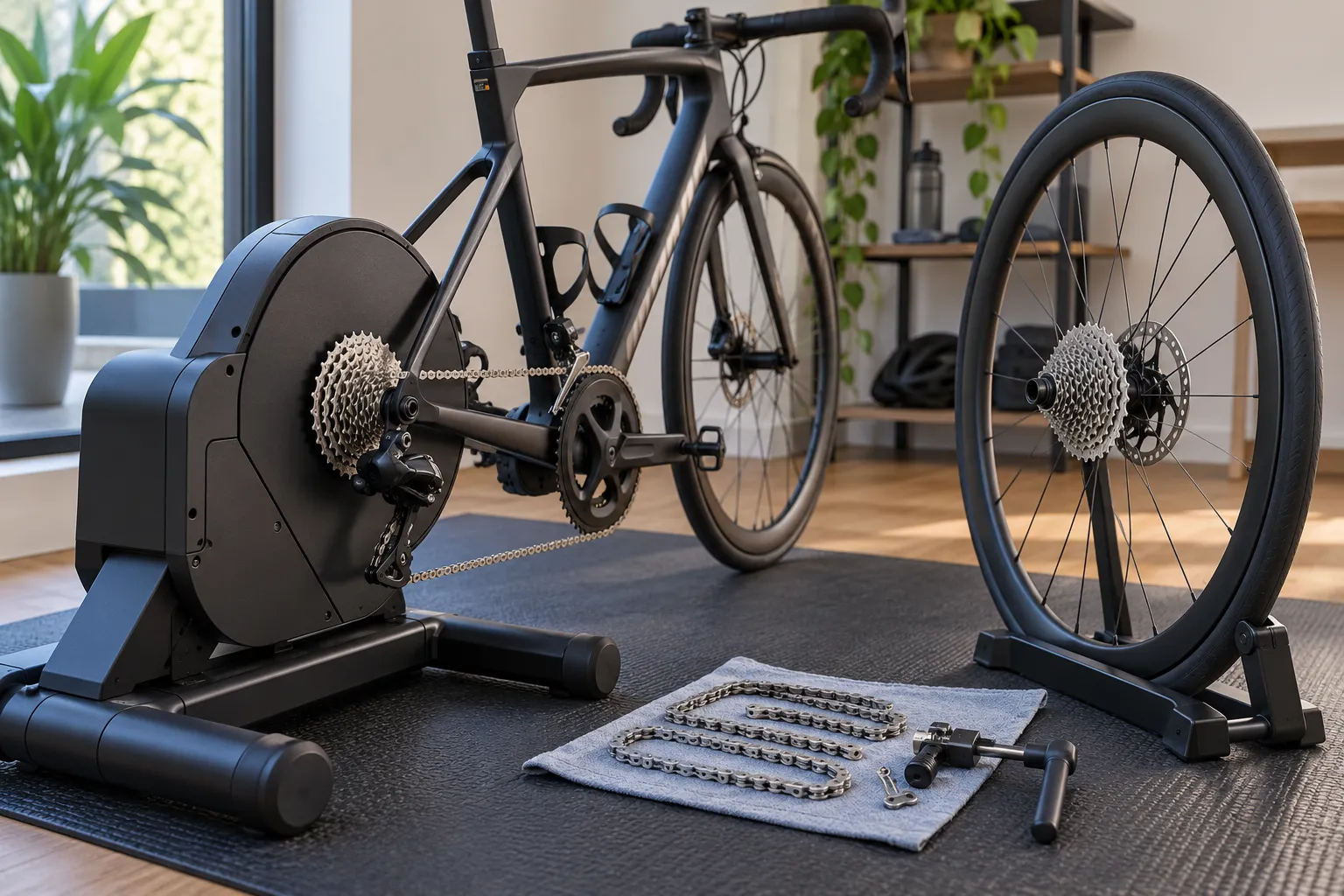
The seven checks that decide compatibility
1. Number of sprockets
Normal mechanical or electronic indexing expects a specific number of rear sprockets and matching spacing. A 10-speed bike generally needs a compatible 10-speed cassette on the trainer; “it fits the freehub” is not enough.
Some virtual-shifting systems use a single cog and compatible controls instead. Follow that trainer and software maker’s supported-bike list rather than applying cassette rules to a virtual-cog setup.
2. Chain and cassette family
Equal speed counts do not guarantee equal chain compatibility. Shimano HG, Shimano LinkGlide/CUES, SRAM road Flattop, SRAM Eagle/Transmission, Campagnolo, and other families have model-specific combinations.
Wahoo’s current trainer compatibility table separates these standards and identifies when a different freehub, cassette, or spacer is required. Record exact model numbers before ordering.
3. Trainer freehub body
The cassette must fit the installed driver: common examples include HG, XDR, Micro Spline, Campagnolo, and N3W. Some narrower cassettes also require a specified spacer on a longer trainer freehub.
Do not improvise the spacer stack. A cassette that tightens while still wobbling, leaves poor lockring engagement, or places the smallest sprocket incorrectly is not installed.
4. Largest sprocket and chain length
The chain must safely accommodate the largest rear sprocket used on either setup together with the relevant front chainring. Shimano’s general chain manual sizes many road systems from the largest chainring and largest sprocket, while also directing users to the exact rear-derailleur procedure when one exists.
This creates a simple direction rule:
- Outdoor cassette larger than trainer cassette: a chain correctly sized for the outdoor setup is not too short merely because the trainer’s largest sprocket is smaller.
- Trainer cassette larger than outdoor cassette: the existing chain may be too short. Do not shift into that largest trainer sprocket until exact sizing and derailleur compatibility are confirmed.
Wahoo explicitly warns that using a trainer cassette whose largest sprocket exceeds the bike’s current setup can damage the drivetrain.
5. Rear-derailleur largest-sprocket limit and capacity
The derailleur must accept the trainer cassette’s largest sprocket and total range. A chain long enough to wrap the combination does not prove the derailleur geometry or capacity is approved.
Check the exact derailleur manual. Do not solve excess range with a random hanger extender or B-screw setting copied from another model.
6. Indexing and lateral position
Even compatible cassettes can sit a fraction differently on two hubs. If one setup clicks after every swap, confirm wheel or trainer axle seating, cassette spacers, cassette tightness, derailleur-hanger alignment, and indexing. A small barrel-adjuster correction may be appropriate on some cable systems, but limit screws are not a routine wheel-swap adjustment.
Use why gears click after a rear-wheel swap for the diagnostic order.
7. Chain and cassette wear
A worn chain can be noisy on a newer trainer cassette, and a fresh chain can skip on an old outdoor cassette. The trainer does not reset drivetrain wear when you move indoors.
Measure the chain and test under controlled load. The guide to replacing a chain or cassette explains why mileage and tooth appearance alone are weak evidence.
A practical example
Suppose a road bike has a compatible 10-speed 12-25 cassette outdoors and you want an 11-28 cassette for the road while moving the 12-25 to the trainer.
A responsible sequence is:
- Confirm the derailleur officially accepts 28 teeth and has sufficient capacity.
- Confirm both cassettes use the correct freehub interface and specified spacers.
- Fit a compatible chain sized by the exact derailleur procedure for the 11-28 cassette.
- Install and torque both cassettes correctly.
- Check trainer indexing and clearance by hand before riding.
- Test every intended gear seated and at low load.
The chain sized for the approved 11-28 combination can normally take up the smaller 12-25 range through the derailleur cage. That does not excuse a worn cassette, wrong chain family, or poor indexing.
When matching cassettes is still the better choice
Use the same model and range on both setups when you want the easiest swaps, identical cadence jumps, fewer indexing differences, and simpler chain sizing. Matching is especially valuable for race practice, older drivetrains with narrow adjustment margin, or riders who do not want to tune between indoor and outdoor use.
Different ranges are useful when the road needs a lower climbing gear but the trainer controls resistance electronically, or when an existing compatible smaller cassette still has good life. Price the whole setup before deciding; the budget smart-trainer guide includes freehub, adapter, cassette, chain, mat, and fan costs.
Your next step
Write one line for each setup: speed and chain family → freehub → spacer → cassette range → derailleur limit → chain-sizing method. If every arrow is supported by the bike, trainer, and drivetrain manuals, install and test. If any link is uncertain, send those exact model numbers to the trainer maker or a qualified shop before shifting under load.
Sources and further reading
- Wahoo: KICKR drivetrain and cassette compatibility
- Garmin Tacx FLUX setup and cassette compatibility
- Shimano: general chain-length procedures
- r/bikewrench reader context: separate trainer and outdoor cassette ranges — used as an editorial demand signal; final compatibility comes from component documentation.