How to train for long cycling climbs when you live somewhere flat
Build climbing endurance without local mountains using sustained trainer work, pacing practice, suitable gearing, strength, and realistic rehearsal.
 Field guide / train-for-long-climbs-without-hills
You can prepare for a long climb without living near one. The main job is to sustain an appropriate effort for the expected duration while pedalling smoothly, fuelling, and resisting the urge to start too hard. An indoor trainer, a flat uninterrupted road, or repeated shorter rises can all train that engine.
The short answer: learn the target climb’s duration and gradient, confirm your easiest gear, build steady endurance, then add one controlled sustained or interval session each week. Do not manufacture “climbing specificity” by grinding a huge gear at an artificially low cadence; current evidence does not show a clear general advantage over training at a freely chosen cadence.
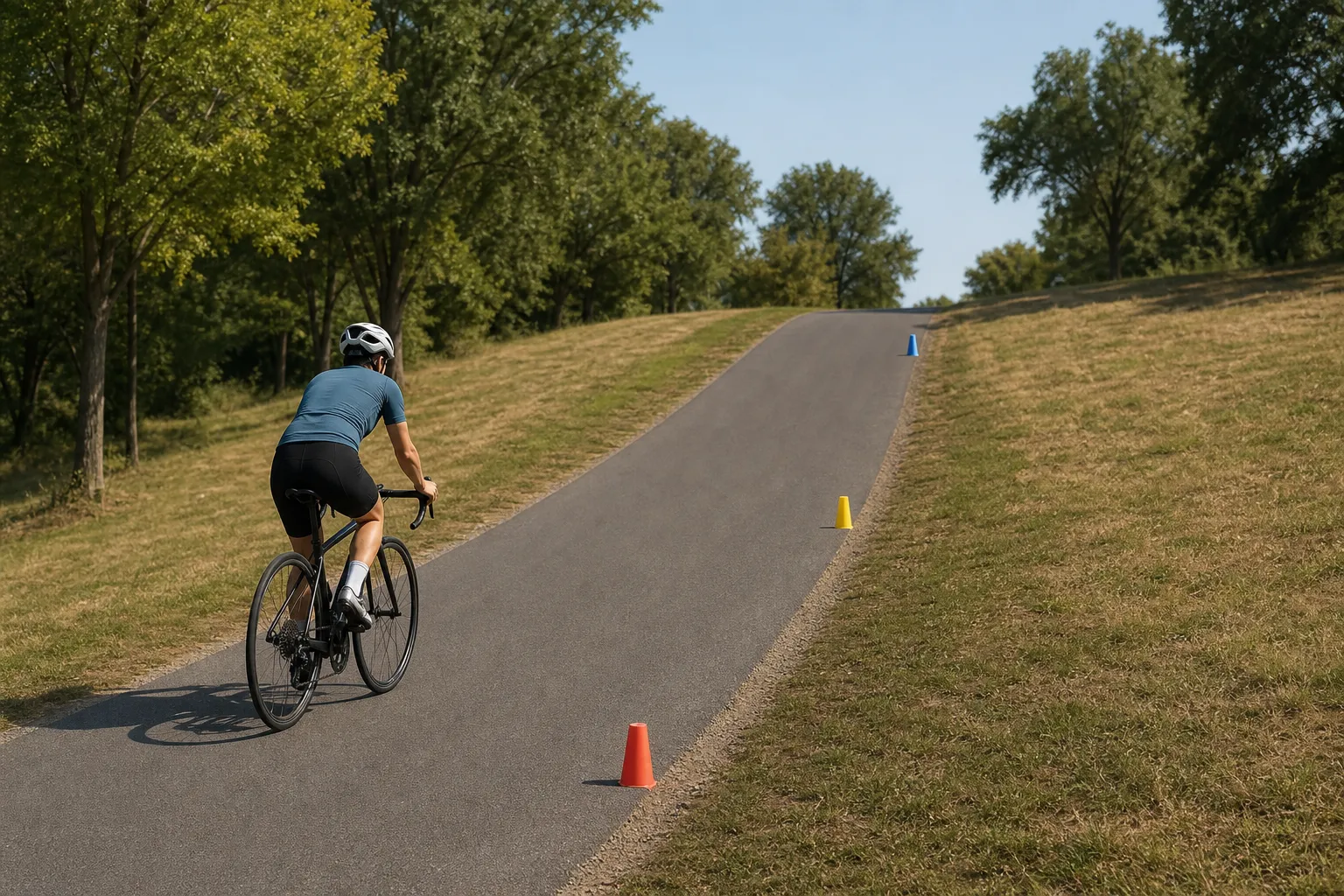
Define the climb you are training for
A highly discussed current Reddit question asked how to improve after fading partway up a long mountain while living far from comparable hills. “Train climbing” is too vague to answer until the target is defined.
Record:
- total climbing time, not only distance;
- average and maximum sustained gradient;
- altitude and likely temperature;
- road surface and traffic;
- whether food and water are available;
- the smallest chainring and largest cassette sprocket on your bike; and
- whether the route includes a technical descent afterward.
A steady 90-minute climb is a different demand from ten steep two-minute ramps. The first rewards conservative pacing and aerobic durability; the second includes repeated harder efforts and recoveries.
Fix gearing before trying to out-train it
Count the teeth on your smallest front chainring and largest rear sprocket. A rider can have adequate fitness yet run out of sustainable cadence because the lowest gear is too hard for the gradient.
Read how to choose easier road-bike gearing and verify derailleur capacity and manufacturer compatibility before buying a larger cassette. Training should improve your capacity, not disguise an avoidable equipment mismatch.
Walking is also a valid bailout. Practise unclipping, stopping, and restarting on a mild slope before the trip.
Build the base that holds the climb together
Complete two or three comfortable rides most weeks before adding specialised work. One should gradually become longer, but it does not need to be mountainous. The goal is to finish able to eat, recover, and ride normally the next day.
Keep most riding conversational and add volume gradually. Do not turn every headwind, bridge, and trainer session into a threshold test. Consistency creates more useful endurance than one heroic workout followed by missed weeks.
Use one sustained session each week
Choose one of these simple formats on a trainer or uninterrupted flat route:
Continuous version
- Warm up easily for 10–15 minutes.
- Ride 20–40 minutes at a firm but controlled effort you could sustain longer.
- Keep breathing and cadence steady enough that the final five minutes resemble the first.
- Cool down for 10 minutes.
Interval version
- Warm up for 10–15 minutes.
- Complete 3 × 8 minutes or 2 × 12 minutes at a firm, controlled effort.
- Pedal easily for 4–6 minutes between efforts.
- Cool down for 10 minutes.
Start at the shorter end. Add minutes before adding intensity. A systematic review of interval training found that it can improve endurance time-trial performance, while also finding no single universally optimal recipe. Your response and training history matter more than copying a professional’s numbers.
Do not confuse low cadence with climbing
Raising the trainer’s resistance or selecting a huge gear can make the legs feel “climb-specific,” but a systematic review found no strong evidence that imposed low-cadence training provides a general performance benefit.
Use a cadence that lets you complete the intended work with stable form. Brief moderate-cadence strength-endurance work may suit some trained riders, but it is not a substitute for suitable gearing, and it should not cause knee, hip, or back pain.
If cadence collapses near the end of every interval, reduce resistance or shorten the effort. That is better preparation than rehearsing failure.
Add strength without sacrificing the bike
One or two short strength sessions can complement cycling. Prioritise movements you can perform well, such as a squat pattern, hip hinge, split stance, calf raise, and trunk stability exercise. Start with technique and modest volume.
Recent evidence suggests heavy strength training can improve cycling performance and efficiency, but the certainty is low and the optimal prescription is not settled. Treat strength as support, not a reason to arrive at every ride sore.
Rehearse pacing and fuelling
Long climbs often fail in the opening minutes. On the event climb:
- Shift early and begin easier than excitement suggests.
- Let speed fall rather than forcing the pace of fresher riders.
- Use breathing, heart rate, or power as a ceiling, not a target to chase upward.
- Eat and drink before the climb if doing so on a steep section will be difficult.
- Stand briefly for comfort or gradient changes, not as the only way to keep the gear moving.
Train with the food and drink you plan to carry. A flat two-hour ride is an excellent place to practise the same schedule.
Rehearse the real hill when possible
Indoor work cannot teach cornering on a descent, changing wind, rough surfaces, heat management, altitude response, or the confidence required to stop and restart safely.
Two to four weeks before the goal, seek the longest accessible climb or use repeated shorter hills. Test the bike, clothing, gearing, pacing, and bailout plan. Do not make the first mountain day the first time you use the easiest gear or eat on the move.
A simple four-week progression
| Week | Sustained session | Long easy ride | Specific rehearsal |
|---|---|---|---|
| 1 | 3 × 8 minutes | Normal duration | Check gearing |
| 2 | 2 × 12 minutes | Add a small amount | Practise food and water |
| 3 | 2 × 15 minutes | Longest controlled ride | Short-hill repeats if available |
| 4 | 2 × 8 minutes, easier | Reduce volume | Arrive rested |
Repeat or extend this pattern only when recovery is normal. One hard week is not a licence to double the next.
Your next step
Find the target climb’s likely duration and steepest sustained section, write down your lowest gear, and schedule one controlled sustained session. Pair it with the beginner pacing guide for hills before changing equipment or intensity.
Sources and further reading
- Systematic review: programming interval training for time-trial performance
- Systematic review: effects of imposed low-cadence cycling training
- Systematic review: heavy strength training and endurance-cycling performance
- r/cycling reader context: training for a long climb without similar local hills
Reddit was used to identify the training problem. Individual performance claims in the discussion were not treated as evidence.