How to stop cycling glasses fogging behind a winter face covering
Redirect warm breath, restore airflow, choose compatible lenses and headwear, and use a safe stop routine when winter cycling glasses fog.
 Field guide / stop-cycling-glasses-fogging-winter
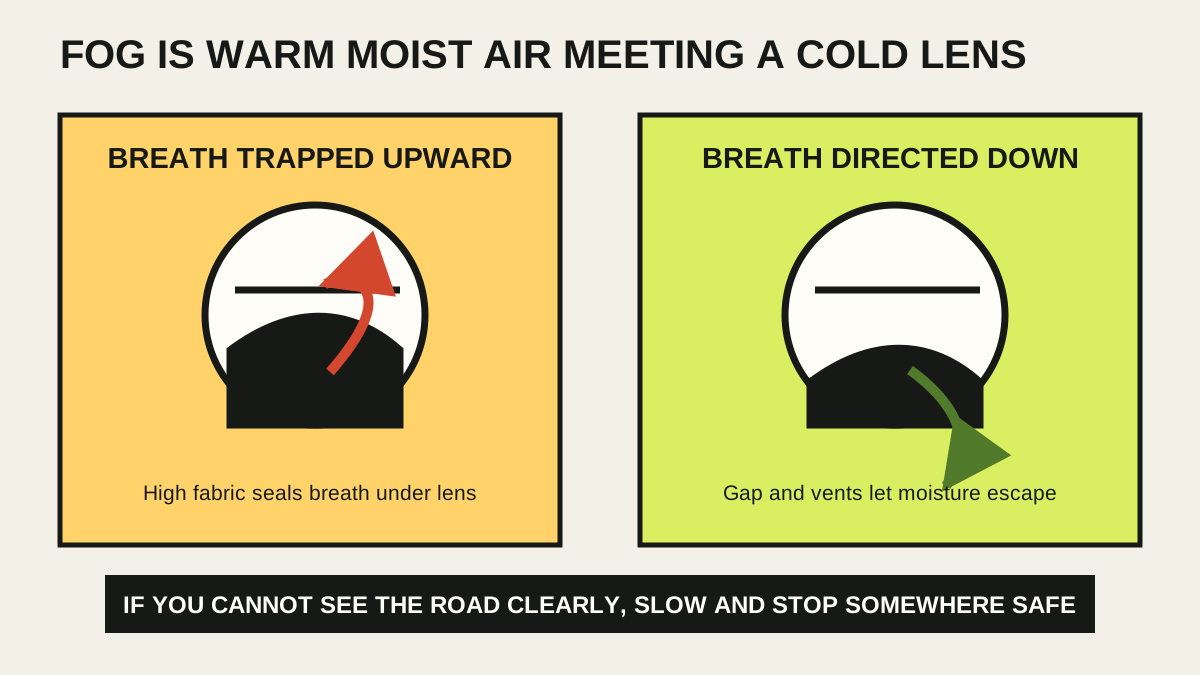
Winter cycling glasses usually fog because a balaclava, neck tube, or mask directs warm wet breath upward onto a cold lens. Fix that airflow first. Pulling the glasses off while moving treats the symptom and can create a new control problem.
The short answer: create a route for exhaled air to leave below or beside the glasses, keep lens vents uncovered, and leave a small airflow gap behind the lens. Use only lens-maker-approved anti-fog products. If vision clouds, slow and stop safely before making an adjustment.
Why the fog appears as soon as you stop
A current r/cycling discussion asks for a winter balaclava that covers the nose without fogging glasses. The product question is understandable, but fit and airflow often matter more than the logo.
Warm breath and sweat add water vapour behind the lens. When that moist air touches a colder lens, water condenses into tiny droplets that scatter light. Forward motion usually supplies ventilation, so fog may appear suddenly at a junction, on a slow climb, or when you tuck the face covering higher.
The first diagnosis is therefore about where the moisture comes from:
- fog rising from the bottom centre usually points to exhaled breath;
- fog spreading from the brow or sides may point to sweat and weak ventilation;
- fog between the layers of a dual lens suggests a failed seal and may require replacement;
- droplets on the outside may be rain, mist, or spray rather than internal condensation.
Route breath away from the lens
Test the complete setup at home in cool air before a ride.
- Put on the base layer, face covering, helmet, and glasses in riding order.
- Exhale firmly through your mouth and nose.
- Feel with a bare finger near the lower lens edge—without touching the lens—to find the escaping air.
- Lower or shape the face covering so breath exits below the glasses or to the sides.
- Repeat while looking down as you would on the hoods.
A face covering pulled tightly over the bridge of the nose can make a warm-air chimney directly under the glasses. A flexible nose panel or separate neck tube may be easier to position. In milder cold, covering the neck, chin, and cheeks while leaving the nose uncovered can reduce fog substantially.
Do not tape a normal cycling face covering to your skin or alter protective respiratory equipment based on a cycling tip. If a medically necessary or workplace-rated mask must seal in a particular way, its instructions and purpose take priority.
Give the glasses an airflow gap
Glasses pushed hard against the brow and cheeks may block their own vents. Adjustable nose pieces can move the lens slightly farther from the face. Some eyewear makers recommend this specifically when lenses fog during exercise.
Check that:
- helmet pads or a cap do not cover upper lens vents;
- the balaclava does not overlap the lower lens edge;
- helmet straps do not force the arms into a distorted position;
- the lens sits evenly rather than sealing on one cheek;
- the glasses remain secure when you look behind or ride over rough ground.
More gap also allows more cold air and debris around the lens, so tune it in small steps. The right position balances ventilation, eye protection, and stability.
Choose the lens for the conditions
A dark summer lens can turn a fog problem into a visibility emergency before condensation even starts. Use a clear or suitable low-light lens for darkness, heavy cloud, or wooded routes. A photochromic lens may cover a broad range, but its speed and darkness range vary; verify the product rather than assuming it becomes fully clear.
Useful winter features include:
- vents that remain open with your helmet and cap;
- an anti-fog coating approved for the lens;
- enough coverage to reduce cold wind and watering eyes;
- a shape that fits your face without creating a complete seal;
- easy lens changes without fingerprints across the viewing area.
Read how to choose cycling glasses for impact protection, ultraviolet protection, lens tint, and fit. Fog resistance is only one requirement.
Treat coatings as delicate equipment
Do not improvise with washing-up liquid, shaving foam, toothpaste, alcohol, or household glass cleaner unless the lens maker explicitly approves it. Treatments that work on plain glass may damage polycarbonate, mirrors, hydrophobic layers, or factory anti-fog coatings.
Follow the eyewear instructions for:
- whether anti-fog spray is permitted;
- which side of the lens can be treated;
- cleaning-water temperature;
- compatible soap or cleaner;
- drying method;
- cloth type;
- how often a coating can be renewed.
Blot rather than scrub a wet inner lens. Grit dragged across the surface can scratch it, while vigorous rubbing can shorten the life of an anti-fog treatment. Carry a clean lens cloth in a dry, sealed pocket, not loose beside keys or food wrappers.
Reduce sweat before it reaches the glasses
Fog from the brow often means the head system is too warm for the effort. Use the least insulation that keeps you comfortable and preserves control.
Options include:
- a thin ear band instead of a full cap;
- a lighter skull cap with open helmet vents;
- unzipping the jacket before a long climb;
- lowering the face covering when effort rises;
- slowing slightly before sweat saturates the headwear.
A balaclava must not make the helmet unstable or too tight. Recheck helmet position and strap fit with winter layers installed. If extra fabric changes the fit, choose thinner headwear or a compatible winter setup rather than loosening the helmet until it floats.
For rain-specific problems, use cycling in rain with prescription glasses. Rain on the outside and fog on the inside often need different fixes.
Use a safe on-road clearing routine
When fog begins:
- Look through the clearest part of the lens and reduce effort.
- Stop pedalling hard so heat and breath production fall.
- Slow smoothly and predictably; do not make a blind swerve toward the kerb.
- Signal and move to a safe stopping place when conditions allow.
- Remove or adjust glasses only after stopping.
- Let moisture clear in open air, then correct the face-covering or vent blockage.
Do not wipe lenses with a gloved thumb while descending or remove both hands from secure control. If fog returns repeatedly, end or shorten the ride. A product that only works at speed is not suitable for a route with frequent junctions and climbs.
Run a ten-minute setup test
Before trusting new winter kit on a long ride:
- ride five easy minutes into the cold;
- climb or increase effort for two minutes;
- stop safely for one minute to imitate a junction;
- look down, over each shoulder, and through the top of the lens;
- check whether the face covering shifts when speaking or drinking;
- verify the helmet still fits correctly;
- confirm you can clear the lens without rushing.
Change one variable at a time: face-covering height, nose opening, glasses spacing, cap thickness, or lens treatment. A simple note will reveal which change actually worked.
Your next step
Put on your full winter head setup before the next ride and perform the firm-exhale test. Redirect the air below the lens, uncover every vent, and rehearse your safe stopping routine on a quiet street. If the glasses still fog at a one-minute stop, change the setup before taking it into traffic or onto a descent.
Sources and further reading
- EnviroCentre winter cycling guide: head coverage, eye protection, and fogging
- American Academy of Ophthalmology: controlling upward breath and lens fog
- SunGod eyewear guide: lens ventilation and nose-pad adjustment
- r/cycling reader context: winter face coverage without fogged glasses — used as a current demand signal; product anecdotes were not treated as verified performance evidence.